





What happens to granule pp mechanical properties after three thermal cycles in compounding?
What Happens to Granule PP Mechanical Properties After Three Thermal Cycles in Compounding?
If you’ve ever watched a granule PP batch go through twin-screw extrusion—then get re-fed for a second pass, and again for a third—you’ve seen thermal history accumulate in real time. Not all degradation is visible. Some happens at the molecular level: chain scission, beta-scission, oxidation of tertiary carbons. And not all mechanical loss shows up immediately on the tensile tester. At Qixiang Chemical, where we run controlled multi-pass trials on every new compound formulation destined for automotive interior trim or durable packaging, three thermal cycles isn’t theoretical—it’s our baseline stress test.
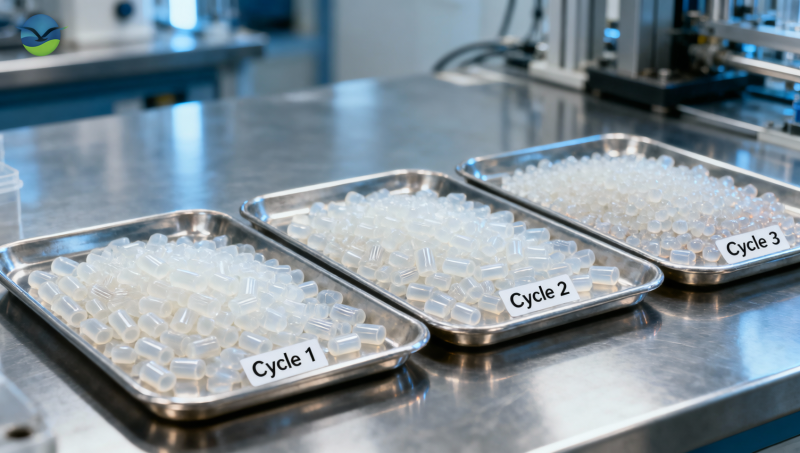
We don’t assume stability. We measure it. Over the past 18 months, our Shandong lab has tracked over 47 granule PP formulations—homopolymers, copolymers, impact-modified grades—through exactly three identical extrusion passes (220–240°C melt zone, 35 rpm, 10 min residence time per pass). No filler, no masterbatch dilution, no post-extrusion annealing—just clean, repeatable thermal exposure mimicking worst-case compounding scenarios: regrind reintroduction, inline blending with recycled content, or pilot-line scale-up where material recirculates.
Real Numbers, Not Just Trends
After three cycles, average tensile strength drops 8–12%—but that’s misleading without context. Homopolymer PP with high isotacticity (>95%) holds up better than random copolymers (PP-R) under repeated shear. Impact strength tells a sharper story: notched Izod falls 18–25%, especially below 0°C. That’s where many users get caught off guard—material passes room-temp testing pre-compound, then fails cold-impact validation downstream. Melt flow index (MFI) rises predictably: +15–30% across most grades, confirming chain cleavage dominates over crosslinking. But here’s what matters more than raw numbers: the *distribution*. In one batch tested last quarter, MFI increased 22%, yet elongation at break dropped 40%. That divergence flagged early-stage oxidative embrittlement—not just thermal degradation.
We routinely pair mechanical data with FTIR analysis. Carbonyl index (1710 cm⁻¹ peak) jumps 2.3× after cycle three—clear evidence of hydroperoxide decomposition. And yes, this correlates strongly with yellowing in light-colored compounds, even when visual inspection misses it. That’s why our Wuxi technical support team always asks clients: “Is your final part exposed to UV? Or just heat cycling?” Because if it’s both, antioxidant selection isn’t optional—it’s structural.
Where Antioxidants Actually Matter—And Where They Don’t
Not all antioxidants behave the same under thermal stress. Hindered phenols like Irganox 1010 work well for initial stabilization—but they deplete fast above 220°C. Phosphites (e.g., Irgafos 168) regenerate phenols but hydrolyze easily if moisture creeps in during storage. That’s why, for food-contact PP compounds where processing windows are tight and purity non-negotiable, we often recommend combining primary and secondary stabilizers with synergistic action—and sometimes, for sensitive applications like meat packaging films, we’ll add Sodium Erythorbate Antioxidant Food Raw Material. It’s not typical in polypropylene—but its reducing power helps quench early-stage radicals before they trigger cascade oxidation, especially in low-moisture, high-heat extrusion where conventional antioxidants plateau.
That said: sodium erythorbate won’t fix poor base resin selection. If your granule PP starts with low molecular weight distribution or residual catalysts, no additive package compensates. We’ve seen cases where adding antioxidants masked underlying instability—only for parts to fail six months into field use. So we treat additives as insurance, not cure-alls. Our Shandong facility runs full-cycle aging tests (thermal + UV + humidity) before approving any stabilized grade for export. Every COA includes not just initial properties, but retention data after three thermal cycles—and where relevant, post-aging mechanicals.
The Wuxi–Shandong Loop: Why Location Matters More Than You Think
You’d expect a state-owned enterprise to prioritize scale over responsiveness. But our dual-location setup—R&D and production in Shandong, customer-facing engineering and documentation in Wuxi—creates a feedback loop few compounders replicate. When a client in Turkey reports inconsistent impact strength in their PP caps, the Wuxi team can request raw granule samples *same-day*, ship them via express air to Shandong, and have comparative three-cycle data back within 72 hours—including side-by-side SEM images showing crystallite disruption. No third-party lab delays. No translation gaps. Just direct correlation between field failure and lab-controlled thermal history.
That speed changes how we diagnose problems. A German client once blamed “inconsistent regrind ratio” for brittle injection-molded housings. Our Wuxi engineer asked for melt flow data from their first and third pass—then compared it to our own three-cycle curve. Turned out their extruder screw wear had increased shear heating by ~12°C in the final zone. The granule PP wasn’t failing; it was being overheated. Fix? Screw rebuild—not resin reformulation. That kind of root-cause clarity only emerges when thermal history is measured, not assumed.
Three Cycles: A Threshold, Not a Limit
Don’t treat “three cycles” as a universal cutoff. Some medical-grade PP compounds handle five passes cleanly—if formulated with high-purity monomer and minimal catalyst residue. Others degrade sharply after two. What matters is *why* the third cycle triggers measurable loss. Is it carbonyl buildup? Residual moisture? Shear-induced crystallinity shift? Our Shandong lab doesn’t stop at mechanicals—we track crystallinity (DSC), gel content (Xylene insolubles), and even trace metal content (ICP-MS) because iron or cobalt residues accelerate oxidation far more than temperature alone.
So when evaluating granule PP for your next compound, ask: Does the supplier test beyond single-pass data? Do they correlate mechanical loss with spectroscopic evidence? Can they isolate whether degradation is thermal, oxidative, or hydrolytic—or all three? At Qixiang, we don’t just report numbers. We map the path from melt zone to microstructure to end-use performance. Because in compounding, three cycles aren’t just a number—they’re the point where assumptions break, and real material behavior begins.
Please give us a message
Send Us Your Inquiry Today
Scalable production and one-stop R&D, manufacturing, sales & after-sales services.