






n-Butyl Acetate in Coatings: How Evaporation Rate Affects Film Formation
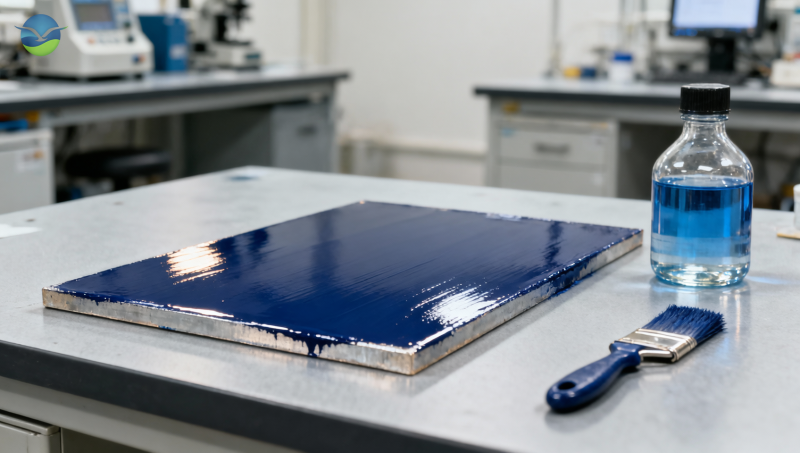
A freshly sprayed coating can look smooth at the gun and still develop orange peel, pinholes, or uneven gloss minutes later. The problem is not always the resin or application equipment. Often, the solvent blend is leaving the film at the wrong pace for the coating to level, release air, and develop its final structure.
In solvent-borne coatings, n-butyl acetate offers a useful balance of solvency and evaporation behavior. However, its performance depends on the resin system, other solvents, application conditions, and film thickness. For technical evaluators, the practical question is not simply whether butyl acetate dries quickly, but whether its evaporation profile supports reliable film formation within the intended processing window.
What an evaporation-rate value actually tells you
n-Butyl acetate, also called normal butyl acetate, is an ester solvent identified by CAS number 123-86-4. It is used in many solvent-borne acrylic, polyurethane, nitrocellulose, and other compatible coating systems. Compatibility must still be verified for the specific resin grade and formulation.
On a widely used relative evaporation-rate scale, n-butyl acetate is assigned a value of 1.0. Solvents with higher values evaporate faster under the same test conditions; those with lower values evaporate more slowly. Always check the reference solvent and test method before comparing supplier data, because not every published scale uses the same basis.
The distinction matters: a solvent’s evaporation rate measured under controlled conditions is not the drying rate of a formulated coating. In an actual wet film, changing solvent concentration, polymer interactions, temperature, airflow, and diffusion all affect solvent release.
Film formation is a race between leveling and viscosity rise
Immediately after application, the coating needs enough mobility to flatten spray texture, wet the substrate, and allow entrained air to escape. As solvent evaporates, the binder concentration increases and viscosity rises. Eventually, the film becomes too resistant to flow for surface irregularities to disappear.
For physically drying coatings, solvent loss is central to solid-film development. In reactive systems, such as two-component polyurethane coatings, solvent evaporation occurs alongside chemical curing. A surface that feels dry therefore does not necessarily indicate complete solvent release or full cure.
The early stage: deposition, wetting, and flow
During spraying, evaporation begins before droplets reach the substrate. Excessive solvent loss in flight can leave droplets too viscous to merge effectively. The result may be dry spray, poor flow, or a rough surface, especially with long gun distances, hot substrates, or strong booth airflow.
Within a compatible blend, n-butyl acetate can contribute to the working interval between deposition and loss of flow. Whether that interval is sufficient depends on the complete solvent package—not on the presence of one solvent alone.
The later stage: release from a concentrated film
As the coating becomes richer in polymer, solvent movement through the film becomes increasingly important. A surface layer that becomes highly viscous too early can restrict release from beneath it. This does not require a completely sealed “skin”; a strong viscosity gradient may be enough to slow transport.
Heavy application, insufficient flash-off, or aggressive heating can then produce solvent popping, pinholes, delayed hardness, or residual-solvent effects. Conversely, keeping the film mobile for too long increases the opportunity for sagging and dirt pickup.
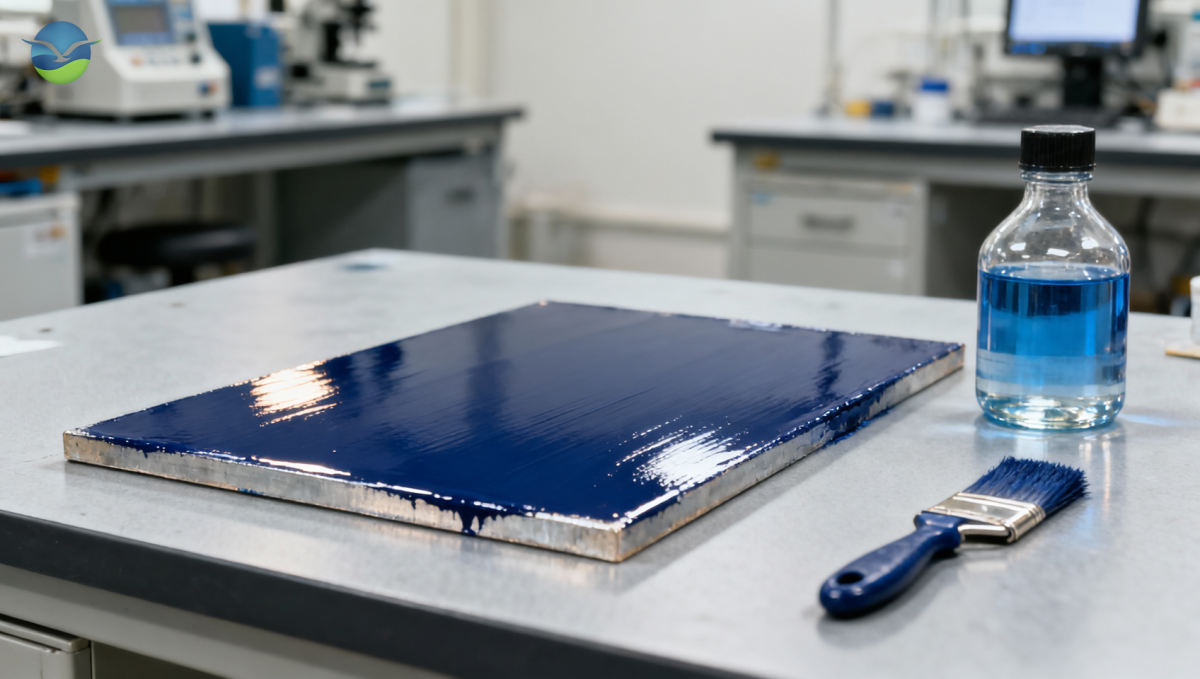
The formulation target is a controlled transition: enough early mobility for leveling, followed by solvent release and viscosity development at a pace appropriate to the film thickness and curing schedule.
Why n-butyl acetate behaves differently in different blends
Solvent mixtures do not evaporate as a fixed composition. Faster components generally leave preferentially, changing the solvency and viscosity of the remaining liquid. Interactions among solvents and the binder can also make blend behavior depart from a simple weighted average.
This is why replacing one solvent on an equal-weight basis can alter a coating even when the two solvents have similar published evaporation rates. Density, solvency, surface tension, and interactions with the resin also matter.
- Fast components can support rapid initial set, but excessive early loss may reduce wetting and leveling.
- Intermediate components such as n-butyl acetate can help balance application flow and subsequent solvent release.
- Slower components may extend flow, but excessive retention can delay handling or increase sagging.
These are functional roles, not a universal recipe. A blend suitable for a thin spray-applied lacquer may perform poorly in a high-build coating. Similarly, a solvent balance developed for ambient drying should not be transferred directly to a forced-drying line.
Compatibility must also persist throughout drying. A clear solution in the mixing vessel can become unstable after its strongest or fastest solvent leaves. Haze, resin precipitation, gloss loss, or surface defects may emerge only during evaporation. Evaluate the drying path, not just initial clarity.
Read defects as evidence—not as a solvent diagnosis
Many coating defects have several possible causes. Increasing or decreasing butyl acetate without checking application conditions can move the problem rather than resolve it.
For moisture-sensitive polyurethane systems, separate solvent-related effects from chemical reactions involving water. Moisture can contribute to carbon dioxide generation and bubbles in isocyanate-containing coatings. Altering evaporation rate alone will not correct contaminated raw materials or unsuitable application conditions.
A validation plan that reflects production conditions
A room-temperature drawdown is useful for screening, but it cannot establish spray-line performance by itself. A defensible evaluation combines controlled comparisons with application trials that represent the actual process.
Build a controlled baseline
Record the resin grade, solids content, solvent composition, application viscosity and measurement temperature, substrate preparation, wet-film thickness, and drying schedule. For reactive coatings, also control mixing ratio, induction time where applicable, and elapsed time after mixing.
When adjusting n-butyl acetate content, state the comparison basis. Holding solids constant answers a different question from holding application viscosity constant. Both approaches can be useful, but changing several variables without documenting them makes the result difficult to interpret.
Challenge the operating window
Test the intended production condition together with credible boundary conditions: warmer substrates, cooler surroundings, higher humidity, stronger airflow, and the upper end of the film-build specification. Include vertical panels when sag resistance matters.
Measure actual panel conditions rather than relying only on booth settings. Air movement and evaporative cooling can create differences between nominal air temperature and the coating surface. Record flash-off time before oven entry and the actual part-temperature profile during forced drying.
Track appearance and performance over time
Evaluate flow, sagging, surface defects, drying stages, gloss, and hardness at defined intervals. Where retained solvent is suspected, mass-loss tracking can provide screening evidence, while validated analytical methods such as gas chromatography can identify and quantify individual residual solvents.
Do not treat a single solvent-resistance or hardness result as a direct measurement of residual solvent. Cure conversion, film thickness, resin chemistry, and test timing can all influence the result.
Standards and specifications worth discussing
Use current editions of methods appropriate to the coating and substrate. Useful references may include:
- ASTM D3539: evaporation rates of volatile liquids using the Shell thin-film evaporometer; useful when interpreting comparable solvent data.
- ASTM D1640/D1640M: drying, curing, or film formation of organic coatings at room temperature.
- ISO 2808: methods for determining coating film thickness.
- ASTM D523: specular gloss measurement.
- ASTM D5402: solvent-rub resistance of organic coatings, where appropriate to the system.
These methods answer different questions. None independently establishes that a solvent blend is suitable for a production line. Agree on conditioning, film thickness, inspection intervals, acceptance limits, and any deviations before comparing laboratory or supplier results.
Qualifying butyl acetate supply without losing the technical focus
Incoming solvent specifications should address the variables that matter to the formulation. Depending on sensitivity, these may include identity, assay, water content, acidity, color, and distillation characteristics. Request numerical acceptance limits and relevant test methods rather than relying on “coating grade” as a complete specification.
Product identity must also remain unambiguous across a broad chemical catalog. A listing such as Sodium Erythorbate Antioxidant Food Raw Material belongs to a different material category and is not a substitute for n-butyl acetate or a recommended coating additive. Technical requests, samples, and documentation should identify the intended solvent explicitly by name and CAS number.
For inquiries handled through Qixiang Chemical, its Wuxi foreign trade team coordinates overseas communication, sample arrangements, and documentation, while the company’s production base is in Shandong. Evaluators should confirm the manufacturing source and available specifications for the particular solvent offered; a company’s broader manufacturing capabilities do not establish a specific n-butyl acetate grade or production route.
Request a representative sample, batch-specific certificate of analysis, and current safety data sheet before qualification. Storage and application controls must account for flammable vapor, ignition sources, ventilation, and applicable occupational and environmental requirements. Evaporation-rate optimization does not replace solvent-safety engineering.
The decision criterion: a stable processing window
The strongest reason to select n-butyl acetate is not that it is universally “fast” or “slow.” It is that, in a suitable formulation, it can contribute to a useful balance between flow, set, and solvent release.
Approve the solvent blend when it delivers acceptable appearance and performance across realistic variations in film build, temperature, airflow, and drying conditions—not only on the best laboratory panel. That evidence turns evaporation rate from a catalog number into a practical film-formation control.
Please give us a message
Send Us Your Inquiry Today
Scalable production and one-stop R&D, manufacturing, sales & after-sales services.