






What to review in organic solvents with MSDS before plant acceptance
What to Review in Organic Solvents with MSDS Before Plant Acceptance
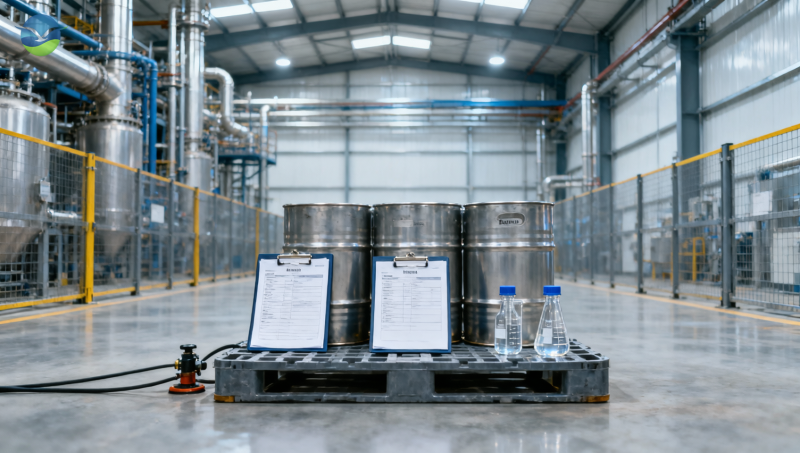
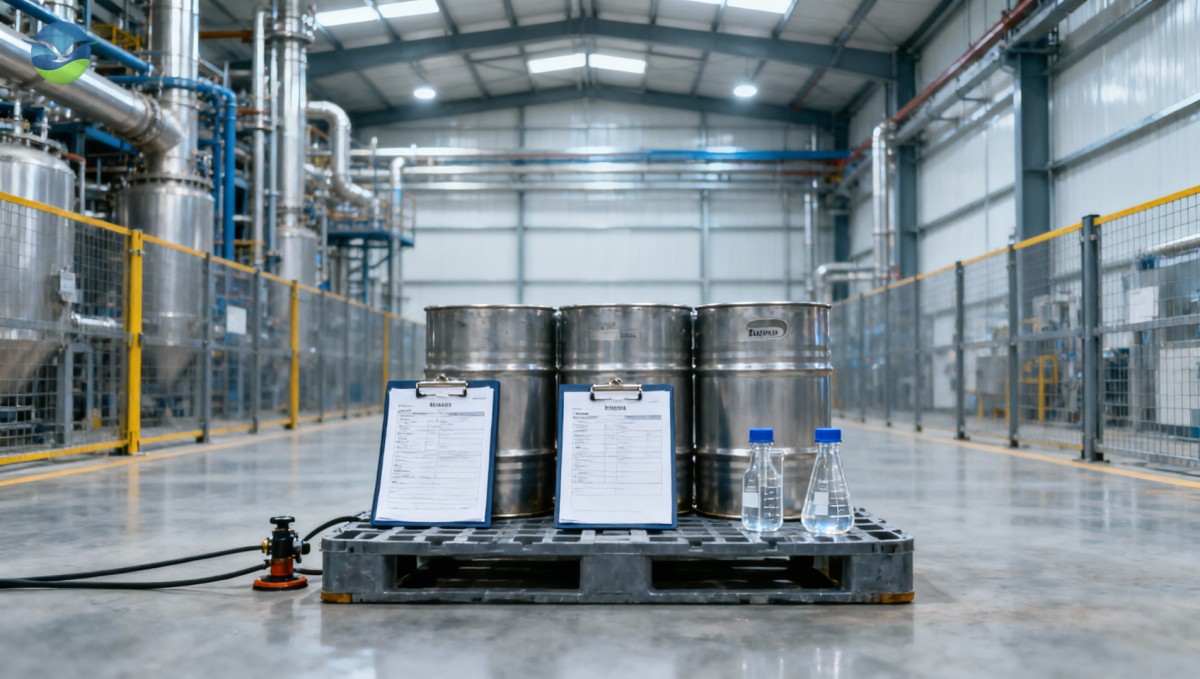
Before an organic solvent is released into plant inventory, the material itself and its documentation need to be treated as one acceptance package. A drum may carry the expected label, appear intact, and match the purchase order, yet still create operational trouble if the safety data sheet is outdated, written for a different grade, incomplete for the destination market, or inconsistent with the certificate of analysis (COA).
For quality-control and safety teams, reviewing organic solvents with MSDS documents is not simply a compliance exercise. It is a practical gatekeeping step. The review determines whether the receiving area can unload the material safely, whether the warehouse has suitable segregation and ventilation, whether production can use the solvent without creating contamination or reaction risks, and whether emergency responders have actionable information if something goes wrong.
The term “MSDS” remains common in purchasing and plant operations, although many jurisdictions now use “SDS” under Globally Harmonized System (GHS) conventions. Whatever title appears on the document, the key question is the same: does it accurately describe the exact substance or mixture arriving at the gate?
Start With Identity, Not the Product Name
Trade names can be useful commercially but are weak acceptance controls on their own. The first review should connect the purchase order, container label, COA, packing list, and MSDS through unambiguous chemical identity. For a single-component solvent, this normally means checking the chemical name, CAS number, molecular formula where applicable, and grade. For a blend, the MSDS should identify hazardous components and their concentration ranges in a manner sufficient for hazard assessment.
This step matters because similar names can conceal materially different products. A solvent may be supplied as anhydrous, technical, reagent, coating-grade, or high-purity material. Those distinctions can affect water content, residue after evaporation, acidity, inhibitor content, odor, processing performance, and storage behavior. If the product code on the COA differs from the code on the MSDS, the discrepancy should be resolved before unloading rather than filed for later.
The revision date is equally important. An old document is not automatically invalid, but it deserves scrutiny when a supplier has changed formulation, manufacturing location, classification, or transport arrangement. The receiving team should know who issued the document, when it was revised, and whether a responsible contact can answer technical questions promptly.
Read Hazard Classification as an Operating Instruction
Sections covering hazards, composition, handling, storage, exposure controls, and physical properties should be read together. Looking at the hazard pictogram alone is not enough. A flammable-liquid classification tells the team that ignition control matters, but the flash point, vapor pressure, vapor density, and lower explosive limit help determine how quickly a release could form a hazardous atmosphere and where vapors may travel.
For example, a low flash point may require more stringent control over unloading equipment, bonding and grounding, nearby hot work, forklift selection, and local ventilation. High vapor density is a reminder that vapor can settle in pits, drains, trenches, or poorly ventilated low areas rather than dispersing harmlessly upward. Water solubility, meanwhile, influences spill response choices and whether wash-down could spread contamination.
The health classification deserves the same attention. Organic solvents can present acute inhalation, skin, eye, aspiration, or central nervous system hazards; some may have longer-term hazards that require specific occupational controls. The MSDS should not replace the site’s exposure assessment, but it supplies the information needed to determine whether the proposed receiving and production conditions are appropriate.
Check the Physical Data Against the Intended Process
Plant acceptance should include a process-fit review, especially when the solvent will enter formulations, extraction systems, cleaning operations, coating lines, or closed transfer systems. The most useful MSDS values are often flash point, boiling range, melting or freezing point, density, vapor pressure, viscosity where available, and solubility. These values do not establish quality by themselves, but they indicate whether the material behavior is plausible and whether the plant’s procedures remain suitable.
A solvent delivered during cold weather may become more difficult to transfer if its freezing behavior has not been considered. A product with appreciable vapor pressure can create pressure and emission concerns during sampling. Density affects tank calibration and mass-to-volume reconciliation. If the process depends on controlled evaporation, a broad boiling range or unexpected water content on the COA may matter more than the nominal solvent name.
Do not expect the MSDS to function as a complete specification. The COA should provide the batch-specific quality results agreed in the purchase specification, such as purity, moisture, color, acidity, nonvolatile residue, or other relevant test items. A sound incoming review compares the COA against acceptance limits and uses the MSDS to interpret the safety implications of the material being accepted.
Storage Instructions Must Match the Actual Warehouse
“Store in a cool, dry, well-ventilated place” is common wording, but it is not a complete storage plan. The acceptance decision should ask whether the warehouse can meet the material’s actual needs: temperature control where required, suitable ventilation, protected electrical equipment, compatible containers, secondary containment, fire protection, and segregation from incompatible materials.
Section 10 of the MSDS is particularly useful here. Incompatibilities may include oxidizing agents, strong acids, strong bases, reactive metals, or other chemical classes depending on the solvent. The plant should translate that information into its own segregation rules rather than relying on a general chemical-storage label. A solvent stored beside an incompatible material may remain stable for months—until a leak, transfer error, or fire exposes the weakness in the arrangement.
Container compatibility also warrants a check. Drums, intermediate bulk containers, seals, pumps, hoses, gaskets, and sampling devices must be appropriate for the solvent. The MSDS may offer general guidance, but site engineers should confirm suitability where the process includes elevated temperature, repeated circulation, or long-term storage.
Review Transport Details Before the Shipment Becomes a Warehouse Problem
For imported material, transport classification needs to be consistent across the MSDS, dangerous-goods declaration where applicable, package markings, and logistics documents. Relevant information may include UN number, proper shipping name, transport hazard class, packing group, and environmental hazard designation. These items influence freight handling, port procedures, labeling, emergency arrangements, and the route by which a shipment reaches the plant.
A receiving team should also verify practical details: package type, net and gross quantities, number of containers, seal condition, leakage, deformation, and label legibility. When receiving bulk deliveries, reconcile the paperwork against the tank allocation before connecting hoses. A documentation mismatch may be administrative, but it can also be the earliest visible sign of a product or logistics error.
PPE and Emergency Sections Need Site-Level Interpretation
The PPE section of an MSDS is often copied into work instructions without enough thought. Gloves, goggles, protective clothing, and respiratory protection should be selected for the task and exposure route, not merely because they appear in a generic list. Chemical resistance depends on the glove material, solvent concentration, contact duration, temperature, and the possibility of immersion or splash. A site safety team may need additional supplier data or internal assessment to choose practical protection.
Emergency measures should be reviewed before acceptance, not after a spill. Confirm that eyewash stations, safety showers, extinguishing media, spill absorbents, drainage protection, ventilation arrangements, and trained responders are available for the stated hazards. The MSDS may distinguish between a small spill and a larger release; the site should be clear about who has authority to isolate an area, stop transfer, notify emergency personnel, and manage contaminated waste.
This is also where language and document accessibility matter. Operators working the unloading bay need instructions they can understand. A technically correct MSDS stored only in a procurement archive does little to protect the person opening a drum.
Avoid Confusing Solvent Controls With Other Raw-Material Controls
Not every chemical incoming inspection follows the same logic. Food additives, for instance, may require close attention to food-grade specifications, shelf life, packaging integrity, and storage protection even when they are not handled as organic solvents. For a material such as Sodium Erythorbate Antioxidant Food Raw Material, the supplied information identifies CAS No. 6381-77-7, a white to yellowish-white crystalline appearance, 25 kg packaging, and storage away from light in a cool, dry place at room temperature. Its stated 24-month shelf life and use in meat products, beverages, canned food, beer, and food processing illustrate why receiving procedures must remain material-specific.
That distinction is useful for mixed plants. A warehouse may receive flammable solvent drums one day and oxidation-sensitive food ingredients the next. Both shipments need current safety documentation and COAs, but their critical acceptance risks differ. Applying a single generic checklist can leave important gaps in either direction.
Make Documentation Review Part of Supplier Control
The most effective review process begins before the truck arrives. Purchasing, quality, EHS, and warehouse personnel should agree on required documents, revision control, batch-release criteria, sampling rules, and escalation paths for discrepancies. A supplier should be able to provide the correct MSDS and COA for the material and support reasonable questions about identity, transport, packaging, and safe handling.
For overseas sourcing, responsiveness matters because discrepancies often emerge across time zones, during customs clearance, or while a shipment is waiting for a receiving decision. Qixiang Chemical’s operating model separates customer-facing coordination from source manufacturing: its foreign trade team in Wuxi, Jiangsu handles inquiries, samples, quotations, logistics coordination, qualification documents, and after-sales documentation, while its Shandong production base manages manufacturing and quality control. The Shandong facility covers 10,000 square meters and includes raw-material storage, production lines, reaction workshops, and quality laboratories. This arrangement can help buyers obtain COAs and MSDSs through a defined communication channel while retaining visibility into source production.
For the buyer, however, the acceptance principle remains unchanged: documents support a decision; they do not substitute for it. Verify the batch, inspect the delivery, compare documents with the agreed specification, and hold material when critical questions remain unresolved.
A Practical Release Decision
Before releasing organic solvents into the plant, confirm that chemical identity is exact, the MSDS is current and applicable, the COA meets the purchase specification, hazard and transport details match the shipment, warehouse controls are adequate, and operators have usable PPE and emergency instructions. Where any of these elements conflict, quarantine is usually the safer short-term choice than assumptions made under production pressure.
A well-reviewed shipment enters the facility with clear ownership: quality understands what was purchased, EHS understands the hazards, warehouse staff understand how to store it, and production understands the limits of use. That is the real purpose of reviewing organic solvents with MSDS documentation before plant acceptance.
Please give us a message
Send Us Your Inquiry Today
Scalable production and one-stop R&D, manufacturing, sales & after-sales services.