






What Does Citric Acid E330 Mean on Ingredient Lists and Compliance Documents?
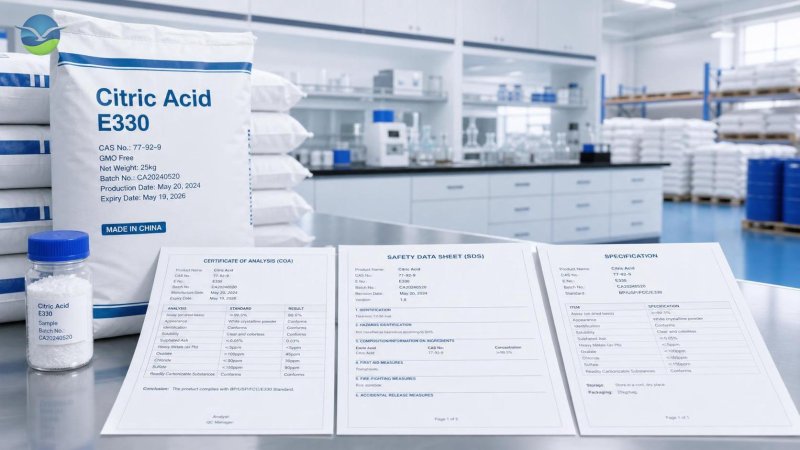
If you work in quality control or safety management, seeing citric acid E330 on ingredient lists and compliance documents should trigger more than simple recognition. It points to a specific additive identity, a functional role in formulation, and a set of documentation expectations that affect labeling, import review, internal approval, and supplier qualification. In practice, the question is rarely “what is citric acid?” It is usually “does this paperwork clearly prove what this material is, how it should be classified, and whether the batch in front of me matches the claim?”
That is where confusion often begins. One document may say citric acid, another may say E330, another may use the CAS number, and the SDS may focus on handling rather than food additive status. For quality teams, these are not minor wording differences. They influence traceability, customs submission, customer audits, and product release decisions.
What E330 actually means
E330 is the European food additive code for citric acid. On ingredient lists, it identifies citric acid when used as an approved food additive, typically for acidity regulation, flavor balancing, preservation support, or chelation. The “E” numbering system is widely associated with EU food labeling, but the material itself may also appear in global documentation simply as citric acid, anhydrous citric acid, or citric acid monohydrate depending on the grade and physical form.
For compliance review, the key point is this: E330 is not a separate chemical from citric acid. It is a regulatory designation used in food contexts. If a specification sheet says citric acid and the label says E330, that is not automatically a mismatch. What matters is whether the supporting documents consistently identify the same substance and the correct grade.
In other words, E330 answers a regulatory naming question, while the rest of the file must answer technical questions such as purity, moisture, assay, intended use, and handling controls.
Why quality and safety teams pay attention to this code
On a production floor or in a document review queue, citric acid E330 tends to appear in routine places: raw material approvals, formulation records, label reviews, transport files, and customer questionnaires. Because it is common, people sometimes treat it as low risk. That is often where avoidable errors slip in.
A common example is assuming that any citric acid document is sufficient for any application. It is not. Industrial, technical, food, feed, cosmetic, and pharmaceutical uses may require different specifications, statements, or declarations. A batch intended for one market may not satisfy another market’s documentation standard even if the chemical identity is correct.
For safety managers, another concern is that familiar materials are often under-checked. The SDS may look standard, but storage compatibility, dust management, packaging integrity, and transport labeling still need verification. Citric acid is widely used, but wide use does not replace document control.
How citric acid E330 is typically described in documents
When you review a supplier file, the name may appear in several parallel ways:
- Ingredient or commercial name: Citric acid
- Additive designation: E330
- Chemical form: Anhydrous or monohydrate
- CAS identification: Often used on SDSs, COAs, and customs documentation
- Grade statement: Food grade, pharma grade, industrial grade, or another declared use category
These descriptors should support each other, not contradict each other. If the commercial invoice says citric acid, the product label says E330, and the COA confirms the matching grade and test results, that is usually a coherent file. If the COA lacks grade clarity or the SDS references a different product form, the material may need hold-and-clarify status before release.
This becomes especially important in export and cross-border trade. A purchasing team may focus on price and availability, while a destination customer or regulator focuses on exact naming consistency. That is why responsive documentation support matters just as much as production capacity.
The four documents that deserve the closest check
Most review problems around citric acid E330 are not caused by the chemistry itself. They come from fragmented paperwork. These are the four documents that deserve the closest attention.
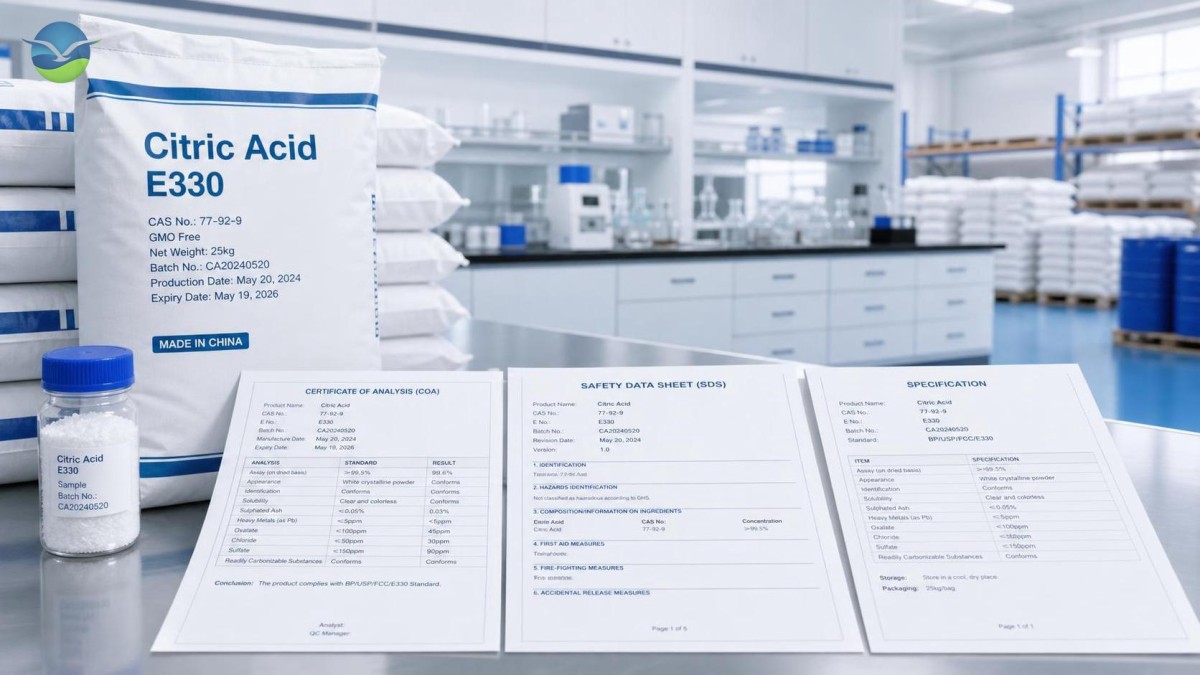
1. Certificate of Analysis (COA)
The COA should confirm that the delivered batch meets the supplier’s declared specification. For citric acid E330, quality personnel usually check identity, assay or purity, appearance, moisture-related parameters, and any impurity limits relevant to the intended application. The product form matters. Anhydrous and monohydrate material should not be treated as interchangeable without confirming the specification basis.
Look for batch number alignment, production date, test date, specification reference, and signature or release authorization. If the COA looks generic or undated, that is a warning sign.
2. SDS or MSDS
The Safety Data Sheet serves a different purpose from the COA. It is not a substitute for additive approval or food compliance, but it is essential for workplace safety, transport understanding, and storage controls. Safety teams should check section consistency: product identification, hazard classification where applicable, first-aid measures, handling precautions, and storage conditions.
If the product is supplied for food or flavor manufacturing, the SDS still must match the exact material identity being purchased. That matters when citric acid is used alongside ingredients such as Vanillin Flavor Fragrance Raw Material, where blended documentation review may involve both food-contact expectations and workplace safety controls.
3. Product label and packaging marks
Labels should show enough information for warehouse and audit traceability: product name, batch or lot number, net weight, manufacturer or supplier information, and sometimes storage instructions. If customer-facing labels use E330, internal receiving labels may still use “citric acid.” That can be acceptable, but traceability records should make the relationship explicit.
4. Compliance declarations or specification sheets
These documents often answer the questions the COA does not: grade, intended use, conformity to customer standards, and declarations related to allergens, GMO status, origin, or restricted substances where requested. For quality departments, this is often the bridge between laboratory results and customer approval.
What to verify when the wording does not match perfectly
Not every wording difference is a compliance problem, but each difference should be explained. A practical review approach is to ask five questions:
- Do all documents refer to the same substance despite naming variations?
- Is the physical form clearly stated and consistent?
- Is the declared grade appropriate for the intended application?
- Are the batch identifiers traceable across label, COA, and shipping records?
- Is there any market-specific requirement that the current file does not address?
If the answer to any of these is unclear, the safest response is not to assume. Request clarification in writing. This is where a supplier’s service structure becomes visible. Fast paperwork turnaround, especially across time zones, can prevent production delays and shipment holds.
Citric acid E330 in cross-border compliance workflows
For importers and overseas manufacturers, the technical review of citric acid E330 often stretches beyond one department. Procurement wants continuity of supply. QC wants clean batch data. Regulatory staff want consistent naming. Warehouse teams want storage instructions that match actual packaging. Customer service may need additional declarations after shipment.
That is why many buyers prefer suppliers that combine source manufacturing with a dedicated foreign trade documentation team. Qixiang Chemical works with this dual-location structure: production is based in Shandong, while foreign trade operations, sample coordination, qualification paperwork, and after-sales communication are handled by its Wuxi team in Jiangsu. For compliance-heavy materials, that kind of arrangement can reduce the usual back-and-forth between plant, trader, and customer, especially when COAs, MSDSs, and supporting files need quick confirmation.
The manufacturing base in Shandong supports controlled production and batch documentation, while the Wuxi foreign trade center handles overseas communication, sample dispatch, logistics coordination, and qualification document processing. For quality and safety managers, this matters less as a sales point and more as a practical control point: when documentation questions arise, response speed and source-level verification are often what keep release schedules on track.
Common mistakes seen in real reviews
Several issues appear again and again in standard certification and technical review work:
- Treating E330 as if it were a different ingredient from citric acid
- Approving a material based on a historical SDS while the current batch uses a different form
- Using a COA without checking whether it belongs to the shipped lot
- Assuming “food use” from commercial habit without obtaining formal grade documentation
- Overlooking whether customer-required declarations are current and signed
These errors are rarely dramatic, but they create friction during audits, customer complaints, export inspections, and internal investigations. A well-organized file prevents a very ordinary ingredient from becoming an administrative problem.
When additional detail may be necessary
Some applications call for more than standard identity confirmation. If citric acid E330 is used in sensitive formulations, export-regulated goods, or products with strict downstream declarations, you may need to request supplementary documents. Depending on the market and use case, that could include statement letters, manufacturing process summaries, impurity-related information, or customer-format specification sheets.
This is also true in flavor and fragrance related supply chains. If citric acid is part of a wider ingredient system that includes acidulants, carriers, or aromatic materials such as Vanillin Flavor Fragrance Raw Material, buyers often want documentation sets that are aligned in style and update cycle. Consistency across materials makes internal review easier and reduces the chance that one missing statement delays an entire product release.
A workable internal checklist for QC and safety teams
If you need a simple operational rule, use this: identify, match, confirm, and archive.
Identify the material correctly as citric acid and recognize E330 as its food additive designation. Match the product name, grade, form, and batch across the COA, SDS, label, and invoice. Confirm that the documentation supports the intended end use and destination market. Then archive the reviewed file in a way that allows quick retrieval during audits or customer questions.
That approach sounds basic, but it solves most of the day-to-day uncertainty around this ingredient.
So, what does citric acid E330 mean on ingredient lists and compliance documents? In technical terms, it means the material is being identified as citric acid under its food additive code. In operational terms, it means your review should go beyond the name itself. The real job is to verify whether the surrounding paperwork proves identity, suitability, and traceability clearly enough for safe use and compliant release. For quality control and safety management teams, that distinction is where routine approval becomes reliable control.
Please give us a message
Send Us Your Inquiry Today
Scalable production and one-stop R&D, manufacturing, sales & after-sales services.