






Warehouse Layout Rules for Safe Chemical Solvent Drum Storage and Segregation

Warehouse Layout Rules for Safe Chemical Solvent Drum Storage and Segregation
Safe chemical solvent drum storage is not achieved by adding more warning signs after the warehouse is full. It begins with the layout: where drums enter, where they wait for inspection, how incompatible materials are separated, whether a forklift can turn without striking a pallet, and whether a spill can be contained before it reaches a drain or another storage zone.
For quality and safety teams, the difficult part is usually not recognizing that solvents can burn, leak, or react. The difficult part is translating the safety data sheet into a workable warehouse plan that still supports receiving, batch control, stock rotation, sampling, and dispatch. A layout that looks orderly on paper can become unsafe once empty drums, return pallets, quarantine stock, and short-term staging begin occupying the same floor space.
The governing requirements depend on the product’s hazard classification, flash point, packaging, stored quantity, building design, and local authority rules. Facilities commonly review applicable fire codes, occupational safety requirements, insurer expectations, and standards such as NFPA 30 where relevant. The SDS remains the starting point. It identifies the actual hazards; a product name alone does not.
Start with Hazard Mapping, Not Available Floor Space
Before assigning rack positions, create a current inventory map that records each material’s SDS revision, UN information where applicable, hazard class, flash point where stated, physical form, incompatibilities, package type, and maximum expected inventory. This is more useful than a simple stock list because it shows what can be placed together and what needs a physical barrier, a separate room, or a different building area.
A common planning mistake is grouping products by customer, purchasing category, or SKU sequence. That may simplify inventory records, but it can place oxidizers beside flammable liquids, acids near reactive metals, or water-reactive materials in an area vulnerable to sprinkler discharge. Chemical compatibility must take priority over picking convenience. Once the safe zones are defined, inventory logic can be fitted around them.
Treat the warehouse as a series of controlled zones rather than one large drum store. In practical terms, this often includes a receiving and inspection area, a quarantine zone for damaged or undocumented material, dedicated flammable-liquid storage, non-flammable liquid storage, segregated incompatible-material areas, empty-drum handling, and a dispatch staging area. Quarantine deserves particular attention. A leaking or incorrectly labeled drum should not be parked “temporarily” beside saleable stock simply because the receiving team is busy.
Segregation Is About the Consequences of a Release
Segregation is often described too simply as keeping incompatible chemicals apart. In reality, the question is more demanding: if one drum leaks, burns, or is punctured by handling equipment, what could it contact next? The answer determines whether distance is enough or whether a fire-rated separation, independent spill containment, or a separate storage room is needed.
Flammable solvents should be stored away from ignition sources, oxidizing agents, and operations that create heat, sparks, or open flames. Electrical equipment, battery charging areas, welding work, and maintenance benches deserve special scrutiny. These are frequently introduced after the warehouse has opened, which is why periodic layout reviews matter. A safe chemical zone can become unsafe when a charging station is added at the end of an aisle.
Do not assume every drum labelled as a “solvent” belongs in the same flammable-liquid bay. Some liquid raw materials have different fire behavior, corrosivity, water sensitivity, or contamination concerns. Likewise, a non-flammable liquid may still need careful segregation because it can compromise product quality, react with another substance, or create a difficult clean-up condition. Compatibility charts are useful screening tools, but they do not replace SDS review and site-specific risk assessment.
Aisles Must Support Emergency Access as Well as Forklift Movement
Aisle width should never be selected solely from the turning radius in a forklift brochure. The real operating condition includes a loaded pallet, drum overhang, pedestrian movement, temporary staging, and the possibility that a damaged drum must be approached safely. The required width should be confirmed against the handling equipment, rack configuration, local code, and emergency access needs.
Main travel aisles should remain visibly defined and free of overflow stock. Cross-aisles, fire doors, electrical panels, eyewash stations, hose connections, exits, and spill-response equipment need the same protection. Tape on the floor helps, but it is not a control if supervisors routinely allow pallets to sit across it. The more effective approach is to give temporary stock a designated place with a time limit and clear ownership.
Drums should also be positioned so labels can be read without climbing onto pallets or moving multiple units. This supports inventory accuracy, emergency response, and first-expired-first-out practice. If operators regularly turn drums around to find a batch number or hazard label, the layout is working against the quality system.
Containment and Drainage Need to Work Together
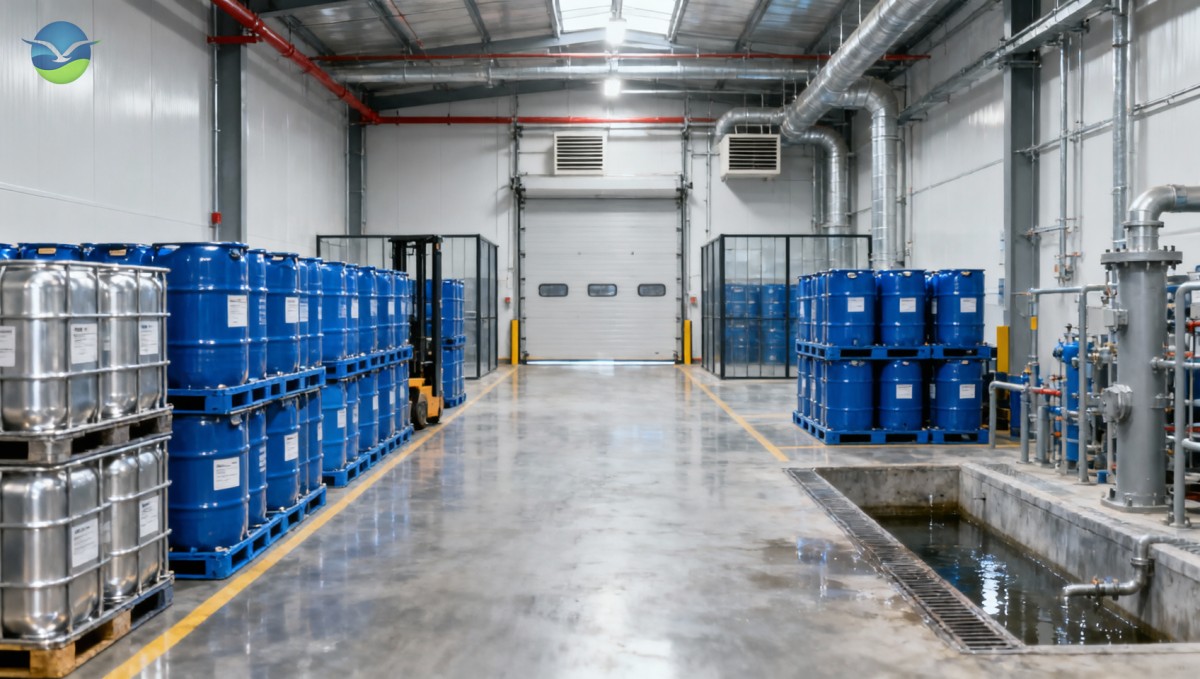
Secondary containment is not just a procurement item. Its capacity, chemical resistance, loading strength, drainage arrangement, and position relative to doorways and floor drains all matter. A containment pallet that is too small for the actual drum arrangement, or that cracks under a forklift impact, offers false reassurance. The design should be checked against the facility’s credible spill scenario and applicable local requirements.
Keep solvent storage away from unprotected drains where feasible. If drainage is present, the site should understand where it leads and how it can be isolated during an incident. This point is routinely missed in older warehouses, especially when a former general-goods area is converted into chemical storage. A minor drum leak is manageable on a sealed floor with nearby absorbent materials; it is a different event once liquid enters a stormwater system or a shared drain network.
Containment also needs housekeeping. Rainwater, wash water, dust, loose shrink wrap, and discarded absorbents reduce usable volume and make inspections less meaningful. Where drum pallets are used, inspect them before use rather than only after a spill. Forklift forks can create damage that is easy to overlook until the next leak occurs.
Ventilation, Temperature, and Product Integrity Are Connected
For volatile solvents, ventilation planning should be based on the hazard assessment and the specific vapor characteristics of the stored products. Natural ventilation may be insufficient in enclosed areas, low points, or spaces where vapors can accumulate. Mechanical systems, where required, need to be suitable for the classified area and maintained as safety-critical equipment rather than treated as ordinary building ventilation.
Temperature control is not only a fire concern. Direct sunlight, high temperatures, and repeated temperature cycling can affect package pressure, seals, viscosity, appearance, and shelf-life expectations. Quality personnel should connect warehouse temperature observations to incoming and retained-sample investigations. When a drum arrives swollen, discolored, or with a compromised closure, the question is not merely whether it can be cleaned and shipped. Its storage and transport history may need review.
This distinction is especially relevant for materials that are liquid but not necessarily managed as flammable solvents. For example, cosmetic-grade vegetable glycerol is supplied as a colorless, viscous liquid in 25 kg barrels and is generally specified to remain sealed in a cool, dry, well-ventilated place away from direct sunlight and high temperatures. For a product such as Glycerin Vegetable Glycerol Raw Material, the warehouse focus may include cleanliness, moisture control, lot traceability, and protection from contamination as much as fire separation. The SDS and product specification should determine the final location.
Receiving Controls Prevent Layout Failures from Entering the Building
Many storage failures begin at receipt. A drum may have a damaged bung, an unreadable label, an unexpected package size, or documentation that does not match the purchase order. If receiving staff have no defined inspection area, these issues enter normal inventory before anyone decides how they should be handled.
A practical incoming check includes verifying product identity, lot number, drum condition, closure integrity, label legibility, quantity, and the current SDS and certificate documentation required by the site. For imported raw materials, document coordination should be treated as part of safe storage, not a separate office task. Accurate SDS access, COAs, packing details, and transport information help the warehouse assign the right zone before the load is broken down.
For suppliers serving overseas buyers, response speed matters when a document question holds stock in quarantine. Qixiang Chemical’s operating model separates foreign-trade communication and documentation support in Wuxi from source manufacturing in Shandong. In practice, that kind of division can help buyers obtain sample coordination, qualification documents, COAs, and MSDSs without waiting for a production-site response. It does not remove the receiving team’s responsibility to verify the shipment, but it can reduce the time that materials remain in an uncertain holding area.
Review the Layout After It Has Been Used
The best warehouse drawings are tested by daily operations. Walk the route from unloading dock to final rack location. Watch where drivers pause, where operators leave samples, where empty drums accumulate, and where a spill kit becomes blocked. These observations often reveal more than a yearly desktop audit.
A useful review trigger is any change in product mix, stored quantity, drum size, racking, handling equipment, ventilation, or nearby work activity. Changes that seem minor in isolation can alter the original separation assumptions. New export volume, for instance, may turn a dispatch lane into permanent storage unless the layout is updated deliberately.
Good chemical solvent drum storage is therefore less about finding the maximum number of pallets that fit in a room. It is about preserving safe separation, access, containment, traceability, and product condition when the warehouse is busy. If one extra pallet blocks an exit, merges incompatible spill zones, or forces staff to store drums in a travel aisle, the layout has already exceeded its practical capacity.
Please give us a message
Send Us Your Inquiry Today
Scalable production and one-stop R&D, manufacturing, sales & after-sales services.