






Chemical Solvent Drum Storage: How to Prevent Leaks, Corrosion, and Container Damage
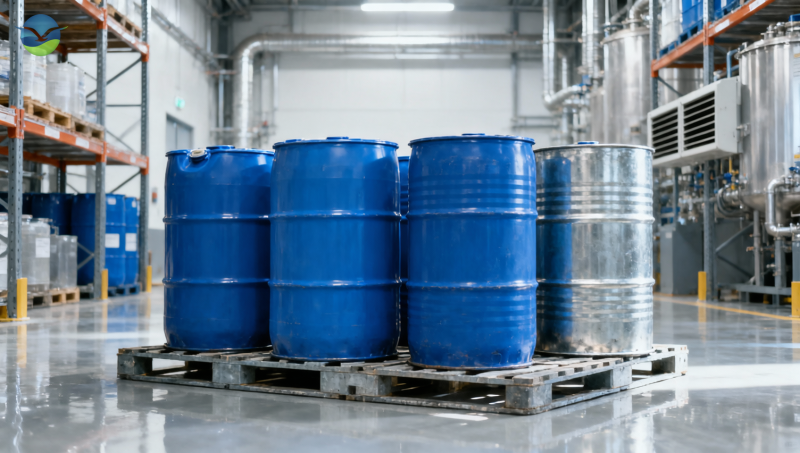
A solvent drum rarely fails without warning. The warning signs are often small: a damp ring under a bung, a softened label, rust streaks at a chime, a distorted lid, an unfamiliar odor near a storage bay, or a pallet that remains wet after housekeeping. Treating these as minor defects allows a contained packaging problem to become a spill, vapor-release, fire, exposure, or product-contamination event.
Effective chemical solvent drum storage begins with a basic rule: the solvent, the drum material, the closure, the storage environment, and the spill-control equipment must work together. A sound steel drum can corrode externally in a humid location, while an apparently clean plastic drum can weaken because its resin is incompatible with the solvent. Good storage practice is therefore not simply “keep drums dry.” It is a controlled system of compatibility checks, physical protection, inventory discipline, and routine inspection.
Start with the solvent and container as a matched system
Before moving a drum into storage, confirm what the safety data sheet (SDS) and supplier documentation specify for packaging, storage temperature, incompatibilities, and ventilation. The drum type supplied with a solvent is not interchangeable with any available container. A substitute drum must be suitable not only for the liquid itself, but also for its vapor, concentration, additives, and anticipated storage duration.
Steel drums are widely used for many solvents, particularly where mechanical strength and fire performance are priorities. Their weakness is corrosion. Water collecting around the base, damaged internal linings, salt-laden air, acidic contamination, and contact with reactive chemicals can all compromise the metal. Galvanized or coated surfaces may provide added protection in certain service conditions, but a coating is not a universal compatibility solution.
High-density polyethylene (HDPE) drums resist many aqueous chemicals and selected solvents, but they must not be assumed safe for every organic liquid. Some solvents can permeate plastic, extract additives, cause swelling, embrittlement, stress cracking, or gradual loss of strength. A drum may look acceptable during a short transfer operation while becoming unsuitable for weeks or months of storage. Closures, gaskets, dip tubes, taps, and vent components require the same compatibility review; a compatible drum with an incompatible gasket can still leak.
Do not judge container compatibility by a chemical’s common name alone. “Thinner,” “solvent blend,” or “cleaning solvent” can describe mixtures with significantly different effects on plastics, elastomers, coatings, and liners. The current SDS, technical data, and packaging recommendation are more reliable than assumptions based on a previous formulation.
Prevent leaks by protecting the drum’s weak points
Most drum leaks occur at predictable locations: bungs and gaskets, fittings, seams, damaged sidewalls, and the lower chime where moisture and impact damage accumulate. Storage arrangements should make each of these areas visible and accessible. If drums are packed so tightly that staff cannot inspect the lower rim or closure, leaks can remain hidden until secondary containment fills or product reaches the floor.
Keep drums upright unless the manufacturer specifically permits another orientation. Upright storage reduces continuous liquid contact with closures and makes it easier to identify bulging, bung seepage, or a compromised head. Closed-head drums are generally preferred for liquids that are not routinely dispensed from the container. Open-head drums require particular attention to lid rings, gaskets, and proper closure after every use.
Bungs should remain closed except during controlled dispensing, sampling, or pressure-management procedures authorized for that material. Improvised venting is dangerous. A worker may loosen a bung to relieve apparent pressure without considering flammability, toxic vapor exposure, moisture ingress, or the risk of a sudden release. If a drum appears pressurized, swollen, hot, or otherwise abnormal, isolate the area and follow the site’s emergency and chemical-handling procedure rather than attempting to force the closure open.
Manual handling is another frequent source of container damage. Rolling a drum over rough ground, dragging it by the chime, striking it with fork tines, or lifting it with unsuitable attachments can deform seams and weaken closure areas. Use drum cradles, handlers, clamps, or lifting equipment designed for the drum type and weight. Forklift operators should avoid penetrating or pressing against drums with fork tips. Even a small dent can remove protective coating and create a future corrosion point.
Secondary containment is not optional spill decoration
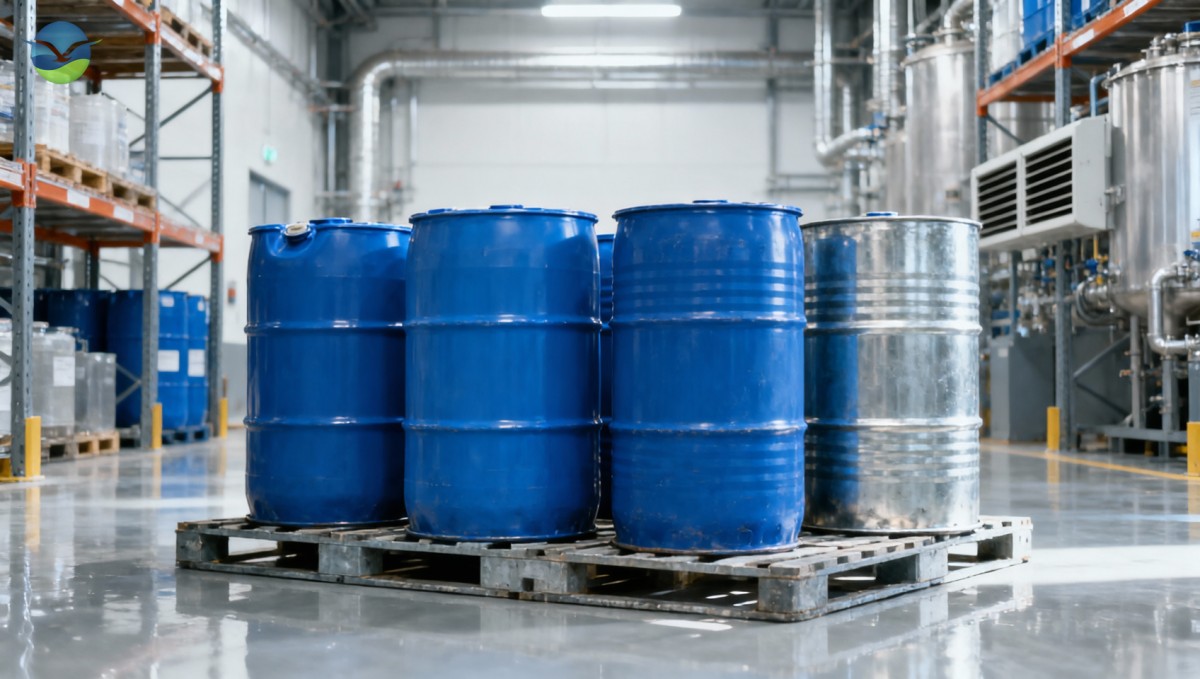
Secondary containment does not prevent a drum from leaking, but it determines whether a leak remains manageable. The containment system should be chemically compatible with the stored solvent, structurally sound, and positioned so that a release does not reach drains, doorways, soil, or traffic routes.
Plastic spill pallets are useful for many solvent packages, but their material compatibility must be checked. A pallet that softens, cracks, or warps under prolonged contact with a solvent creates a second failure. Steel containment may be suitable in other circumstances, provided corrosion and chemical compatibility are managed. Grating should support the drum safely and allow inspection of the sump below; hidden liquid in a containment tray should never be treated as normal.
Capacity requirements vary by jurisdiction, site permit, and chemical inventory. Rather than relying on a universal number, set containment capacity according to applicable local rules and the largest credible release scenario. A single drum bay needs enough capacity for the relevant drum failure; a shared area must also account for the number of containers and the possibility of accumulated rainwater or fire-suppression water where applicable.
Containment should not become a permanent storage basin for spilled solvent, rainwater, or mixed residues. Liquids in the sump can obscure new leaks, increase vapor levels, degrade the containment material, and complicate waste classification. Remove accumulated liquid through an approved waste-handling process after identifying what it contains. Never discharge it to a drain merely because it appears to be water.
Control corrosion from the outside in
External corrosion is commonly caused by the storage environment rather than the solvent inside the drum. Drums stored directly on concrete are especially vulnerable because concrete can hold moisture against the lower chime. Repeated wetting and drying, condensation, poor drainage, and washdown water accelerate deterioration at exactly the point that is hardest to see.
Store drums on racks, pallets, grating, or other supports that keep the base clear of standing water and allow visual inspection. Wood pallets may retain liquid and can be unsuitable in flammable-liquid areas or where contamination control is critical. Select support materials according to the fire, load, drainage, and compatibility conditions of the storage location.
Outdoor storage introduces further problems: ultraviolet exposure can degrade labels and some plastics; rain can collect around closures; temperature swings can drive condensation; and windblown debris can damage drum surfaces. Where outdoor storage is necessary, use a purpose-designed covered area with stable flooring, drainage control, ventilation, and protection from direct weather. A tarp laid directly over drums often traps moisture and prevents inspection; it is not equivalent to a properly designed shelter.
Labels must remain readable throughout storage. Replace damaged labels promptly using the site’s approved identification process. A drum that cannot be reliably identified should not remain in ordinary inventory. The temptation to identify it by appearance, odor, or location is unsafe, especially where several clear or similarly colored solvents are handled.
Temperature and ventilation protect both product and people
Temperature affects drum integrity in two ways. It changes vapor pressure inside the container, and it can change the physical behavior of the container material. Heating increases pressure in closed drums and can increase vapor losses when a drum is opened. Very low temperatures may make certain plastics less impact-resistant or alter a product’s viscosity and handling characteristics.
Keep solvent drums away from direct sunlight, steam lines, heaters, hot process equipment, and other sources of localized heat. “Room temperature” should not be interpreted as permission to store a drum next to a warehouse wall that receives intense afternoon sun. The relevant condition is the actual temperature at the drum, not the nominal temperature elsewhere in the building.
Ventilation should prevent flammable or harmful vapors from accumulating, particularly in dispensing rooms, enclosed stores, low points, and areas with limited air movement. General ventilation may not be sufficient where solvent vapor generation is expected. Local rules, the SDS, and hazardous-area engineering requirements determine when mechanical ventilation and ignition-controlled equipment are needed. Fans should not be selected casually: equipment used in flammable-vapor areas may need to meet the site’s applicable electrical classification requirements.
Segregate solvent drums from oxidizers, strong acids, strong bases, reactive materials, and any substances identified as incompatible by the SDS. Physical distance, separate containment, fire-rated separation, or dedicated rooms may be appropriate depending on the chemicals and local requirements. The goal is to prevent a leak or fire from bringing incompatible materials together.
Use an inspection routine that can detect gradual damage
A useful inspection is not a quick count of containers. It should identify changes in condition. The frequency depends on the material hazards, turnover rate, storage environment, and site procedures, but the inspection points remain practical:
- Check for wetness, stains, drips, crystals, discoloration, or solvent odor around bungs, taps, seams, and chimes.
- Look for dents, punctures, rust, blistered coatings, bulging heads, softened plastic, cracks, or distorted closures.
- Verify that labels, hazard markings, batch identification, and receiving dates remain legible.
- Inspect pallets, racks, containment sumps, and floor surfaces for damage, pooled liquid, corrosion, and blocked drainage.
- Confirm that access routes, emergency equipment, and spill-response materials are not obstructed by excess inventory.
- Review whether partially used drums are properly closed and whether any containers have exceeded the site’s permitted holding period.
Inspection records are valuable when they lead to action. A repeated note such as “minor rust at bottom rim” should trigger correction of the storage condition, not months of repeated notation. Move affected drums safely, inspect the containment area, address moisture sources, and evaluate whether nearby containers face the same exposure.
First-in, first-out inventory control also reduces risk. Older drums are more likely to experience label deterioration, seal aging, corrosion, and uncertainty about product condition. The receiving date, opening date, and retest or expiry information should be available without moving multiple containers. Avoid storing unneeded drum quantities simply because floor space is available.
Transfer operations often create the damage discovered in storage
Many storage leaks begin during dispensing. Leaving a funnel in place, failing to wipe threads before resealing, using a mismatched pump adaptor, overtightening a plastic closure, or returning a contaminated bung can compromise a drum that was intact on arrival. Use dedicated transfer equipment where cross-contamination matters, bond and ground equipment when handling flammable liquids as required by the operation, and reseal the drum immediately after transfer.
Do not return unused solvent to the original drum unless the procedure explicitly allows it and contamination has been ruled out. A small amount of incompatible residue can alter product quality, damage the package, or create an unrecognized reaction hazard. The same caution applies to reused empty drums. An “empty” solvent drum can contain hazardous vapor and residue; it requires controlled handling, labeling, and disposal or reconditioning under the applicable rules.
Storage requirements differ sharply between liquid solvents and solid chemical raw materials. For example, PVC Resin Polyvinyl Chloride Raw Material is normally supplied as a white powder or particulate material in 25 kg bags and is stored at room temperature away from light. Its dry-bag storage needs do not justify using the same assumptions for drums of volatile liquid solvent. Packaging form, vapor pressure, closure design, and incompatibility profile determine the controls—not the fact that both materials are used in chemical processing.
When a damaged drum is found
Do not wait for a routine collection round if a drum shows active leakage, severe corrosion, swelling, or closure failure. Stop nearby work if needed, keep ignition sources away where flammability is possible, prevent the release from entering drains, and use the site’s spill-response process. Personnel should wear the protective equipment specified for the solvent and task. Moving a leaking drum without overpacking, containment, or a planned transfer arrangement can turn a small leak into a larger release.
For a slow leak, the immediate priorities are containment, identification, and controlled transfer into a compatible salvage drum or other approved recovery package. The replacement container must be compatible with the solvent and capable of being closed securely. Record the original container identification so that batch tracking, waste determination, and investigation remain possible.
The most effective chemical solvent drum storage program is built around early detection and prevention. Keep containers compatible, upright, protected from impact and moisture, inside suitable containment, away from heat and incompatible chemicals, and visible enough to inspect. When these controls are maintained together, leaks and corrosion are more likely to be corrected while they are still packaging issues rather than operational incidents.
Please give us a message
Send Us Your Inquiry Today
Scalable production and one-stop R&D, manufacturing, sales & after-sales services.