






How moisture in PC resin raw material affects molded part strength
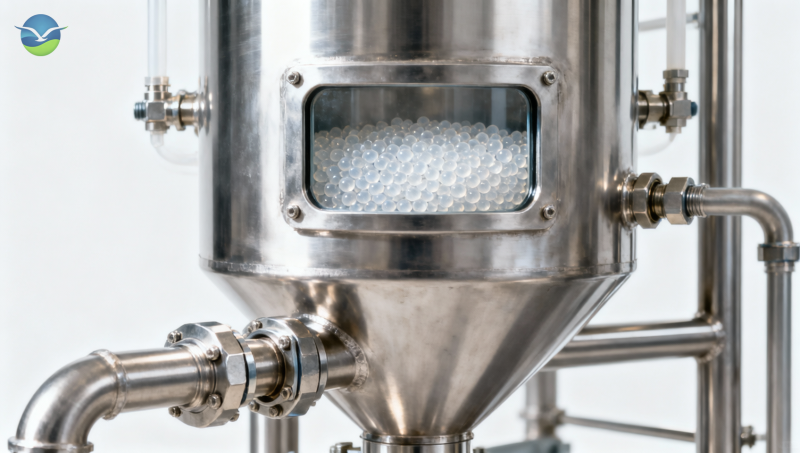
A polycarbonate housing can leave the mold with an acceptable surface and still crack during assembly or fail an impact test. Moisture in the pc resin raw material is one possible cause: at molding temperatures, absorbed water can break polymer chains through hydrolysis, reducing molecular weight and weakening the material. The damage may appear as reduced toughness or premature brittle failure rather than an obvious molding defect.
The first response should be to verify pellet moisture at the machine feed, then check drying and material transfer against the specific grade’s processing instructions. A clear surface does not prove that PC was dry enough, and drying already degraded material cannot restore its original strength. Separating moisture damage from stress, contamination, and excessive thermal exposure is essential before changing the molding cycle.
Moisture changes the polymer, not just the surface
PC is hygroscopic: it absorbs water from surrounding air into the pellets. This is different from surface condensation, although both can introduce water into processing. Pellets may look dry and flow normally while containing enough absorbed moisture to create problems when melted.
At elevated processing temperatures, water can cleave carbonate linkages in the polymer backbone. The resulting shorter chains provide less resistance to deformation and crack propagation. Impact performance and elongation can be particularly sensitive; tensile strength alone may not reveal the full loss of toughness.
The effect depends on moisture content, melt temperature, residence time, and the grade itself. Wet material held hot for an extended period faces a different degradation risk from correctly dried resin processed within its approved window. Raising barrel temperature to improve filling can make a moisture-related problem worse by increasing thermal exposure.
There is no reliable universal percentage of strength loss per unit of moisture. Geometry, molecular weight, additives, reinforcement, and test conditions all influence the result. A measured moisture value helps assess processing readiness; it does not independently predict the finished part’s strength.
Read the symptoms without treating them as proof
Silver streaks, splay, bubbles, and occasional foaming can direct attention toward moisture. However, similar surface defects can arise from trapped air, volatile contamination, or unsuitable processing conditions. Conversely, hydrolytic degradation may occur without conspicuous streaking.
A change in flow behavior is supporting evidence, not a moisture measurement. Melt flow testing can help compare suspect and reference material, but its own conditioning and test procedure must be controlled. A higher melt flow rate cannot, by itself, distinguish hydrolysis from other causes of molecular degradation.
Measure at the point where the material enters production
A moisture result from an unopened bag does not describe pellets after drying, conveying, and waiting in a machine hopper. For troubleshooting, sample material as close as practical to the machine feed while following the site’s safe sampling procedure. Seal the sample promptly in a suitable moisture-tight container and minimize exposure before testing.
Use a method capable of measuring the low moisture levels relevant to PC. Oven-assisted Karl Fischer analysis is commonly used for polymer moisture determination when the extraction conditions are validated. The selected oven temperature must release water without causing decomposition that distorts the result.
A general-purpose loss-on-drying balance may not have adequate sensitivity or selectivity at the required level. It measures mass loss, which can include substances other than water. Use it for release decisions only when the method has been demonstrated suitable for the grade and acceptance limit.
Some PC processing guides specify a maximum residual moisture of approximately 0.02% by mass, or 200 ppm. Treat this as a commonly encountered reference, not a limit for every PC formulation. The resin supplier’s current technical guidance and the approved production specification take precedence, particularly for blends, filled grades, and specialized applications.
Record the sample location, sampling time, resin lot, dryer conditions, and measurement method. Without these details, two moisture results may reflect different handling histories rather than a meaningful difference between resin lots.
Make the drying recipe work in the actual hopper
Successful drying requires the right combination of temperature, dry-air quality, airflow, and time. A controller showing the correct temperature confirms only one part of that system. The pellets must actually reach the required conditions and remain there long enough for absorbed water to diffuse out.
For many conventional PC grades, supplier instructions commonly use drying temperatures around 120°C with several hours of drying. These are orientation values, not a production recipe. Some formulations require different conditions, and excessive heat or prolonged exposure can create additional problems. Follow the grade-specific temperature, duration, and maximum exposure guidance.
- Check actual pellet-zone temperature. Compare the dryer display with verified measurements at relevant locations. Heat loss, poor circulation, or sensor placement can leave the resin cooler than expected.
- Verify drying-air quality. Desiccant systems commonly operate with supply-air dew points near −40°C, but the required condition depends on the equipment and resin guidance. Check sensor location, calibration, regeneration performance, and air leaks.
- Confirm airflow through the material. Blocked filters, obstructed distributors, or an unsuitable hopper fill level can prevent uniform drying even when the displayed dew point is satisfactory.
- Match residence time to throughput. Increasing machine output without increasing effective drying capacity can send insufficiently dried pellets to the barrel.
- Release by verified moisture where required. A completed timer cycle is not proof that unusually wet incoming material has reached the acceptance limit.
Nominal hopper capacity divided by material consumption gives a rough residence-time estimate, but it assumes usable capacity and orderly flow. Channeling or uneven material movement can allow some pellets to leave sooner. Check drying capacity at the highest planned consumption rate, not only during a slow startup.
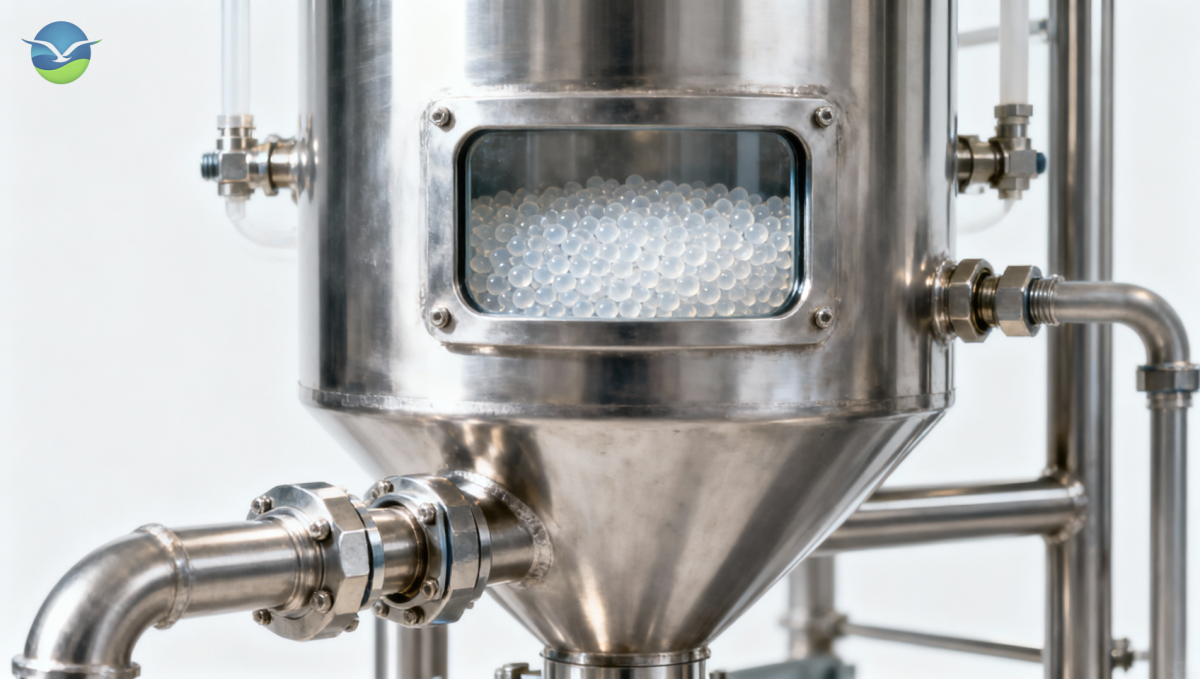
Drying problems can also appear after a stoppage. Material remaining in the dryer may have accumulated excessive heat exposure, while resin elsewhere in the feed system may have absorbed moisture. Restart decisions should account for both locations rather than treating all material in the system as equally conditioned.
Keep dried PC dry until it reaches the screw
Open bins, uncovered hoppers, and long transfers through humid air can undermine an otherwise effective drying process. Reabsorption rate depends on ambient humidity, temperature, exposure time, and pellet characteristics; there is no single safe open-air waiting period for every plant.
Use closed conveying and an appropriately controlled hopper arrangement where required. Inspect lids, seals, loader connections, and transfer hoses. Check whether conveying air can reintroduce moisture, especially when the machine hopper is distant from the dryer.
Partly used bags should be resealed using packaging suitable for moisture protection, then identified with their opening and handling history. A label saying “previously dried” is not enough to release material after uncontrolled storage. Recheck or redry it according to the approved procedure.
Regrind needs separate attention. It may arrive with a different moisture history, contain fines, and already have experienced thermal processing. Drying removes water but does not reverse previous chain scission. Control regrind proportion and handling, and confirm that its use is permitted for the application.
Run a controlled check before changing the whole process
When weak parts appear, changing drying temperature, injection speed, packing pressure, and barrel settings together obscures the cause. Begin with containment: identify affected production, retain representative parts and material samples, and record the settings and handling history.
Then use a comparison that isolates moisture as far as practical:
- Confirm the resin grade, lot, colorant, and regrind content. Check for mixed material or an undocumented formulation change.
- Measure moisture in the current machine-feed material using the approved method.
- Prepare a controlled quantity of the same grade using the supplier’s drying instructions, and verify its moisture before molding.
- After the approved changeover procedure has displaced suspect material, mold comparison parts using documented, stable conditions.
- Evaluate the relevant failure mode using consistent test conditions, rather than judging only by appearance.
Improved performance with verified dry feed supports moisture as a contributor, especially when other variables remain controlled. It does not automatically establish the acceptability of earlier production. Release or rejection should follow the applicable part specification and quality procedure.
If weakness persists, examine actual melt temperature, barrel residence time, screw recovery conditions, and extended interruptions. Then investigate weld lines, gate location, packing, mold temperature, sharp features, assembly loading, and chemical contact. Dry resin cannot compensate for excessive residual stress or an unfavorable load path.
Keep material-specific limits separate
A plant processing several engineering plastics should not apply one moisture rule to every resin. For example, Polyamide PA6 PA66 Engineering Plastic Raw Material belongs to the nylon family, not polycarbonate. PA6 and PA66 are used for components such as gears, bearings, and electrical parts, but their drying requirements and moisture-dependent mechanical behavior require separate specifications. They are not drop-in remedies for moisture-related PC failures.
This distinction also matters in testing. Moisture absorbed by a finished nylon part can change its stiffness and toughness; that behavior should not be confused with hydrolytic chain damage occurring while wet PC is molten. Use the correct material identity, conditioning procedure, and acceptance criteria for each comparison.
For repeated PC strength failures despite verified dry feed, request grade-specific processing guidance and consider laboratory comparison of suspect and reference material. Molecular-weight or rheological analysis can help investigate degradation, while part testing establishes performance under the required loading conditions. Preserve moisture records and processing history alongside the samples: drying the remaining pellets later cannot reconstruct their condition when the failed parts were molded.
Please give us a message
Send Us Your Inquiry Today
Scalable production and one-stop R&D, manufacturing, sales & after-sales services.