






How glycerin manufacturers maintain consistency between production batches
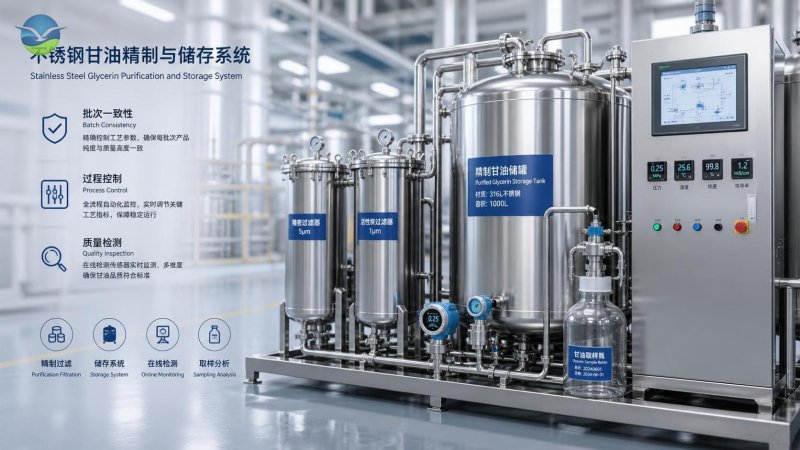
For quality control and safety teams, batch-to-batch consistency is not a cosmetic purchasing preference. It is a control point that can affect formulation performance, cleaning validation, finished-product release, workplace handling, and customer compliance. Whether glycerin is used as a humectant, solvent, processing aid, carrier, or intermediate, a small shift in composition can show up later as viscosity variation, odor, color change, microbial concern, unexpected water balance, or a failed incoming inspection.
A capable glycerin manufacturer does not create consistency simply by issuing a certificate of analysis. Stable quality is built through controlled feedstocks, defined process windows, representative sampling, analytical discipline, documented change control, and traceability that survives a customer audit. For buyers, the practical question is therefore not “Does this lot meet a headline purity number?” It is “Can the supplier demonstrate that the process, specifications, and release system will keep the material fit for our actual use?”
Purity is necessary, but it is not the full quality profile
Glycerin, also called glycerol, is often purchased against a familiar assay requirement such as 99.5% or 99.7%. That number matters, but it can conceal differences that are operationally important. The remaining fraction may include water, inorganic salts, residual organic matter, fatty-acid-derived materials, methanol or other process-related residues, and trace contaminants associated with the feedstock or refining route. A high assay alone does not establish equivalence between two batches or two suppliers.
Quality teams should first define the intended-use profile. A technical-grade material for an industrial formulation may tolerate a different impurity profile from material intended for food, pharmaceutical, oral-care, personal-care, or highly sensitive chemical processing. In particular, requirements concerning color, odor, ash, water, specific gravity, chloride, sulfate, heavy metals, aldehydes, microbial limits, and residual process contaminants should be determined by the application and the governing customer or regulatory standard, rather than copied from a generic supplier sheet.
For regulated uses, references such as the applicable pharmacopeial monograph, food standard, or customer-approved specification may be relevant. Their current editions, regional applicability, and testing methods should be verified by the buyer before they are written into a supply agreement. A supplier statement that material is “pharma grade,” “food grade,” or “cosmetic grade” should be treated as a starting point for qualification, not as a substitute for a mutually agreed specification and supporting evidence.
Feedstock control determines what refining must remove
Commercial glycerin can originate from oleochemical processing, biodiesel production, synthetic routes, or other industrial streams. These routes can all produce suitable material when properly refined, but they do not begin with the same impurity burden. Crude glycerin derived from biodiesel, for example, may contain methanol, soap, catalyst salts, free fatty acids, and organic residues that require robust separation and purification. Oleochemical routes may present a different profile of fatty matter and color-forming substances.
This is why “same CAS number” is not a sufficient incoming-risk assessment. The identity of glycerin is straightforward; the route-specific impurity profile is where qualification work begins. A manufacturer seeking stable batches should define approved feedstock sources, incoming acceptance criteria, storage controls, and segregation rules. Material that falls outside the accepted feedstock range should not simply be blended into production in the hope that final refining will correct it.
Buyers do not necessarily need every proprietary detail of a supplier’s process. They do need enough visibility to judge whether the manufacturer understands the risk. Useful questions include whether feedstock origin is controlled, whether there are supplier approval procedures, how mixed feedstocks are managed, and which impurities are monitored because of the chosen production route. A reluctance to discuss all process details is understandable; an inability to discuss risk controls is more concerning.
One specific area deserves heightened attention: contamination control for materials used in food, pharmaceutical, personal-care, and other sensitive applications. Historical industry incidents have shown that identity testing alone may not detect all economically motivated adulteration risks. Risk-based screening for relevant contaminants, secure raw-material sourcing, and documented traceability are more meaningful safeguards than reliance on appearance or density alone.
Standardized processing means controlling the process window
Consistency is maintained in the plant by controlling variables that affect separation efficiency and final composition. Depending on the process, these can include neutralization conditions, filtration performance, activated-carbon treatment, evaporation temperature and vacuum, distillation parameters, residence time, and final water adjustment. A manufacturer should establish operating ranges rather than depend on individual operator judgement or end-of-line correction.
In-process testing is important because a final COA only confirms the sample tested at release. It does not explain whether the batch passed through a stable and reproducible process. Appropriate in-process checks may cover concentration, pH where relevant, conductivity, color, water content, odor observations, and process-specific impurity indicators. Trending these values over time helps reveal gradual drift before a batch reaches an out-of-specification condition.
Blending can be a legitimate method for achieving a uniform commercial batch, provided it is controlled and documented. It should not be used to obscure weak process capability or to dilute nonconforming material without a justified quality decision. The distinction matters in supplier audits: controlled blending has defined inputs, validated mixing, traceable batch records, and release testing; uncontrolled blending mainly transfers uncertainty downstream.
Sampling and testing must represent the material actually shipped
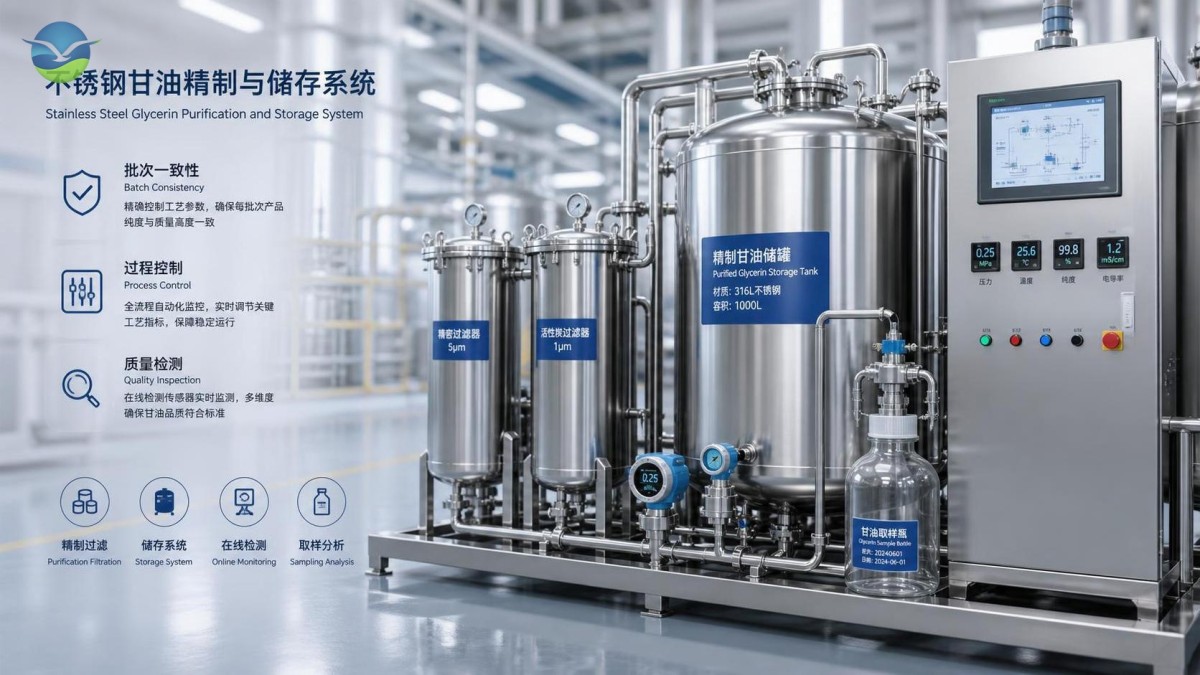
Glycerin is hygroscopic. It can gain moisture if containers are poorly sealed, if transfer lines are exposed to humid air, or if tanks are inadequately protected during storage and loading. Because water affects assay, density, and formulation calculations, sampling practices are not a minor laboratory detail. Samples should be representative of the batch, collected using clean equipment, protected from contamination, and linked unambiguously to the production lot and packaging lot.
For bulk shipments, buyers should understand whether the COA reflects the manufacturing tank, the final storage tank, the loading stream, or a retained composite sample. The preferred approach depends on the supply arrangement, but the sampling point should be clear. A COA generated before transfer may not fully represent material after a long storage period or a complex loading operation.
Analytical methods also matter. Assay by a recognized method, water determination, color measurement, specific gravity or relative density, ash, and targeted impurity tests should have defined methods, acceptance limits, and appropriate calibration controls. A result without a method reference can be difficult to compare across suppliers or laboratories. When a critical attribute is close to a limit, quality teams should consider method precision, laboratory uncertainty, and whether a retain sample is available for investigation.
COA and SDS serve different decisions
A certificate of analysis is a batch-specific release document. It should identify the lot, product grade, manufacturing or release date as applicable, test results, acceptance limits or specification references, and authorized release information. Its value depends on whether the listed tests match the buyer’s critical quality attributes. A generic COA with only appearance, assay, and water may be adequate for one industrial application and inadequate for another.
A safety data sheet serves a different purpose. It supports hazard communication, transport preparation, storage procedures, exposure controls, spill response, and emergency planning. It is not proof that a particular batch meets a quality standard. Safety managers should review the SDS against actual site conditions, including heated handling, transfer methods, confined-space considerations, compatible materials, local occupational exposure rules, and waste-management requirements. Classification and transport information may vary by jurisdiction or be updated; the current supplier SDS should be checked rather than assumed to remain unchanged.
The best suppliers keep technical, quality, and commercial documentation aligned. A discrepancy between the product name on the invoice, the grade on the COA, the SDS revision, and the container label is often treated as administrative noise. In an incident, complaint, or audit, it becomes a traceability problem. Purchase specifications should state the required document package and the acceptable timing for receipt, especially when material must be released before it enters production.
Packaging, storage, and logistics can undo good manufacturing control
Even a consistent production batch can become a problematic delivery if the packaging system is not managed. Glycerin should be protected from contamination and moisture ingress, and containers must be suitable for the product, transport route, and planned storage duration. Drums, intermediate bulk containers, and bulk tankers each introduce different risks: residual material from previous use, poor valve hygiene, damaged seals, incorrect labeling, temperature-related handling issues, or partial-container exposure during repeated withdrawals.
Incoming inspection should be scaled to risk. A low-risk, well-established supplier relationship may rely on periodic verification and document review. A new supplier, a new grade, a route change, a bulk shipment, or a sensitive application may justify identity confirmation, water testing, appearance checks, and selected impurity screening before release. The goal is not to duplicate every supplier test forever. It is to establish enough independent evidence that the supplier’s controls can be trusted and that changes will be detected.
For overseas supply, delivery consistency also includes communication speed and document control. A dual-location model can be useful when a foreign-trade team manages quotations, sample coordination, shipping documents, and post-sales responses while the production site controls manufacturing and laboratory release. Qixiang Chemical describes this arrangement through its Wuxi customer-engagement operation and its Shandong production base. For a buyer, the relevant due-diligence point is not the location itself, but whether responsibilities are clearly assigned: who approves specifications, who issues the COA, who responds to a deviation, and who can provide traceability records without delay.
Change control is the test of a mature supplier relationship
Many supply disruptions begin with a change that was not considered material by the supplier: a new feedstock source, alternate processing aid, revised purification step, different container, laboratory method update, production-site transfer, or logistics route change. The final batch may still meet the old specification, yet behave differently in a customer’s formulation or trigger a documentation gap.
A quality agreement should therefore define which changes require prior notification, what lead time is expected, and what evidence must accompany the notice. The right threshold depends on application risk. For a tightly controlled formulation, buyers may require notification and approval before changes affecting manufacturing site, feedstock category, test method, specification, packaging, or shelf life. For less sensitive industrial use, notification may be sufficient, but it still needs to reach the people who can assess the impact.
Complaint handling should be equally specific. When a batch is questioned, the supplier should be able to retrieve the retained sample, production records, raw-material history, test data, shipment details, and any related deviations. A prompt replacement shipment can resolve a commercial problem, but it does not replace root-cause analysis when the material has entered a regulated or safety-sensitive process.
How to qualify a glycerin manufacturer without over-auditing
The most effective qualification program concentrates on risk rather than accumulating documents. Begin by defining critical attributes in terms of the actual process: what can cause a formulation failure, a safety issue, a regulatory concern, or a customer complaint? Then compare those attributes with the supplier’s specification, methods, process controls, and change-notification commitments.
- Request representative COAs from multiple recent lots, not only a single ideal sample.
- Review lot numbering and traceability from finished product back to feedstock and packaging.
- Confirm the methods and reporting limits for application-critical impurities.
- Assess whether incoming-test results show meaningful trends rather than isolated pass/fail values.
- Verify that the SDS, label, transport documentation, and quality documents are current and consistent.
- Conduct a risk-based technical review or audit when the intended use is sensitive, volumes are large, or supplier changes are planned.
Cross-material discipline is valuable here. A company that purchases glycerin alongside formulation inputs such as Silicone Oil Polydimethylsiloxane Raw Material should avoid treating each supplier document as an isolated record. Storage compatibility, container cleanliness, product identification, and change communication should be governed by one incoming-material control system, even though the analytical risks of glycerin and PDMS are different.
In the end, consistency is demonstrated by repeatable evidence: stable trends, representative testing, controlled deviations, clear ownership, and reliable traceability. The glycerin manufacturer that can provide those controls gives quality and safety teams something more useful than a high purity claim: a defensible basis for releasing material into the next batch of their own process.
Please give us a message
Send Us Your Inquiry Today
Scalable production and one-stop R&D, manufacturing, sales & after-sales services.