






News Center
Why polyamide resin pellets need drying before molding
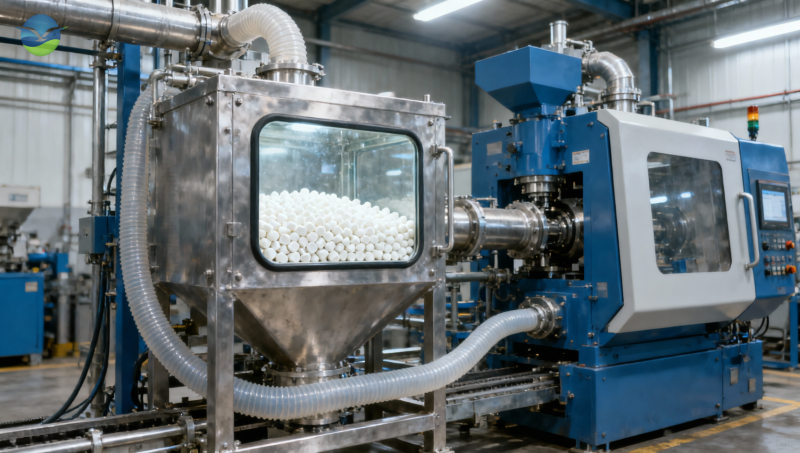
Polyamide resin pellets are highly hygroscopic, meaning they draw moisture from the surrounding air during storage, transport, and routine handling. For an operator standing beside an injection molding machine, the pellets may look perfectly normal—clean, free-flowing, and dry to the touch—while carrying enough absorbed water to affect the next production run. That is why drying is not a minor preparation step for PA6 or PA66. It is a core part of controlling molded-part quality.
When wet polyamide enters a hot barrel, moisture does more than turn into steam. At processing temperature, it can react with polymer chains and reduce molecular weight. The result may appear as silver streaks, bubbles, rough surfaces, discoloration, inconsistent dimensions, brittle sections, or lower mechanical performance. In demanding applications such as gears, bearings, automotive components, electrical devices, and structural mechanical parts, these defects are not merely cosmetic.
What happens when moisture enters the molding process?
Polyamide contains chemical groups that attract water molecules. Unlike a material that only holds water on its surface, PA6 and PA66 can absorb moisture into the pellet structure. A bag opened on a humid day can gradually take on moisture even when the pellets are stored indoors. Pellets transferred to an open hopper, left in a feed line, or returned from an unsealed container may also absorb moisture before molding begins.
Inside the plasticizing barrel, the resin is exposed to high heat and shear. If the moisture level is too high, water vapor expands rapidly. This can leave tiny voids or visible marks in the melt and in the final part. More importantly, moisture may promote hydrolysis: a chemical breakdown of the polyamide molecular chains. Shorter chains generally mean lower melt strength and reduced mechanical properties.
The operator may notice several symptoms at once:
- Silver streaks or splay marks radiating from the gate area;
- Small bubbles, internal voids, or a porous fracture surface;
- A dull, uneven, or unusually rough molded surface;
- Excessive flashing or unstable flow behavior caused by lower melt viscosity;
- Parts that pass visual inspection but show reduced impact resistance or tensile performance;
- Greater variation from shot to shot, especially during long production cycles.
These signs can be confused with poor venting, excessive barrel temperature, contamination, or injection settings. Those factors certainly matter, but changing machine parameters cannot repair resin that has already absorbed too much moisture. If drying has been skipped or handled inconsistently, the process window becomes unnecessarily narrow.
Drying protects more than the part surface
A common mistake is to judge dryness only by appearance. If streaks disappear after a temperature adjustment, an operator may assume the issue has been solved. Yet hydrolytic degradation may still be occurring inside the melt. The part can look acceptable when it leaves the mold but perform poorly later under load, vibration, wear, or heat.
This matters especially for polyamide resin pellets used in functional parts. PA6 and PA66 are chosen because they offer tensile strength, abrasion resistance, and useful chemical stability. Those advantages depend on preserving the resin’s structure through processing. A gear with reduced toughness, a bearing with unstable wear behavior, or an automotive connector with inconsistent dimensions can create far more trouble than a visible surface defect.
Drying also improves process repeatability. Properly conditioned material tends to show more stable melt viscosity, filling behavior, packing response, and part weight. That does not eliminate the need for good mold design and correct processing conditions, but it gives the operator a dependable starting point. Instead of repeatedly adjusting temperatures, pressure, and cycle time to chase a changing result, the team can troubleshoot from a more controlled baseline.
PA6 and PA66: similar concern, different drying discipline
Both PA6 and PA66 need moisture control, but they should not be treated as identical materials. Grade formulation, reinforcement, pigments, recycled-content level, and the manufacturer’s processing guidance can change the recommended drying method. A filled or modified grade may behave differently from a standard unfilled resin, even when the base polymer is the same.
PA6 is widely used for injection-molded mechanical parts, films, fibers, and general engineering applications. PA66 is often selected where higher heat resistance and stiffness are required. In either case, resin should be dried according to the supplier’s technical data sheet, rather than relying solely on a standard setting used for another nylon grade.
In practical terms, a desiccant dryer is usually preferred because it supplies low-dew-point air and helps remove absorbed moisture efficiently. Hot-air ovens may be less reliable when the incoming air itself contains moisture or when airflow is uneven. Drying time and temperature must be balanced: insufficient drying leaves water in the pellets, while excessive temperature or unnecessary residence time can contribute to discoloration, oxidation, agglomeration, or avoidable energy use.
The best question is not, “What temperature do we always use for nylon?” It is, “What moisture condition does this specific grade require before it enters this process?”
A practical workflow from sealed bag to machine hopper
Good drying begins before the dryer is switched on. Start by checking the package condition. Torn inner liners, loose closures, damaged cartons, and pellets exposed during warehouse handling all increase the chance of moisture uptake. For production planning, it is helpful to open only the quantity needed for the scheduled run instead of opening multiple packages in advance.
Once opened, the material should move promptly into a clean, properly functioning dryer. Avoid adding fresh pellets directly onto partially dried material without knowing their condition. Mixing material with different exposure histories can make the actual moisture level difficult to predict.
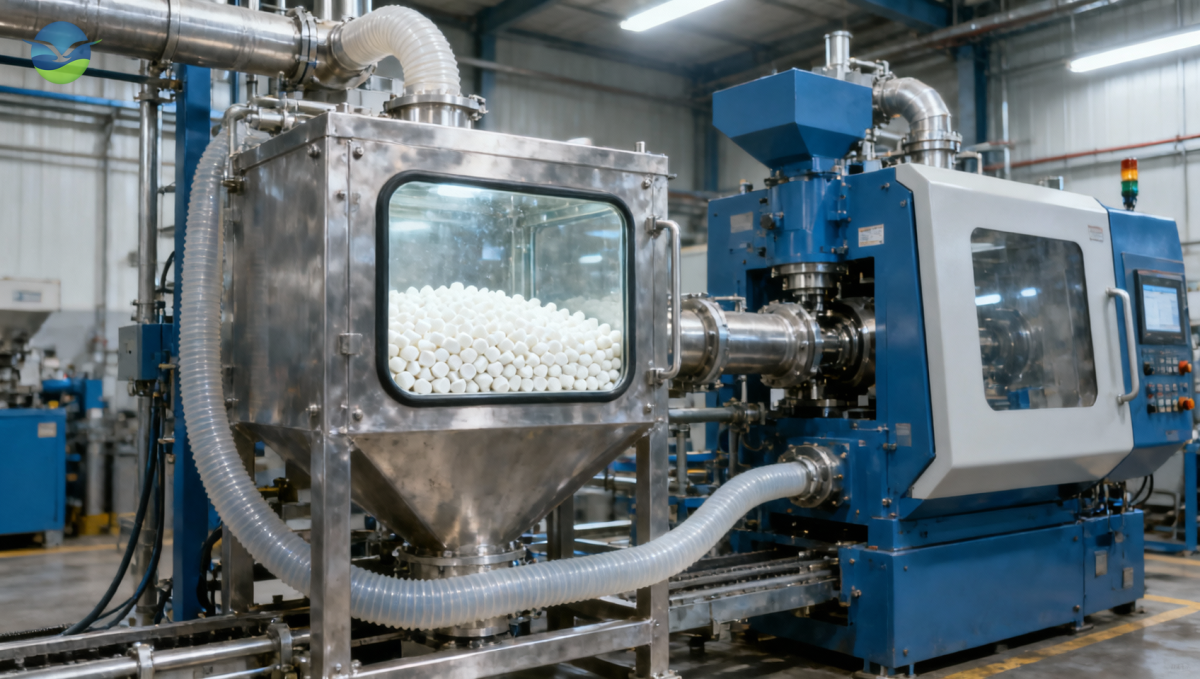
After drying, keep the path to the molding machine as closed as possible. A sealed hopper or dry-air conveying system is preferable to leaving resin in an open container beside the press. In humid environments, pellets can begin to reabsorb moisture surprisingly quickly. A well-run drying process can lose its benefit during the last few meters of material transfer.
Operators should also pay attention to dryer loading. Overfilling the hopper may reduce air contact and create uneven drying. Underloading may cause material to remain at high temperature longer than necessary. Confirm that air filters are maintained, airflow is unobstructed, and the dryer is operating at the intended dew point. A display showing the correct temperature does not automatically prove that drying performance is adequate.
Useful checks before production starts
- Verify the resin grade, lot identification, and supplier drying guidance.
- Inspect the packaging and note whether the bag was previously opened.
- Confirm dryer temperature, drying time, airflow, and desiccant condition.
- Use a moisture analyzer where available, particularly for critical parts or after a process interruption.
- Make sure dried pellets are transferred through sealed or protected equipment.
- Record drying conditions with the production batch so repeated defects can be traced.
Moisture testing is especially valuable when operators are dealing with unexplained quality variation. Visual inspection alone is reactive: it finds a problem after molding begins. A moisture measurement provides a more direct check before resin is melted. The exact acceptable moisture level should come from the material supplier’s specification for the relevant grade and application.
Why machine settings are not a substitute for drying
When bubbles or streaks appear, it is tempting to reduce barrel temperature, increase back pressure, slow injection, or alter mold temperature. These changes can sometimes reduce the visibility of moisture-related defects, but they do not restore polymer chains that have already been degraded. In some cases, increasing temperature or residence time can make hydrolysis more severe.
Likewise, stronger mold venting is important for releasing trapped air, but it cannot remove moisture already dissolved in the resin. The distinction matters in troubleshooting. Trapped air generally depends on mold filling and vent design; absorbed water originates in the material and must be addressed before plasticization.
A simple diagnostic approach is to compare material from a verified drying cycle with material from the existing hopper, while keeping the molding conditions as consistent as possible. If the properly dried sample produces clearer surfaces and more stable processing, the evidence points toward moisture control rather than an immediate mold redesign.
Handling regrind and production interruptions
Regrind deserves special attention because it often has a more complicated moisture history than virgin pellets. Sprues, runners, rejected parts, and startup scrap may sit in open bins before being ground. Their surface area can increase after granulation, making exposure more significant. If regrind is allowed by the material and part specification, it should be kept clean, clearly identified, and dried according to the same disciplined approach as virgin material.
During a machine stoppage, do not assume resin remaining in the hopper is still ready for use. The answer depends on how long it has been exposed, whether the hopper is sealed and supplied with dry air, and how humid the environment is. A short interruption under protected conditions may require only routine checks. An extended stop with an open hopper may call for re-drying before restarting.
For operations molding safety-related, load-bearing, or electrically sensitive components, conservative handling is often the more economical choice. The cost of re-drying material is usually smaller than the cost of sorting questionable production, remolding parts, or investigating a field-quality concern.
Material quality and drying work together
Even the most carefully maintained dryer cannot compensate for inconsistent incoming resin. Operators need clear grade identification, stable supply, and documentation that supports traceability. For processors working with PA6 or PA66 in applications ranging from automotive parts to electrical devices and wear-resistant mechanical components, material selection should include practical processing support—not just a property list.
Polyamide PA6 PA66 Engineering Plastic Raw Material can be supplied for injection molding and extrusion-related applications, with PA6 and PA66 options suited to engineering uses such as gears, bearings, mechanical parts, automotive components, and films. Regardless of the selected grade, the supplier’s COA, MSDS, packaging condition, and grade-specific processing instructions should remain part of the operator’s preparation routine.
Qixiang Chemical coordinates overseas customer communication, sample arrangements, documentation, and after-sales support through its Wuxi foreign trade operations center, while its Shandong production base manages manufacturing, quality testing, and batch supply. For processors, this type of coordination is useful when a new material is being introduced: questions about grade selection, shipment documentation, lot details, and handling recommendations can be resolved before the resin reaches the shop floor.
The real goal is a stable starting point
Drying polyamide resin pellets before molding is not simply about avoiding a few surface streaks. It protects melt quality, reduces the risk of hydrolytic degradation, supports consistent dimensions and mechanical performance, and makes the molding process easier to control. It also gives operators clearer information: when the resin condition is known, machine and mold issues become much easier to identify.
For PA6 and PA66 processing, the most reliable habit is straightforward: keep pellets sealed until needed, dry them using the grade-specific recommendation, protect them from reabsorbing moisture, and document the conditions used. That discipline may feel routine, but it is often the difference between a production run that needs constant adjustment and one that proceeds with confidence.
Please give us a message
Send Us Your Inquiry Today
Scalable production and one-stop R&D, manufacturing, sales & after-sales services.