





Why DMF Is Used in Synthetic Leather Coating and Wet Process Formulations
DMF remains central to many polyurethane (PU) synthetic leather systems because it does more than dissolve resin. Its combination of strong solvency, water miscibility, relatively slow evaporation, and predictable interaction with PU makes it a process-control solvent. In coating formulations, it helps create a smooth, uniform film. In wet-process production, it enables the solvent–water exchange that forms the porous structure associated with many PU leather substrates.
This distinction matters because “DMF for synthetic leather” does not refer to a single application. The same solvent can influence resin dissolution, viscosity, coating leveling, phase inversion, pore formation, drying behavior, residual-solvent control, and solvent-recovery design. A formulation can contain an appropriate grade of PU resin yet still produce uneven coating, poor hand feel, weak adhesion, or unstable porosity if the solvent balance is not properly controlled.
Why PU systems respond well to DMF
Dimethylformamide, commonly abbreviated as DMF, is a polar aprotic solvent with high solvency for many polyurethane resins and related formulation components. PU used for synthetic leather is built from hard and soft segments that must remain uniformly dispersed or dissolved before coating or coagulation. DMF can interact effectively with the polar groups in the polymer chain, helping the resin form a stable solution rather than a gelled, particulate, or phase-separated mixture.
This property is especially useful when the formulation contains pigments, fillers, chain extenders, adhesion promoters, matting agents, or other functional additives. A solvent that dissolves the binder but does not adequately support the overall blend can create local viscosity variation, poor pigment distribution, or surface defects. DMF provides a broad operating window for many established PU systems, which is one reason it has long been used in both base-coat and wet-process lines.
Its boiling point, approximately 153°C at atmospheric pressure, is also relevant. DMF does not flash off as rapidly as highly volatile solvents. That gives the wet coating more time to level before drying and allows the manufacturer to manage film formation with dryer temperature, airflow, line speed, and solvent blend design. Slow evaporation is not automatically an advantage: excessive retention can raise drying demand and residual-solvent risk. But controlled evaporation is valuable when film uniformity matters.
Its role in synthetic leather coating formulations
In a dry coating process, a PU solution is applied to release paper, a transfer carrier, fabric, or an intermediate layer. The coating may later be dried, laminated, embossed, or transferred. Here, DMF primarily supports polymer dissolution and coating rheology.
A coating must have a viscosity suitable for the selected application method. Knife coating, gravure coating, reverse-roll coating, and other systems each require a different balance between flow and body. If viscosity is too high, the coating can show streaks, poor wetting, inadequate coverage, or excessive thickness variation. If it is too low, the film can run, penetrate too deeply into a textile substrate, or lose pattern definition.
DMF gives formulators a way to adjust solids content and flow while retaining the resin in solution. It can also be blended with other solvents to tune drying speed and surface appearance. Faster-evaporating co-solvents may assist early drying; slower components can reduce surface skinning and help avoid defects caused by uneven solvent release. The correct blend depends on resin chemistry, coating weight, substrate absorbency, oven profile, and the performance expected from the finished leather.
Surface quality is not merely cosmetic. A smooth and continuous PU layer can affect abrasion resistance, print definition, water resistance, color consistency, and the adhesion of later topcoats. Premature solvent loss can leave a surface that appears dry while deeper solvent remains trapped. That condition can contribute to bubbles, pinholes, shrinkage, intercoat adhesion problems, or inconsistent embossing response.
Some formulations use silicone-based additives to modify slip, release, foam behavior, or surface feel. Their compatibility must be checked carefully because a material that lowers surface tension can improve coating flow in one system but impair intercoat adhesion in another. For comparison when reviewing raw materials used in adjacent formulation roles, Silicone Oil Polydimethylsiloxane Raw Material is a PDMS-based material used as a lubricant, release agent, defoamer, or additive in several industries. It is not a replacement for DMF: silicone oil and DMF perform fundamentally different functions in a PU leather formulation.
Why DMF is particularly important in the wet process
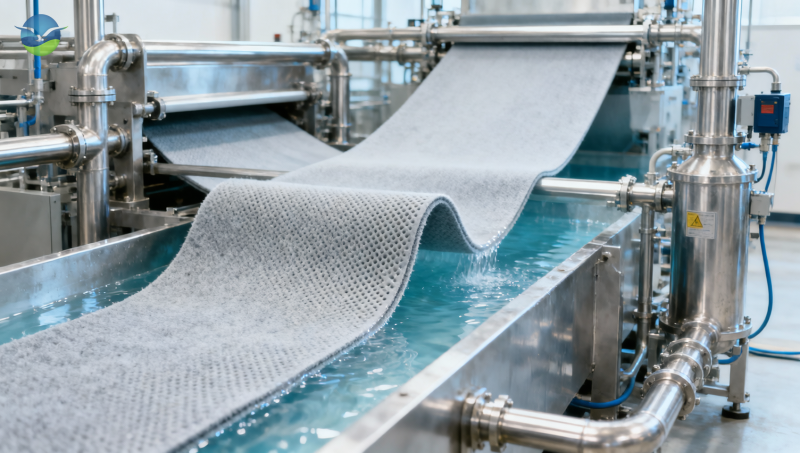
The wet process uses a different mechanism. A PU solution containing DMF is coated onto a textile, nonwoven, or other support and then introduced into a water-based coagulation bath. Water is a non-solvent for the PU, while DMF is miscible with water. As water diffuses into the coating and DMF diffuses out, the dissolved polymer loses solvency and precipitates into a solid network.
This solvent exchange is often called coagulation or phase inversion. It is the basis for forming the microporous layer that gives many synthetic leathers their softness, breathability, bulk, and cushioning character. The structure is not created by DMF alone. It develops from the interaction of resin composition, DMF concentration, co-solvent choice, water-bath conditions, coating thickness, substrate construction, and post-washing conditions. Still, DMF is the transport medium that makes the exchange process workable in many conventional PU systems.
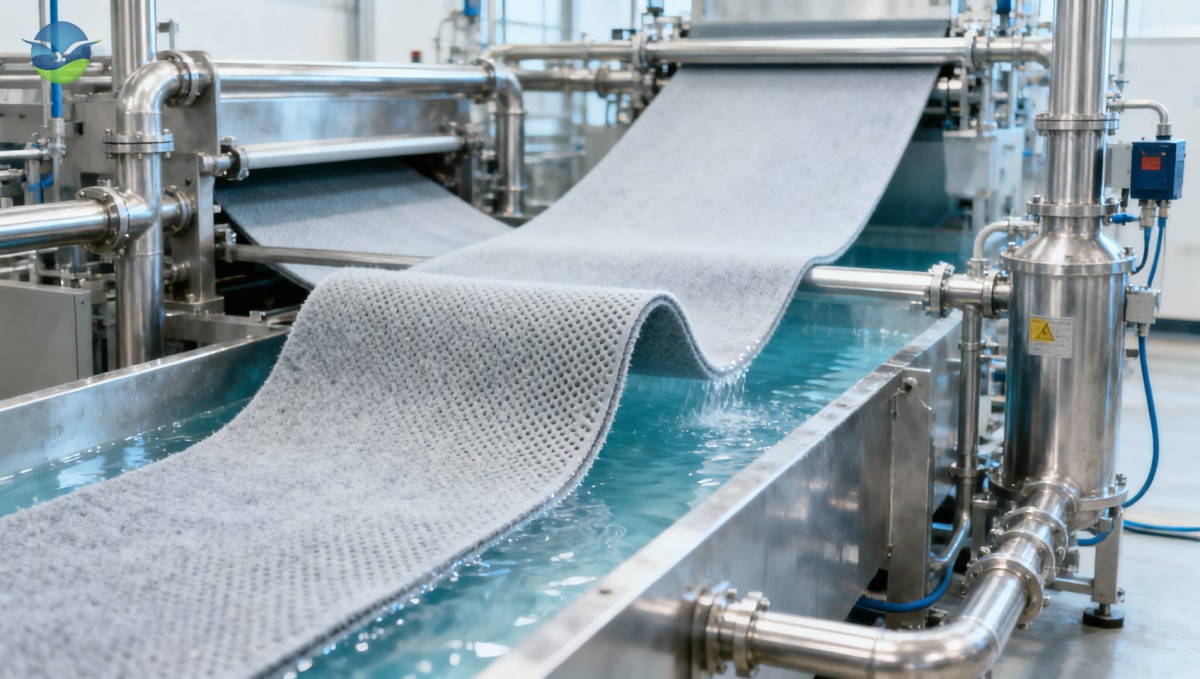
The speed of coagulation has a direct effect on pore morphology. If solvent exchange happens too rapidly, the outer surface can solidify before the inner region develops a uniform network. This may produce a dense skin, irregular voids, weak areas, or a brittle feel. If exchange is too slow, the coating may lose structural definition or require impractically long processing time. The objective is not simply to remove DMF as quickly as possible; it is to control the rate and uniformity of solvent–water exchange.
Bath conditions therefore require close attention. Water temperature, DMF concentration accumulated in the bath, circulation, bath cleanliness, and residence time can all alter the coagulation result. As production continues, extracted solvent increases the DMF content of the bath unless the system is managed through replenishment, recovery, or treatment. A bath with changing composition may shift pore structure even when the coating formulation itself has not changed.
After coagulation, the material must be washed thoroughly to remove remaining DMF and then dried under conditions that preserve the intended structure. Incomplete washing can leave residual solvent in the substrate; overly aggressive drying can cause shrinkage, hardening, curling, or distortion. This is why wet-process quality cannot be evaluated only at the mixing stage. The coating solution, coagulation bath, wash sequence, and dryer settings operate as one connected process.
What DMF contributes beyond simple dissolving power
It is tempting to describe DMF as a “strong solvent” and leave the explanation there. That misses several operational reasons for its continued use.
- Stable PU dissolution: DMF can support homogeneous solutions of many PU grades used in synthetic leather, allowing predictable coating behavior.
- Water compatibility: Its miscibility with water is essential to the wet-process coagulation mechanism.
- Rheology control: It enables adjustment of solids and viscosity without immediately forcing polymer precipitation.
- Film formation time: Its evaporation profile gives a wet coating time to flow and level before final drying.
- Process familiarity: Equipment, recovery systems, operating practices, and resin grades have historically been developed around DMF-based processes.
These advantages explain technical suitability, not an absence of trade-offs. DMF has a high heat demand relative to more volatile solvents, requires effective recovery and workplace controls, and must be removed from finished materials to an appropriate level. A plant without adequate ventilation, containment, washing, drying, and waste-handling capability should not treat solvent selection as a laboratory-only decision.
The relationship between solvent quality and leather quality
For a solvent supplied into synthetic leather production, the most relevant quality questions are often practical rather than promotional. Water content can influence PU solution stability and viscosity. Non-volatile residue may affect film appearance, color, or pore formation. Trace contaminants can matter where a formulation uses sensitive pigments, reactive additives, or light-colored finishes. Batch-to-batch consistency is important because a change in solvent properties can be misread as a resin or process problem.
Purity alone is not the whole specification. A plant should also consider the consistency of the certificate of analysis, packaging integrity, lot traceability, transport conditions, and whether the supplier can provide the safety and technical documentation required for the destination market. In a wet process, a small formulation change can be amplified by the coagulation system; in a coating line, it may appear as a change in viscosity, gloss, leveling, or drying behavior.
Moisture deserves particular attention. DMF is hygroscopic, meaning it can absorb water from the atmosphere. Exposure during storage, transfer, or tank handling can gradually alter the solvent condition. The result may be a viscosity shift, reduced storage stability of some PU solutions, or variation in coating response. Sealed storage, controlled transfer practices, and clear incoming inspection criteria are therefore more meaningful than a nominal purity figure viewed in isolation.
Residual DMF is a process issue, not just a compliance issue
Residual DMF in synthetic leather can affect odor, product acceptability, downstream processing, and regulatory evaluation. The concern is especially significant because DMF is classified in the European Union as a substance of very high concern due to its reproductive toxicity classification. Requirements can differ by market, product category, intended use, and supply-chain agreement, so a universal residual limit should not be assumed without reviewing the applicable legal and customer requirements.
From a manufacturing perspective, residual control begins much earlier than final testing. High initial solvent loading, thick coatings, poor bath exchange, insufficient washing, overloaded dryers, or inadequate air circulation can all contribute to retained DMF. Testing the finished material is necessary, but it does not correct an unstable process. The more useful approach is to connect residual-solvent results to coating weight, solution solids, bath condition, washing efficiency, and drying history.
Solvent recovery also changes the economic and environmental picture. DMF recovered from exhaust streams or wash water may be returned to use only when the recovery system and quality controls maintain suitability for the intended formulation. Recovered solvent with variable water content or impurities can alter processing behavior. Whether virgin and recovered DMF can be blended, and at what ratio, depends on the technical specification of the product being made rather than on a general assumption that all recovered solvent performs identically.
Why substitution is more difficult than it appears
Pressure to reduce hazardous-solvent exposure has led formulators to investigate alternatives, including NMP-free systems, waterborne PU dispersions, alternative polar solvents, and non-DMF wet-process routes. These developments are important, but replacement is not a one-for-one purchasing decision.
Changing from DMF can affect resin solubility, solution viscosity, coagulation kinetics, pore size distribution, drying profile, adhesion, color development, and equipment requirements. Waterborne systems may reduce reliance on certain organic solvents, but they bring different demands involving dispersion stability, drying energy, foam control, substrate wetting, and film formation. A material described as “DMF-free” should therefore be assessed according to the end-use performance and the entire manufacturing route, not treated as automatically equivalent to a conventional DMF-based PU system.
The same principle applies to product claims. A softer hand feel, higher breathability, or lower odor may result from the combined effect of substrate, resin design, coating architecture, topcoat, and process control. Attributing these outcomes solely to the presence or absence of DMF oversimplifies how synthetic leather is made.
The practical meaning of DMF selection
DMF is used in synthetic leather because its chemical behavior aligns with two demanding tasks: keeping PU formulation components workable before application, and enabling controlled polymer precipitation in water during wet processing. Its value lies in controllability. It supports formulation uniformity, coating quality, and porous-structure development when the entire system is correctly designed.
That role also explains why DMF requires disciplined handling. Solvent grade, water content, process recovery, wash efficiency, residual testing, worker protection, and destination-market requirements are all connected to the same material choice. In synthetic leather production, DMF is not simply an input listed on a formulation sheet. It is one of the variables that links resin chemistry to the final surface, structure, safety profile, and consistency of the material.
Please give us a message
Send Us Your Inquiry Today
Scalable production and one-stop R&D, manufacturing, sales & after-sales services.