






What Niacinamide USP Means for Formulators and Quality Control Teams
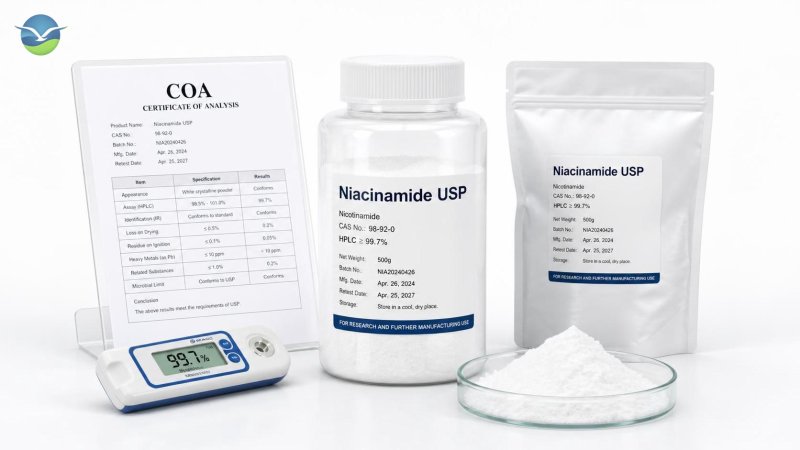
For technical evaluators and quality control teams, “niacinamide USP” is not just a cleaner way of saying vitamin B3. It is a shorthand for a material that is expected to conform to the applicable monograph in the United States Pharmacopeia, with implications for identity, assay, impurities, documentation, and consistency. In practical terms, that affects whether a batch can move into formulation, whether a supplier can pass qualification, and whether an internal deviation becomes a minor paperwork issue or a full containment event.
That distinction matters because niacinamide is used across pharmaceuticals, nutraceuticals, personal care, and some industrial formulations where purity and behavior under processing conditions directly influence product performance. A technical team reviewing niacinamide USP is usually not asking a theoretical standards question. They are trying to answer more operational ones: Is this grade genuinely suitable for our system? Does the documentation support the claim? What failure modes should we monitor? And how much risk sits behind a seemingly simple “USP” label?
What the USP designation actually signals
When a supplier offers niacinamide USP, the claim generally means the material is intended to meet the relevant USP monograph requirements for niacinamide. That typically covers core parameters such as identity and assay, and may include limits tied to related substances or physical characteristics depending on the current compendial text. What it does not automatically mean is that every supply-chain element around the material is equally controlled. A compliant test result is one part of qualification; the robustness of manufacturing, contamination control, change management, packaging integrity, and traceability still require separate review.
This is where technical evaluators often see confusion. Some organizations treat USP as a full quality conclusion. It is better understood as a standards anchor. It tells you which reference framework the material should satisfy, but it does not replace supplier audits, incoming inspection strategy, or application-specific compatibility studies.
For formulators, the value of niacinamide USP lies in predictability. A compendial-grade raw material reduces uncertainty around potency and impurity profile, which in turn helps when building stable formulations or defending specifications in regulated environments. For QC teams, it creates a common basis for release testing and document review. But that advantage only holds if the supplier’s quality system is strong enough to deliver the same quality repeatedly, not just on a qualification sample.
Why technical teams pay close attention to niacinamide, even when the chemistry looks straightforward
Niacinamide is often perceived as a relatively simple, familiar ingredient. That perception can lead to underestimating its evaluation requirements. In reality, the material can create meaningful differences in downstream performance depending on purity, residuals, particle characteristics, and storage history.
In solution-based systems, dissolution behavior and pH interaction may matter. In solid-dose or powder blending applications, particle size distribution and flow can affect uniformity. In personal care formulations, trace impurities, color, and odor can become more commercially significant than teams initially expect. None of these concerns are unique to niacinamide, but the ingredient’s broad use across sectors means the acceptable quality window is not universal.
A niacinamide USP material may be entirely suitable for one application and still create avoidable processing issues in another if the purchaser relies on the compendial claim alone. Technical review should therefore connect the USP basis to the actual use case rather than stopping at certificate matching.
How QC teams should read a niacinamide USP dossier
The first checkpoint is obvious but frequently mishandled: verify what exactly the supplier is claiming. “USP grade,” “meets USP,” and “manufactured according to USP” are not interchangeable phrases in commercial practice. The documentation package should make clear whether the released batch complies with the applicable USP monograph and whether the methods used are aligned with compendial requirements or validated equivalents.
A practical dossier review usually includes:
- Certificate of Analysis with batch-specific values rather than template limits only
- Specification sheet showing the claimed release criteria
- Method references, especially when non-compendial or in-house methods are used
- Manufacturing site information and change control statements
- Stability or retest information
- Safety documentation such as SDS/MSDS
- Statements on allergens, residual solvents, heavy metals, GMO status, or other customer-specific requirements where relevant
The technical risk usually sits in the gaps between these documents. For example, a COA can look acceptable while revealing little about trend stability. A specification sheet may mirror compendial wording but omit tighter internal controls needed for a sensitive formulation. A supplier may provide assay and identity data but be vague on impurity management or packaging controls.
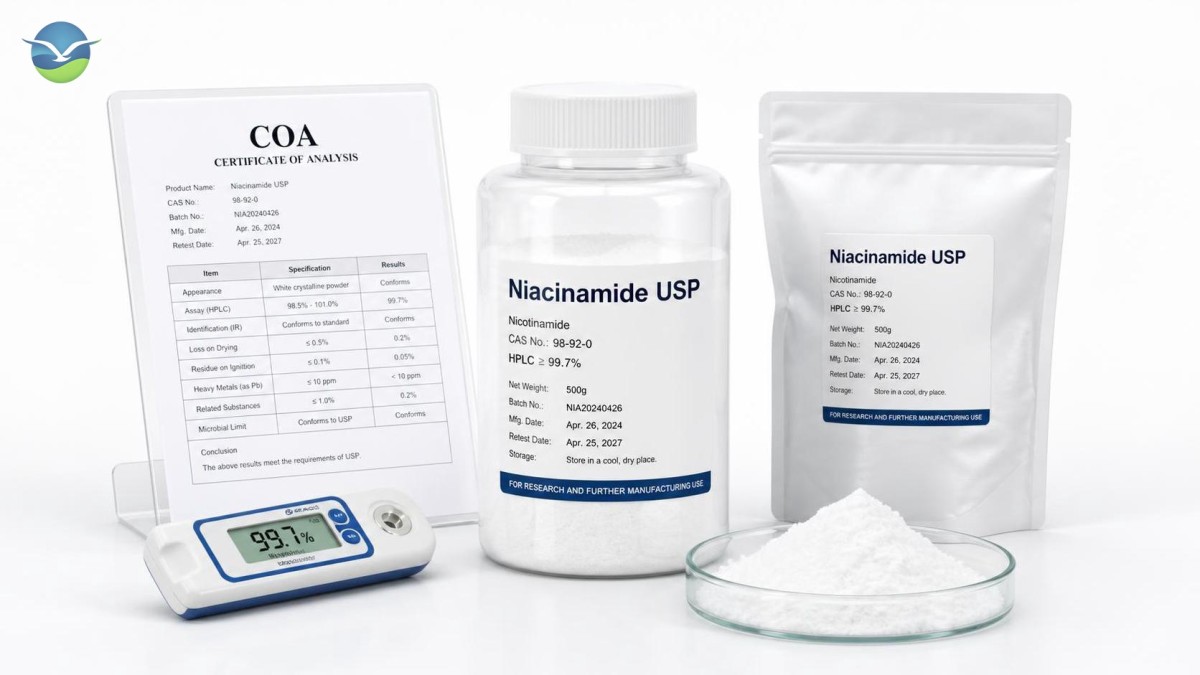
Experienced QC teams therefore review not only whether a batch passes, but how narrow or wide the process appears to be. If historical lots repeatedly sit near specification edges, the material may remain technically “compliant” while still posing elevated formulation risk. That is especially important in long-term sourcing where production scale, raw material shifts, or process optimization can gradually change batch behavior before an official out-of-specification event appears.
Common misunderstanding: USP compliance does not guarantee formulation equivalence
One of the most expensive mistakes in raw material qualification is assuming that two USP-compliant niacinamide sources are functionally interchangeable. They may be, but that conclusion needs evidence. Compendial compliance sets a baseline; it does not always capture every material attribute that influences your process.
Technical teams often need to look beyond monograph items and evaluate:
- Particle size and morphology
- Bulk density and flow properties
- Moisture behavior during storage and transfer
- Dissolution time under actual process conditions
- Color stability in end-product matrices
- Compatibility with actives, excipients, solvents, and packaging
These are the factors that determine whether an alternate source can be introduced without rework, line slowdowns, visual defects, or shelf-life surprises. In regulated or highly standardized manufacturing, this distinction becomes critical. Procurement may focus on equivalent grade claims, while technical teams know that “same standard” is not the same as “same process performance.”
What matters most in supplier qualification
From a technical evaluation standpoint, supplier selection for niacinamide USP should be treated as a capability assessment, not just a pricing exercise. A strong supplier is one that can consistently translate a specification into reproducible batch output, complete records, and responsive issue resolution.
That is why manufacturing and trade support structure both matter in export supply. For overseas buyers, a supplier with a clear division between production and foreign trade operations can reduce execution risk if the coordination is well managed. In practice, teams often value a setup where commercial communication, sample handling, and post-sales documentation are centralized, while production remains at a dedicated source manufacturing base with in-house QC and scalable capacity. This model is common in chemicals and also seen in adjacent raw-material sectors, including materials such as PE Polyethylene Polyolefin Plastic Raw Material, where documentation discipline and batch consistency are just as important as physical product supply.
For niacinamide specifically, technical qualification should examine:
- Whether the production site is the actual manufacturer or a trader-only source
- How raw materials are controlled and released
- Whether the laboratory is capable of the relevant assays and impurity tests
- How deviations, complaints, and change notifications are handled
- Whether the supplier can support both sample-scale evaluation and stable commercial volumes
In cross-border procurement, responsiveness matters more than many teams initially assume. Delays in COA correction, shipping condition clarification, or qualification paperwork can disrupt internal release timelines even when the chemistry is acceptable. For technical evaluators, this is not a soft issue; it is part of supply reliability.
Batch-to-batch consistency is where the real quality picture emerges
A single conforming batch proves very little. Technical teams gain meaningful confidence only after seeing reproducibility across multiple lots and, ideally, across a realistic time window. This is especially relevant when niacinamide is going into validated products, sensitive skincare systems, or high-throughput production environments.
Trend review should include assay distribution, appearance, impurity levels if reported, moisture behavior, and any process-relevant physical characteristics available. If possible, compare commercial batches against qualification samples rather than assessing them in isolation. Some suppliers perform well on initial sample control but show broader variation after scale-up or during periods of feedstock volatility.
Another point frequently missed is packaging’s role in consistency. Niacinamide is generally stable under appropriate storage conditions, but packaging quality still influences caking, contamination risk, and moisture exposure during transport and warehousing. QC teams evaluating overseas supply should review not only the primary specification but also packaging material, sealing method, palletization, labeling discipline, and retest period rationale.
What formulators should ask before approving an alternate niacinamide USP source
For formulation teams, the approval question is rarely “Does it meet USP?” in isolation. A more useful question is “Does it meet USP and behave acceptably in our product and process?” That leads to a more grounded review path.
Before approving a new source, teams typically need to answer:
- Will the material dissolve or disperse at the same rate under current process conditions?
- Does it alter pH adjustment requirements or buffering behavior?
- Does it influence color, odor, or appearance during accelerated stability?
- Are there interactions with preservatives, acids, salts, or packaging components?
- Does the supplier’s typical batch profile fit our internal control limits, not just pharmacopeial limits?
This is where internal specifications become strategically important. Many mature manufacturers set receiving criteria narrower than the compendial standard because the end-product process requires tighter control. That is not overengineering. It is often the difference between smooth production and recurring deviations that appear unrelated until trend analysis connects them back to raw material variation.
Documentation quality is a technical indicator, not just an administrative one
In chemical sourcing, poor documentation often signals broader control weaknesses. If a supplier cannot provide clear, consistent, batch-linked records for niacinamide USP, technical teams should treat that as a quality concern rather than a clerical inconvenience. Errors in lot traceability, inconsistent test references, or vague origin statements can complicate audits, customer complaints, and recall readiness.
Well-managed suppliers usually show discipline across the full chain: inquiry response, sample identification, qualification files, shipping marks, COA issuance, and after-sales follow-up. That operational maturity is relevant whether the product is niacinamide or another industrial input such as PE Polyethylene Polyolefin Plastic Raw Material. For technical buyers, consistent paperwork is often one of the earliest visible signs of a stable system behind the product.
Where technical evaluation should be cautious
Three situations deserve extra scrutiny.
The first is when a supplier emphasizes “USP” heavily but provides limited batch evidence. Marketing language should never substitute for data. The second is when a source appears price-competitive because it is operating with thinner testing, looser packaging control, or weaker post-sale support. The cost reduction may be real, but so is the hidden quality risk. The third is when internal teams assume compendial conformity eliminates the need for application testing. That shortcut tends to fail most often during source transfer projects.
Technical evaluators should also be aware that regulatory, customer, and compendial expectations can evolve. If a procurement program depends on niacinamide USP status, periodic verification of the current monograph basis and supplier alignment is prudent. Where details cannot be confirmed through provided records, the appropriate position is not assumption but “【待核实】”.
What niacinamide USP should mean in a decision context
For formulators and QC teams, niacinamide USP should be treated as a starting framework for trust, not the endpoint of evaluation. It is valuable because it anchors the material to a recognized standard and supports a common language for identity, purity, and release expectations. But the quality decision that matters in production is broader: whether the supplier can consistently deliver a material that meets both the pharmacopeial requirement and the practical demands of the formulation, process, and market being served.
That is why the strongest technical decisions combine compendial review, supplier system assessment, multi-batch evidence, and application-specific verification. When those four pieces align, niacinamide USP becomes more than a label on a specification sheet. It becomes a workable control point in raw material governance.
Please give us a message
Send Us Your Inquiry Today
Scalable production and one-stop R&D, manufacturing, sales & after-sales services.