






How phenol for aspirin intermediates affects downstream conversion
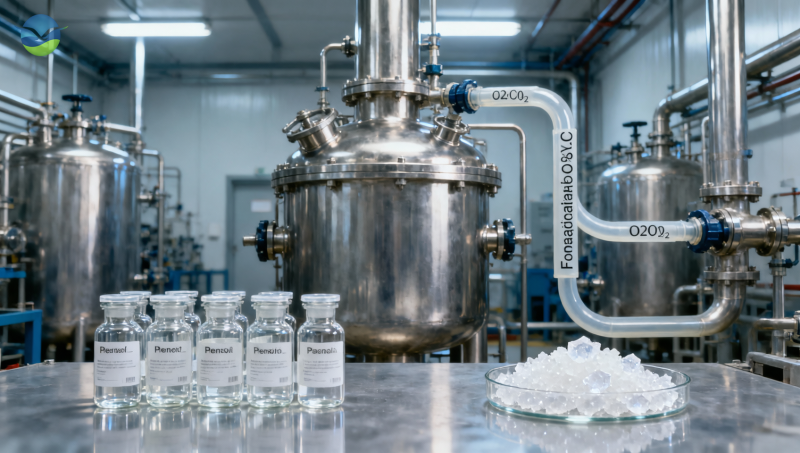
Phenol quality affects aspirin intermediate production most directly at the salicylate-forming stage, where phenol is converted to sodium phenoxide and then carboxylated with carbon dioxide in the Kolbe–Schmitt reaction. A phenol lot can meet a broad commercial assay requirement yet still create problems in conversion if its water content, carbonyl compounds, color-forming impurities, inorganic residues, or handling history are not aligned with the actual process.
The key technical point is that “high purity” is not a complete process specification. For phenol for aspirin intermediates, the useful question is whether a lot delivers predictable sodium phenoxide formation, controlled ortho-carboxylation, clean salicylic acid isolation, and stable acetylation performance downstream. This requires evaluating the impurity profile in relation to reaction conditions rather than relying on assay alone.
Where phenol enters the aspirin intermediate route
The conventional route begins with phenol conversion to sodium phenoxide, followed by reaction with carbon dioxide under elevated temperature and pressure. This produces sodium salicylate, which is acidified to obtain salicylic acid. Salicylic acid is then acetylated, commonly with acetic anhydride, to produce acetylsalicylic acid.
Phenol is therefore not simply consumed as a stoichiometric raw material. Its composition influences the physical and chemical behavior of the reactive phenoxide salt, the carboxylation selectivity, the impurity burden carried into crude salicylic acid, and the purification demand placed on later operations. A specification designed only for resin, solvent, or general chemical applications may not control the attributes that matter in a pharmaceutical-intermediate route.
The primary chemistry also explains why a small deviation can have a disproportionate effect. The Kolbe–Schmitt reaction is sensitive to the condition of sodium phenoxide, carbon dioxide availability, reaction temperature, moisture, and mass transfer. When feed quality changes at the same time as these variables, root-cause analysis becomes difficult. A technically useful phenol qualification program should therefore separate raw-material effects from reactor-control effects.
Assay is necessary, but it does not define conversion quality
Phenol assay establishes the amount of active starting material available, but it does not identify what occupies the remaining fraction of the material or how those minor components behave under alkaline, high-temperature carboxylation conditions. A narrow assay range supports mass balance and charging accuracy, yet the same assay result can coexist with substantially different impurity patterns.
For example, aromatic co-components may enter the process as chemically related substances that are difficult to separate from salicylic acid derivatives. Oxidized compounds can contribute color, alter side-reaction pathways, or raise the load on decolorization and recrystallization. Trace inorganic contaminants may become more important when phenol is converted to an alkali salt, especially where filtration, corrosion control, or final residue limits are demanding.
A robust incoming specification should distinguish between:
- phenol assay and identity;
- water content;
- color or color-forming tendency;
- individual related organic impurities where process-relevant;
- nonvolatile residue or ash, where justified by the process;
- metal contamination when downstream quality requirements make it relevant;
- physical appearance, crystallization condition, and packaging integrity.
The appropriate limits cannot be selected by copying a generic phenol certificate. They need to be linked to the conversion process, purification capability, intended salicylic acid grade, and the impurity-control strategy for the final acetylsalicylic acid product.
Water changes more than the calculated phenol concentration
Water is among the most consequential variables in phenol handling for this route. It affects the effective concentration of phenol, the stoichiometry of caustic addition, the composition and handling behavior of sodium phenoxide, and the operating window of the carboxylation system.
In a controlled process, caustic is calculated against phenol content and adjusted for known water contribution. If water is underestimated, the process may experience inconsistent salt formation or a shift in solids behavior. This does not necessarily mean that every wet lot will fail conversion; the impact depends on the charging method, solvent system, reactor design, dehydration capacity, and temperature profile. The issue is that unmeasured or variable water introduces uncertainty exactly where consistent phenoxide preparation is required.
Moisture also matters during storage and transfer. Phenol is often handled in a heated liquid state because its melting point is close to typical ambient temperatures. Tank breathing, poorly controlled heating systems, contaminated transfer lines, and unsuitable sampling practices can introduce water after the supplier’s release test. A representative sample taken at receipt is therefore more useful than treating the supplier COA as a complete description of the received material.
Karl Fischer titration is normally the preferred analytical basis when low-level water control is important. The method should be validated for the phenol matrix and applied with a sampling plan that addresses phase condition, tank stratification risk, and heated-transfer safety.
Trace organics can influence selectivity and purification burden
The desired carboxylation product is associated with ortho substitution, but reaction conditions may also form para-hydroxybenzoic acid and other by-products. Phenol feed impurities do not act independently of this inherent selectivity challenge. They can add chemically similar species that survive initial processing or complicate the impurity pattern of crude salicylate.
Cresols are a useful example of why a single total-impurity figure is insufficient. Their alkyl substitution changes reactivity and can generate carboxylated derivatives outside the intended salicylic acid profile. Depending on the downstream analytical method and purification train, these compounds may be detectable as distinct impurities, may contribute to broader chromatographic complexity, or may concentrate in mother liquors. Their significance must be judged against the actual salicylic acid and aspirin quality targets, not only against an upstream phenol commodity standard.
Carbonyl-containing impurities and oxidation products are another concern. Phenol can discolor through oxidation during storage, especially where air exposure, elevated temperature, metal contact, or extended residence time are poorly controlled. Color itself is not always a direct predictor of conversion yield, but it is often a practical warning that the material or its handling history differs from the validated state. If color excursions correlate with higher carbon treatment, lower crystallization efficiency, or unstable product appearance, the investigation should look beyond the visible color number and identify the responsible chemical fraction.
Batch consistency matters more than a one-time “pass” result
For a production route that has been optimized around a defined phenol source, the greatest risk may be lot-to-lot movement within the supplier’s accepted range. A batch can remain within release limits while still shifting water, trace cresols, oxidation indicators, or residue levels enough to affect downstream control limits.
This is why technical evaluation should compare multiple representative lots rather than qualifying a supplier from one sample. The objective is not merely to confirm that phenol can produce salicylic acid once. It is to establish whether normal batch variation remains compatible with the process capability of sodium phenoxide preparation, carboxylation, acidification, purification, and acetylation.
The salicylic acid stage is where upstream variation becomes visible
Not every defect in phenol is apparent during phenoxide preparation. Some become visible only after carboxylation and acidification, when crude salicylic acid is isolated. Shifts in crude color, filterability, mother-liquor profile, crystallization behavior, or related-substance chromatograms can all signal that the raw-material profile has changed.
It is important not to assign every salicylic acid deviation automatically to phenol. Carbon dioxide purity, pressure control, reactor temperature, sodium phenoxide quality, acidification pH, activated carbon use, crystallization solvent composition, and wash efficiency can each influence the result. The technical value of raw-material monitoring lies in making such investigations tractable. When retained phenol samples, lot-specific test results, and process records are available, it becomes possible to examine correlation instead of relying on assumption.
Salicylic acid purity also affects the acetylation step. Residual phenolic impurities, water, colored compounds, and inorganic residues can influence reaction behavior or create a larger downstream purification burden. Since acetylation is often treated as a relatively straightforward conversion, there is a tendency to focus quality control at the salicylic acid release point. That control remains essential, but it should not replace upstream phenol qualification. Preventing impurity introduction is generally more controllable than removing a complex impurity mixture after carboxylation.
Analytical methods should answer process questions
Gas chromatography is commonly suitable for phenol assay and volatile or semi-volatile related aromatic compounds, provided the method has adequate resolution for the impurity profile under consideration. Water should be measured separately rather than inferred from assay balance. Color testing can be useful as a release or trend parameter, but it should not be treated as a chemical identity test. Ash or residue methods may be appropriate where inorganic carryover has been identified as a relevant risk.
For materials intended for pharmaceutical intermediate manufacture, the analytical package should be scientifically connected to the control strategy. A long certificate with many unlinked tests is not automatically stronger than a focused package containing identity, assay, water, relevant organic impurities, appearance, traceability, and method references.
Method comparability deserves attention when changing suppliers. A supplier result and an internal result can differ because of sampling temperature, sample preparation, chromatographic conditions, reference standards, integration rules, or reporting thresholds. Before interpreting small numerical differences as a material-quality change, laboratories should establish whether the methods are genuinely comparable.
Supplier qualification is also a change-control issue
A phenol source should be assessed as part of the manufacturing system, not merely as a commercial input. The qualification record should identify manufacturing origin, production route where relevant, packaging type, storage requirements, transport conditions, batch traceability, and the supplier’s notification practice for changes that may affect impurity profile.
Cross-border supply introduces additional variables: transit duration, temperature exposure, terminal handling, bulk-tank cleaning status, and document consistency. Phenol can solidify during shipment or storage if temperature control is inadequate. Remelting must be managed carefully to avoid localized overheating, prolonged thermal exposure, or contamination introduced during transfer. Technical release procedures should define acceptable heating conditions and the point at which re-sampling is required after abnormal logistics events.
In multi-product chemical supply chains, material identification must remain unambiguous. Products with unrelated functions and specifications should never be treated as interchangeable simply because they are common industrial chemicals. For example, Glycerin Vegetable Glycerol Raw Material is a vegetable-derived glycerol used as a humectant, solvent, and conditioning material in applications such as personal care, food, and pharmaceuticals; it has no role as a replacement for phenol in the salicylate route. Clear segregation of specifications, storage instructions, containers, and documentation prevents such basic but consequential material-control errors.
What a fit-for-process phenol specification should accomplish
The most effective specification does not attempt to eliminate every detectable impurity. It establishes limits for attributes that can change reaction performance, impurity purge, safety, equipment reliability, or final intermediate quality. It also defines how those limits are measured and what happens when a new lot differs materially from the qualified baseline even while remaining within specification.
For phenol for aspirin intermediates, this normally means connecting incoming controls to conversion data: phenoxide preparation behavior, carboxylation yield and selectivity, crude salicylic acid profile, purification demand, and acetylation performance. Where a clear relationship is demonstrated, a raw-material parameter belongs in the control strategy. Where no relationship exists, adding a restrictive limit may only create unnecessary supply risk without improving product quality.
The downstream effect of phenol is therefore best understood as a chain of controllable dependencies. Assay supports stoichiometry; water affects phenoxide preparation; trace organics influence impurity formation and purge; oxidative condition can affect color and purification; and lot consistency determines whether a validated reaction window remains dependable. Treating those dependencies as part of one conversion system provides a more reliable basis for technical approval than a generic purity claim.
Please give us a message
Send Us Your Inquiry Today
Scalable production and one-stop R&D, manufacturing, sales & after-sales services.