






How moisture content in pp pellets affects melt flow during extrusion processing
Time:Sep 12, 2026
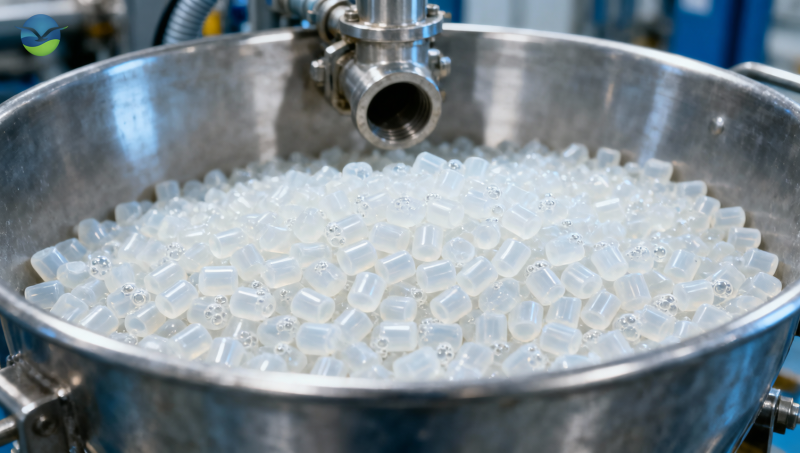
Moisture content in PP pellets is not a secondary concern—it directly governs melt stability, pressure consistency, and surface integrity during extrusion. Operators routinely attribute surging output, die lip buildup, or inconsistent gauge to screw wear, temperature profile errors, or screen pack clogging. Yet when moisture exceeds 0.05% w/w—well below the visual or tactile detection threshold—it initiates hydrolytic chain scission at processing temperatures (180–240°C), reducing molecular weight and altering melt rheology before the polymer even reaches the die.
This degradation isn’t uniform. It begins in the feed throat, where residual moisture vaporizes rapidly under compression, forming microvoids that coalesce into macro-bubbles downstream. These bubbles don’t just cause surface splay or pinholes—they disrupt melt homogeneity, destabilize pressure transducers mounted near the die, and induce cyclic fluctuations in line speed as the extruder’s drive compensates for variable melt resistance. Field data from over 30 extrusion lines across Asia and Europe show that moisture-related downtime spikes most frequently between 2nd and 4th shifts—precisely when ambient humidity rises and storage protocols lapse.
The root issue lies in how moisture interacts with polypropylene’s semi-crystalline structure. Unlike hygroscopic polymers such as nylon or PET, PP does not absorb water into its bulk matrix. Instead, moisture adheres to pellet surfaces and resides in interstitial voids formed during granulation and packaging. Standard drying protocols often misfire here: hot-air dryers set at 80°C for 2 hours may remove surface moisture but leave trapped interstitial water intact—especially in high-density, low-porosity pellets produced via underwater pelletizing. Vacuum-assisted drying at 60°C for 4 hours achieves deeper penetration, but only if pellets are loaded loosely and airflow isn’t restricted by overfilling hoppers.
More critically, moisture doesn’t act alone. Its effect compounds with thermal history. A batch dried correctly but stored in non-climate-controlled warehousing for 72 hours—particularly in coastal or monsoon-affected regions—can reabsorb up to 0.12% w/w within 48 hours. That level triggers measurable MFR (melt flow rate) increases of 8–12% at 230°C/2.16 kg, shifting viscosity curves outside process windows calibrated for nominal resin specifications. This explains why identical screw configurations and barrel profiles yield different outputs across batches—even when COAs report “within spec” MFR values. The discrepancy isn’t in the reported number; it’s in the unmeasured moisture-induced depolymerization occurring *during* extrusion.
Process engineers often overlook two diagnostic indicators: first, a gradual rise in backpressure without corresponding increase in melt temperature—a sign of volatile generation from hydrolysis rather than thermal degradation; second, inconsistent die swell ratios across consecutive runs using the same formulation and tooling. Both point to altered chain entanglement density, not equipment drift.
Controlling moisture requires intervention at three distinct stages—not just drying. Pre-drying verification matters: use calibrated Karl Fischer titration on *in-line* samples drawn directly from the hopper, not lab-stored reserve vials. In-process monitoring helps: inline NIR sensors positioned pre-barrel can detect moisture shifts ≥0.03% w/w with <2-second latency, allowing real-time feed-rate adjustment before melt instability manifests. Post-extrusion validation is essential: measuring MFR on extrudate—not raw pellets—reveals actual in-process rheological change. A 10% MFR increase in extrudate versus raw material signals active hydrolysis, regardless of initial pellet moisture reading.
At Qixiang Chemical, moisture control is embedded in production architecture—not layered on top. Pellets exit Shandong’s granulation lines into nitrogen-purged silos, then undergo dual-stage vacuum drying (60°C/4h + 40°C/2h under 5 mbar) before metallized barrier packaging. Each batch carries traceable moisture data logged at three points: post-drying, pre-packaging, and post-shipment retest. This enables operators to correlate extrusion anomalies with specific moisture trajectories—not just endpoint values. Wuxi’s technical support team accesses this data in real time during troubleshooting calls, eliminating guesswork around whether an issue stems from resin, machine, or environmental factors.
One common misconception is that “low-MFR PP grades are more moisture-sensitive.” In practice, higher-molecular-weight resins exhibit greater viscosity drop per unit moisture gain—not because they absorb more water, but because their longer chains are more vulnerable to end-chain cleavage. A 0.07% moisture level may shift a 3 g/10 min grade by 15%, while the same moisture level shifts a 25 g/10 min grade by only 4%. The operator sees this as erratic output from high-viscosity material, not as a moisture-driven rheology shift.
Another overlooked factor is additive interaction. Antioxidants like Irganox 1010 decompose faster in moist, high-temperature environments, accelerating chain scission. Calcium stearate, used as a processing aid, reacts with liberated carboxylic acids from hydrolysis to form insoluble soaps—contributing to die buildup independent of thermal degradation. These secondary reactions mean moisture content affects not just flow, but also long-term tooling maintenance cycles and scrap rates.
For applications demanding tight dimensional control—such as thin-wall medical tubing or precision automotive trim—moisture variability accounts for over 60% of first-article failures traced to extrusion, according to internal failure-mode analysis across 12 OEM supply chains. Consistency isn’t achieved by drying once; it’s sustained through closed-loop handling: desiccant-fed conveying systems, humidity-monitored drying hoppers (<30% RH), and immediate processing post-drying (ideally within 90 minutes).
 In cosmetic-grade formulations requiring polymer carriers—like those incorporating Niacinamide Vitamin B3 Cosmetic Raw Material into thermoplastic elastomer delivery systems—moisture-induced MFR shifts compromise active ingredient dispersion uniformity. Even minor viscosity changes alter shear history in the melt zone, affecting particle distribution and final release kinetics. Here, moisture control isn’t about part aesthetics—it’s about functional consistency.
Ultimately, moisture in PP pellets behaves less like an impurity and more like a reactive process variable—one that modifies rheology dynamically, invisibly, and irreversibly during extrusion. Treating it as a static specification to be met pre-shipment misses the operational reality: its impact emerges only under processing conditions, and its consequences compound across time, temperature, and mechanical stress. The most effective control strategy acknowledges this—it combines verified pre-process moisture levels, real-time in-line detection, and empirical correlation between extrudate rheology and final part performance—not just pellet test reports.
In cosmetic-grade formulations requiring polymer carriers—like those incorporating Niacinamide Vitamin B3 Cosmetic Raw Material into thermoplastic elastomer delivery systems—moisture-induced MFR shifts compromise active ingredient dispersion uniformity. Even minor viscosity changes alter shear history in the melt zone, affecting particle distribution and final release kinetics. Here, moisture control isn’t about part aesthetics—it’s about functional consistency.
Ultimately, moisture in PP pellets behaves less like an impurity and more like a reactive process variable—one that modifies rheology dynamically, invisibly, and irreversibly during extrusion. Treating it as a static specification to be met pre-shipment misses the operational reality: its impact emerges only under processing conditions, and its consequences compound across time, temperature, and mechanical stress. The most effective control strategy acknowledges this—it combines verified pre-process moisture levels, real-time in-line detection, and empirical correlation between extrudate rheology and final part performance—not just pellet test reports.
Please give us a message
Jiangsu Qixiang Chemical Technology Co., Ltd.
Phone : +86 15052287583
WhatsApp : +86 15052287583
WeChat : +86 15052287583
Send Us Your Inquiry Today
Scalable production and one-stop R&D, manufacturing, sales & after-sales services.