






How PDMS silicone oil volatility affects vacuum applications
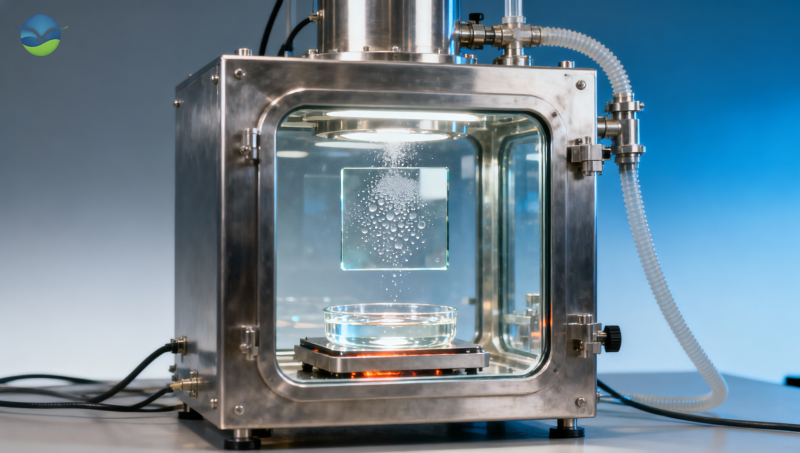
A vacuum chamber may reach its target pressure when empty, then become slow to stabilize after a silicone-containing assembly is installed. The oil may look unchanged, and its viscosity may still meet specification. Yet small quantities of volatile siloxanes can create a persistent gas load or deposit on colder surfaces.
For technical evaluators, selecting PDMS silicone oil therefore requires more than comparing viscosity. Vapor pressure at operating temperature, low-molecular-weight siloxane content, exposed surface area, and application-specific outgassing all matter. Conventional evaporation-loss data can help screen materials, but it rarely answers the complete vacuum compatibility question.
The practical objective is not simply to find an oil described as “low volatility.” It is to establish whether a particular grade, batch, and preparation process can satisfy the system’s pressure, cleanliness, and thermal requirements.
What actually leaves PDMS silicone oil under vacuum?
Polydimethylsiloxane, or PDMS, consists of a silicon–oxygen backbone with methyl groups attached to silicon. Commercial silicone oils contain a distribution of molecular sizes rather than one uniform molecule. Depending on synthesis and finishing, that distribution can include lower-molecular-weight linear chains and cyclic siloxanes.
These lighter constituents generally have greater volatility than the larger polymer chains. Under reduced pressure, they can leave the liquid surface and enter the chamber. Dissolved gases, absorbed moisture, and contamination introduced during handling can also contribute to the initial gas load, although these are not the same as evaporation of the silicone itself.
Three mechanisms should be distinguished:
- Evaporation: volatile constituents transfer from the liquid into the gas phase.
- Desorption and degassing: previously absorbed or dissolved species are released during pumpdown or heating.
- Thermal degradation: excessive thermal exposure generates new volatile products through chemical changes.
This distinction matters because the corrective actions differ. Degassing may reduce an initial pressure spike, but it cannot make an unsuitable molecular-weight distribution suitable indefinitely. Likewise, removing light fractions does not prevent degradation if service conditions exceed the material’s thermal capabilities.
Why viscosity is useful—but insufficient
Within a comparable family of PDMS fluids, higher viscosity often indicates a higher average molecular weight and tends to accompany lower volatility. That makes viscosity a useful preliminary screening parameter, not a vacuum performance specification.
Two oils with the same nominal viscosity can contain different amounts of low-molecular-weight material. An oil subjected to an effective stripping process may behave differently from another grade whose average viscosity is similar but whose distribution includes a larger volatile fraction.
End-group chemistry, additives, manufacturing history, and storage conditions can further influence behavior. A viscosity value measured at one temperature provides no direct measurement of vapor pressure at the temperature of a heated chamber component.
For a critical application, the question should be: What evidence supports this grade under our operating conditions? That is more useful than asking whether the oil is “high viscosity” or “vacuum grade” without a defined qualification basis.
How volatility changes vacuum performance
Pressure stability and pumpdown
Evaporating material adds a gas load that the pumping system must remove. In a simplified steady-state balance, pressure contribution follows P ≈ Q/S, where Q is gas throughput and S is the effective pumping speed at the chamber. Units must be consistent, and conductance restrictions must be included when determining effective speed.
This relationship explains why the same oil can be acceptable in one installation and troublesome in another. A small exposed quantity near a well-pumped region presents a different burden from a large film behind a restricted flow path. Increasing pump capacity may lower the measured pressure, but it does not necessarily eliminate deposition on sensitive components.
Surface contamination can precede an obvious pressure problem
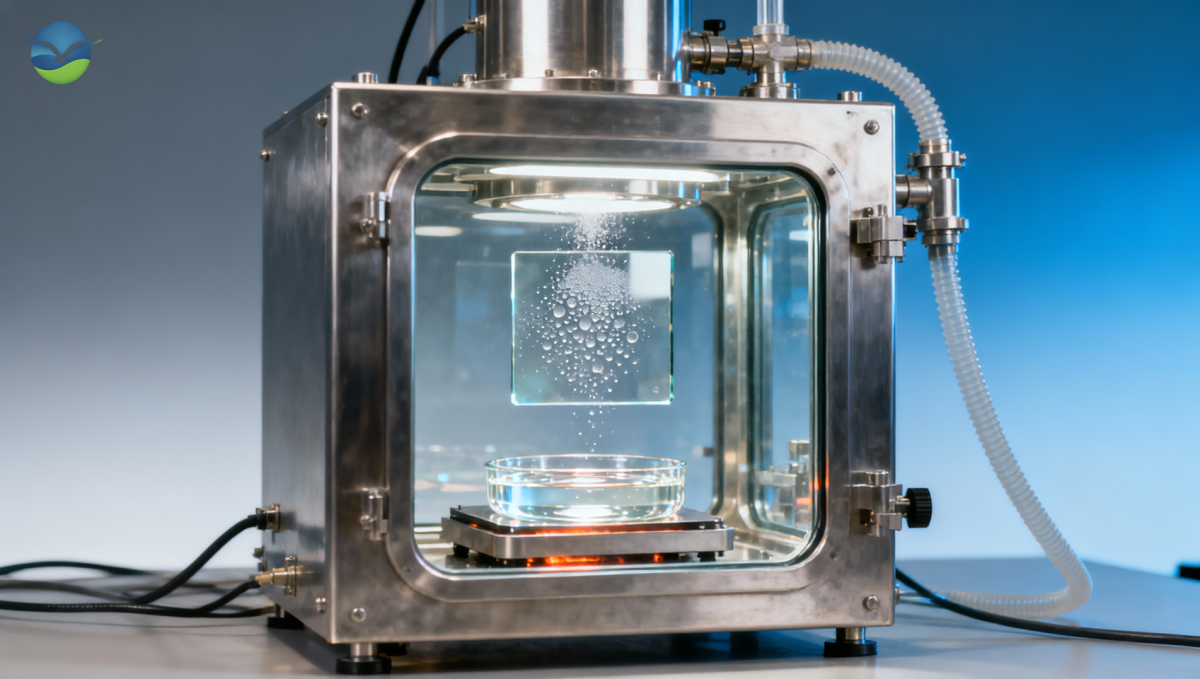
Volatile siloxanes can migrate through the vacuum space and condense or adsorb on cooler surfaces. Optical windows, sensor elements, analytical samples, and coating substrates may be affected even when the total pressure remains within an apparently acceptable range.
Depending on the process, contamination may alter optical transmission, adhesion, electrical behavior, or surface chemistry. In plasma or other energetic environments, deposited silicone species may also undergo further reactions. A satisfactory pressure reading is therefore not, by itself, evidence of satisfactory cleanliness.
The important transport path is from the oil’s exposed surface to vulnerable components, not merely from the oil to the pump.
Temperature can turn a manageable load into a limiting one
Vapor pressure rises with temperature. Qualification at room temperature may miss the behavior of an oil exposed to a hot fixture, repeated thermal cycles, or chamber bakeout. Local hotspots deserve attention because the fluid temperature may exceed the temperature recorded elsewhere in the system.
Prolonged heating may also change composition as lighter species leave preferentially. Outgassing can decrease during conditioning, but that trend should not be extrapolated indefinitely: degradation or contamination may introduce a different release mechanism later.
Why an evaporation-loss result is not a vacuum guarantee
An evaporation-loss percentage is meaningful only alongside its method. Test temperature, exposure duration, pressure, sample mass, exposed area, and vessel geometry all affect the result. A low percentage measured in a bulk sample can still represent too much material for a contamination-sensitive vacuum process.
Atmospheric-pressure heating and vacuum exposure are not interchangeable. Surrounding gas changes mass transport, while vacuum systems introduce different pumping, temperature, and condensation conditions. A result reported without the method cannot support a defensible comparison.
ASTM D972, for example, addresses evaporation loss of lubricating greases and oils under specified conditions. Such data may be useful when the method and material applicability are clear, but they should not be presented as proof of high-vacuum compatibility.
ASTM E595 evaluates total mass loss and collected volatile condensable material during vacuum exposure, principally for spacecraft-material screening. It can inform contamination assessment, but its fixed conditions do not reproduce every industrial vacuum process. Any commonly cited acceptance limits belong to the relevant procurement or program requirements; they are not universal PDMS approval criteria.
For liquid oils, confirm sample containment and preparation with the laboratory. Otherwise, spreading, handling loss, or inappropriate sample geometry can complicate interpretation. A standard designation should make the evidence traceable—not replace engineering judgment.
A qualification sequence that separates the risks
A useful evaluation begins with the actual application envelope. Record the required pressure, fluid temperature range, exposure duration, oil quantity, exposed area, pumping arrangement, and nearby contamination-sensitive surfaces. Specify whether the oil is directly exposed to vacuum or isolated behind a barrier.
- Measure the system background. Run the clean fixture without oil through the intended pressure and temperature cycle. Establish background pressure and, where appropriate, residual gas behavior.
- Test a representative oil exposure. Use a realistic quantity, surface area, substrate, and location. Record pumpdown, stabilized pressure, temperature, and behavior during thermal cycling.
- Assess deposits separately. Use suitable witness surfaces or a quartz crystal microbalance where appropriate. Select a detection method and acceptance criterion relevant to the vulnerable component.
- Repeat after any proposed conditioning. Compare as-received and conditioned material without changing other variables. Document conditioning time, pressure, temperature, and handling.
- Check reproducibility. Evaluate repeat samples and, for demanding applications, more than one production lot. A successful single test does not establish batch consistency.
A residual gas analyzer can help investigate evolving species, but interpretation requires care. Fragment patterns can overlap, and instrument background or previous contamination may affect results. Confirm suspected siloxanes with an appropriate analytical method when identification is important to the decision.
Avoid assigning all pressure rise to the oil before checking leaks, seals, fixtures, and chamber history. Silicone contamination from previous work can persist and obscure an otherwise well-designed comparison.
Where PDMS fits—and where another choice may be necessary
PDMS silicone oil can be useful where lubrication, damping, or heat-transfer behavior is needed and the resulting gas load is tolerable. Its suitability depends on the exposure conditions, however, and general-purpose silicone oil should not automatically be treated as a diffusion-pump fluid.
Diffusion pumps require fluids selected for their intended vapor generation, condensation behavior, thermal stability, and system design. Specialty silicone-based pump fluids are not interchangeable with ordinary PDMS grades solely because both contain siloxane chemistry.
For ultrahigh vacuum, precision optics, or highly surface-sensitive processing, a directly exposed PDMS fluid may be unacceptable even after conditioning. Possible responses include isolating the lubricant, reducing exposed area, lowering local temperature, or evaluating another lubricant chemistry or a dry-running design. Alternatives need their own compatibility testing.
The same distinction applies across chemical procurement: general material properties do not establish vacuum suitability. For example, PP Polypropylene Polyolefin Plastic Raw Material is a separate polymer feedstock for applications such as injection molding and extrusion, not a substitute for silicone oil. If a polypropylene component is incorporated into a vacuum assembly, its finished formulation, additives, cleanliness, and temperature limits require independent assessment.
What to request before approving a supply
Ask for grade-specific documentation rather than a generic silicone brochure. A useful review package includes viscosity and its measurement temperature, available vapor-pressure data, evaporation-loss results with complete conditions, information on volatile siloxanes, and relevant thermal limitations. An SDS supports safe handling but is not a vacuum performance certificate.
A batch COA should identify the supplied lot and the properties actually tested. If vacuum-critical attributes are not routine release criteria, agree on additional testing, reporting limits, and change notification before purchase. Retained samples can support later investigations if behavior changes between deliveries.
For inquiries coordinated through Qixiang Chemical, the Wuxi foreign trade team can serve as the contact point for sample coordination, qualification documents, and overseas order communication, while manufacturing operations are based in Shandong. Technical requests should identify the exact material and test requirements; integrated supply support does not itself establish that a specific PDMS grade is vacuum-qualified.
The approval decision should rest on measured performance. A suitable PDMS silicone oil is one that meets the defined gas-load and contamination limits throughout the intended thermal cycle, with reproducible supply quality. Viscosity helps narrow the candidates. Traceable testing determines whether they belong in the chamber.
Please give us a message
Send Us Your Inquiry Today
Scalable production and one-stop R&D, manufacturing, sales & after-sales services.