






When Should Chemical Solvents Be Shipped in IBCs Instead of Drums or ISO Tanks?
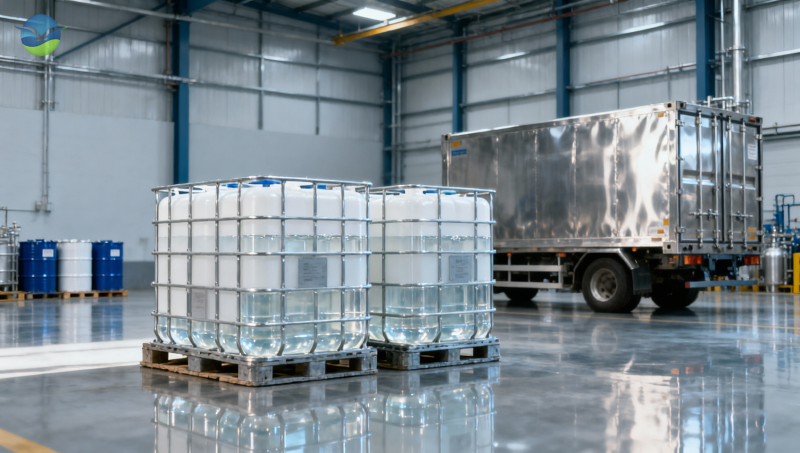
Intermediate bulk containers (IBCs) are usually the right choice for a chemical solvent shipment when the required volume is too large for efficient drum handling but too small, too variable, or too operationally fragmented to justify an ISO tank. For many project-driven purchases, the practical range is a few hundred to several thousand liters per delivery, especially where material must be received, staged, dispensed, or moved between work areas in controlled quantities.
That initial answer needs qualification. An IBC does not automatically provide the lowest freight cost per liter, the best safety outcome, or the simplest compliance route. The right format depends on the solvent's hazard classification, compatibility with the container system, shipment frequency, destination handling equipment, and how quickly the receiving site can consume the product. A container that is efficient during ocean transport can create avoidable exposure, storage, or residue problems after arrival.
For project managers, the packaging decision should therefore begin with the operating model at the destination, rather than with nominal container capacity alone.
Where IBCs sit between drums and ISO tanks
Drums remain useful when a project needs low volumes, multiple grades, frequent formulation changes, or manual distribution to separate users. They are also easier to isolate if a quality issue affects a single package. Their disadvantages become more visible as volume rises: more packages to inspect, more closures to manage, more forklift movements, more labels, and more opportunities for handling damage or inventory discrepancies.
ISO tanks serve a different operating model. They are suited to repeat bulk movements, relatively stable consumption, dedicated unloading capability, and customers able to receive a full tank without tying up working capital or storage space. The unit freight economics can be attractive at higher volumes, but an ISO tank can be excessive for a time-limited project, a one-off export order, or a site without the appropriate unloading connection and tank management procedures.
IBCs occupy the middle ground. A typical palletized IBC can consolidate the volume of several drums while remaining a discrete unit that can be stored, counted, transferred, and dispensed through its outlet valve. That makes chemical solvent IBC transportation particularly relevant when a project has meaningful solvent demand but cannot reliably consume a tank-scale quantity within its preferred storage period.
Choose IBCs when the receiving site needs flexibility, not just volume
An IBC is often justified when the solvent will be consumed over several days or weeks rather than discharged immediately into a permanent bulk tank. Construction-related chemical work, coating operations, resin production campaigns, cleaning processes, and contract manufacturing schedules can all have uneven demand patterns. The project may need an available buffer, but not a full tank container standing at the site.
In these cases, palletized IBCs give the receiver more control. Units can be delivered to a designated hazardous-material storage area, moved with suitable forklift equipment, and issued according to the work schedule. A site can open one unit while keeping the others sealed, which is generally easier to manage than holding an entire bulk shipment in a single system.
IBCs also make sense when delivery must be divided among multiple operating points. A project may have a central warehouse, a blending area, and one or more work fronts that need controlled releases of the same solvent. Moving a sealed IBC to a point of use may be operationally simpler than decanting drums repeatedly or installing temporary transfer lines from a bulk tank.
The same logic applies to export shipments where buyers need less than tank-container volume but still want fewer packages than a drum shipment would require. For full-container-load logistics, IBCs can offer a manageable compromise between cubic utilization, handling labor, and receiving flexibility. The specific loading pattern must still account for gross weight, cargo securing, dangerous-goods segregation, and the carrier's acceptance conditions.
The solvent and container must be assessed as one system
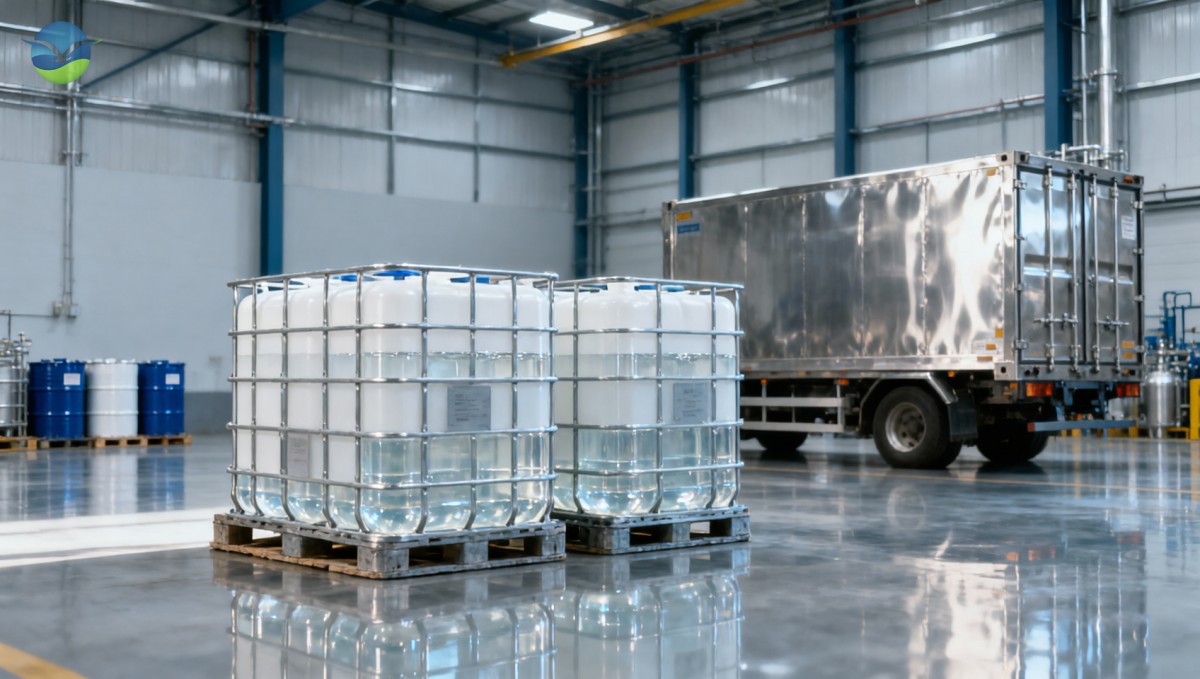
“Suitable for chemicals” is not a sufficient description for an IBC. Solvent selection must be matched to the bottle material, closure, valve seals, gaskets, pallet design, and any liner used. A solvent can be compatible with the inner bottle while degrading a valve seal or creating vapor leakage through a component that was not designed for that chemical family.
For many liquids, the familiar high-density polyethylene inner bottle is a starting point, not the final answer. Some solvents can permeate polymer walls, soften plastics, affect seals, or create static-control concerns. Flammable liquids may require packaging and handling arrangements that address grounding, bonding, ventilation, ignition control, and the applicable dangerous-goods transport rules. A supplier's safety data sheet and packaging specification should be reviewed together; treating them as separate documents is a common source of weak decisions.
Project teams should also determine whether the material is moisture-sensitive, oxidation-sensitive, light-sensitive, or prone to contamination from residues. If product purity is critical, a standard reusable IBC may not be appropriate unless its cleaning, inspection, and prior-use controls are documented. For some high-purity or tightly specified solvent applications, a new container, approved liner, dedicated packaging route, or smaller sealed packs may be preferable even when an IBC looks better on a simple cost-per-liter calculation.
Ask these questions before approving an IBC format
- Is the exact solvent, concentration, and additive package approved for the bottle, valve, gasket, cap, and any liner?
- Does the transport classification permit the selected IBC type for the intended road, sea, rail, or multimodal route?
- Will the destination have suitable forklift access, protected storage, spill containment, and compatible transfer equipment?
- Can the site consume the contents within the allowable period after opening?
- Is product quality sensitive to residual material, water ingress, air exposure, or container history?
- Who is responsible for empty-container return, recycling, disposal, or hazardous residue management?
When drums are still the better project choice
IBCs can reduce handling, but fewer packages do not always mean lower project risk. Drums are often a stronger option where daily consumption is low and a partly used IBC would remain open for an extended period. This matters for volatile solvents, materials affected by moisture pickup, and products whose composition or performance may change after repeated breathing through the container venting arrangement.
Drums may also be safer for facilities that cannot position an IBC near the point of use or do not have reliable pump-and-hose arrangements. An IBC outlet valve is convenient when it is protected and correctly connected; it becomes a significant release point when exposed to traffic, impact, poor hose support, or hurried manual operation. A damaged drum creates a serious incident as well, but the potential release volume from an IBC is materially larger.
Multiple drum sizes can be useful for projects that need different solvent grades in small quantities. Combining every requirement into IBCs simply because they look efficient can leave excess inventory at completion. The cost of disposal, return freight, or prolonged storage can outweigh the apparent savings from package consolidation.
This distinction is also important when reviewing unrelated chemical raw materials. A dry cosmetic-grade product such as Niacinamide Vitamin B3 Cosmetic Raw Material, supplied as a white crystalline powder in 25 kg kraft paper bags, follows a completely different packaging and handling logic from a liquid solvent. Project teams should avoid applying IBC assumptions across a purchasing list merely because several materials travel in the same export container.
When an ISO tank becomes the more disciplined decision
An ISO tank should be evaluated once solvent demand becomes frequent, consistent, and large enough that repeated IBC shipments create a high number of unloading and empty-packaging events. The decision is strongest when the receiving facility has a dedicated bulk-storage arrangement, trained operators, approved transfer connections, and a consumption schedule that prevents long dwell time.
Repeated IBC unloading can introduce several points of failure: moving units into position, connecting hoses, opening valves, controlling static, managing drips, resealing, and handling empty containers with residual vapor or liquid. When those activities occur many times for the same material, a well-designed bulk transfer system may provide better process control.
However, ISO tank use should not be driven only by the supplier's willingness to ship in bulk. A receiving site needs to verify that the tank's arrival, waiting period, discharge sequence, cleaning expectations, detention exposure, and return logistics fit the project schedule. A delayed project can turn a bulk shipment from an efficiency gain into a storage and equipment-management burden.
Freight cost should be measured through the site, not just to the port
Comparing a drum quotation, IBC quotation, and ISO tank quotation only at FOB or port-arrival level can produce the wrong answer. The relevant comparison includes packaging cost, container utilization, inland transport, loading labor, dangerous-goods handling, unloading time, warehouse space, pumping equipment, empty-package treatment, and the cost of unused material at project closeout.
IBCs often perform well when they reduce package count without forcing the buyer to accept tank-scale inventory. Yet they may underperform where destination warehousing is costly, forklift capacity is limited, or the site needs special spill pallets and segregation space for every unit. Conversely, drums can have a higher freight and labor burden but avoid investment in IBC transfer equipment for a short project.
A practical evaluation uses the expected consumption curve. Estimate the maximum inventory required on site, the number of handling movements from arrival to use, the likely time between opening and emptying a package, and the residual volume expected at project completion. That view usually reveals whether the apparent “middle option” is genuinely the most economical one.
Documentation and execution decide whether the format works
For international solvent shipments, the packaging choice must align with the shipment documentation before cargo is packed. The shipping name, classification, packing group where applicable, package approval, marks and labels, safety data sheet, and transport declaration all need to describe the actual material and packaging arrangement. Changes made late in the process, such as switching from drums to IBCs to improve container loading, can affect carrier acceptance and documentation requirements.
Project managers should ask for the documents early enough to resolve operational questions: the current SDS, certificate of analysis where quality parameters matter, packaging specification, net and gross weights, pallet dimensions, compatibility confirmation for the intended solvent, and instructions for storage and dispensing. For recurring shipments, these details should be controlled as part of the approved purchasing specification rather than recreated through email for each order.
The final decision is straightforward in principle: use IBCs when the project needs a manageable bulk quantity, palletized handling, and controlled staged consumption, while the solvent and all container components are demonstrably compatible. Stay with drums when flexibility, segregation, low consumption, or simple point-of-use handling matters more. Move to an ISO tank when demand and site infrastructure support a repeatable bulk-transfer operation. The package is part of the process design, not an afterthought to the solvent purchase.
Please give us a message
Send Us Your Inquiry Today
Scalable production and one-stop R&D, manufacturing, sales & after-sales services.