





Replacing Methyl Ethyl Ketone in Coatings: What to Test Before Switching
Approve a replacement for methyl ethyl ketone only after it meets defined limits for application, drying, film performance, and safe handling in the actual coating system. Resin dissolution is an initial screening result; it does not establish that a substitute will spray consistently, release from the film, or preserve adhesion. A solvent blend often deserves evaluation alongside individual solvents because solvency and evaporation must remain balanced throughout drying.
Begin with a retained sample of the current MEK-based formulation and a written acceptance window. Use the same resin and pigment batches, substrate preparation, application equipment, and conditioning schedule wherever possible. Otherwise, normal formulation or process variation can obscure the effect of the replacement.
Define the comparison before selecting candidates
The reason for removing MEK determines which alternatives remain eligible. An odor complaint, an exposure-control objective, a customer restriction, and a change in VOC requirements create different selection criteria. Lower odor does not establish lower exposure risk, and a higher boiling point does not establish regulatory acceptability.
Record the baseline at its normal application solids and film thickness. Include viscosity at a stated temperature, practical working time, flash-off interval, handling time, appearance, and the coating properties required in service. For a baked coating, document the actual part temperature profile as well as the oven setting. For a two-component coating, fix the mixing ratio and elapsed time after mixing.
Set numerical acceptance limits using the existing product specification and process capability. Where no formal limit exists, establish one from repeat baseline measurements and the end-use requirement. “Similar to control” is too subjective when a small change in blocking or hardness affects packaging or assembly.
Screen solvency across the drying path
Compare candidates in the complete binder system, including modifying resins, plasticizers, and additives. A clear solution of the main resin alone can conceal incompatibility with another component. Examine clarity, haze, gel particles, viscosity drift, and separation immediately after mixing and after a defined hold.
Solubility parameters provide a useful way to narrow the shortlist, especially when comparing solvent blends. They do not account fully for resin molecular weight, functional groups, commercial-grade impurities, or the changing composition of a drying film. Confirm the shortlist experimentally at the intended resin concentration.
Preferential evaporation deserves particular attention. A blend can begin as a good solvent and become a poor solvent as its fastest component leaves. The resulting loss of compatibility can produce haze, resin precipitation, gloss loss, or weak film formation. Observe drawdowns during flash-off and examine films at more than one thickness; a bulk solution remaining clear in a sealed jar cannot establish drying compatibility.
Use chemical identity and physical form to exclude irrelevant materials before formulation trials. For example, Sodium Cyclamate Sweetener Food Raw Material is a crystalline sweetener, not a replacement coating solvent; its water solubility provides no evidence of suitability for replacing MEK in a resin solution.
For pigmented coatings, extend screening to dispersion stability. A solvent change can alter resin adsorption and pigment wetting, producing flocculation, settling, color development changes, or rub-up differences. Compare fineness of grind, color strength, and viscosity after storage, rather than relying solely on an acceptable fresh drawdown.
Separate solvent effects from dilution effects
Run an initial comparison at equal nonvolatile content. Then evaluate a second series adjusted to the required application viscosity. These comparisons answer different questions: the first reveals changes at a fixed solids level; the second establishes what the application process would actually require.
A replacement that needs more solvent to reach the same viscosity changes applied solids, coverage per pass, solvent release, and potentially VOC content. Calculate those consequences from the final application formulation. An equal-volume substitution is a convenient starting experiment, but differences in density and solvency prevent it from serving as the final qualification basis.
Measure viscosity at controlled temperature using the same method and timing. A flow cup is useful for routine application control, but it does not fully describe shear-dependent behavior. Where sag resistance, atomization, or roller transfer changes, examine the relevant rheology instead of correcting every symptom through dilution.
Keep a separate record of any additive or thinner adjustments. Once these changes become necessary, the trial concerns a reformulated coating, and the full performance comparison must follow that final composition.
Follow evaporation through application and film formation
Boiling point and published relative evaporation rate help organize candidates, but neither predicts the drying curve of a formulated coating. Solvent interactions, airflow, humidity, substrate temperature, and film thickness influence release. Late-stage solvent retention becomes especially important as the binder concentrates and diffusion slows.
Apply the control and candidates under nominal conditions and at the edges of the intended process window. Include the thickest permitted film and the shortest allowed flash-off. For ambient application, examine relevant cool, humid conditions and warm conditions that encourage rapid surface drying.
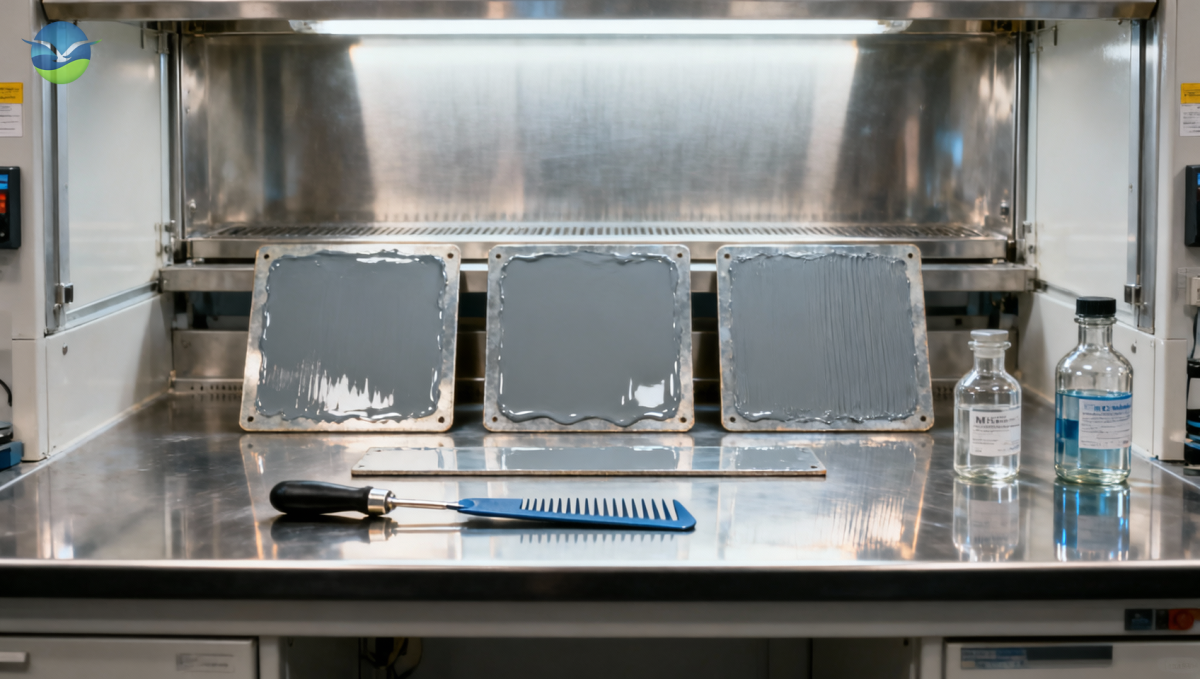
Record the sequence from wet application to handling readiness. Fast surface drying combined with a soft underlying film suggests restricted solvent release. Pinholes or popping during a bake can indicate solvent escaping after the film has developed substantial resistance to flow. Dry spray and poor leveling point toward excessive solvent loss before or immediately after deposition, although spray setup also needs examination.
Haze requires a different diagnosis. Evaporative cooling can promote moisture condensation under humid conditions, while a changing solvent balance can cause resin incompatibility. Comparing humidity-controlled drawdowns with solution compatibility observations helps distinguish these mechanisms before changing the blend.
For spray coatings, document nozzle, pressure, fluid delivery, distance, and booth conditions. For roll or dip application, use representative transfer and drainage conditions. A successful laboratory drawdown does not reproduce atomization losses or solvent accumulation in production equipment.
Measure performance at the time it matters
Evaluate the film at its actual handling, assembly, and service intervals. Testing only after extended laboratory conditioning can hide an unacceptable delay in hardness or solvent release. Conversely, testing every formulation after the same short interval can confuse slower development with a permanent loss of performance.
Use both the specified release time and a later conditioning point where appropriate. If early performance fails but later performance recovers, the practical decision concerns available drying time and production capacity. If the difference persists, investigate compatibility, cure, and film structure.
- Adhesion: Use the intended substrate and pretreatment. Include intercoat adhesion at the permitted recoat intervals, since residual solvent and surface condition affect subsequent layers.
- Hardness and flexibility should be interpreted together. Increased hardness alone does not demonstrate an improved film if bending or impact performance deteriorates.
- Blocking and print resistance matter when coated parts are stacked, wrapped, or contacted soon after drying. Reproduce the relevant contact material, pressure, and temperature.
- Chemical and water resistance testing should reflect service exposure. Examine blistering, whitening, softening, and recovery after exposure, with film thickness and conditioning held constant.
Reactive systems need additional scrutiny. Water contamination or solvents with reactive functional groups can interfere with particular curing chemistries. In isocyanate-containing coatings, alcohol-containing candidates and moisture require specific compatibility assessment because they can consume isocyanate groups. Track pot life and cure development rather than assuming that a clear mixture is chemically suitable.
Include storage and operating constraints in qualification
Store candidate formulations in representative, compatible containers under the intended conditions. Examine viscosity drift, separation, sediment redispersibility, skinning, and gel formation. Accelerated storage can expose weaknesses, but it does not by itself establish shelf life. Retain real-time samples, particularly when the solvent package affects moisture sensitivity or package compatibility.
Evaluate the solvent grade as well as its chemical name. Water content, acidity, purity, and nonvolatile residue are relevant where they affect cure, color, corrosion, or appearance. Define incoming limits from demonstrated formulation sensitivity and obtain batch documentation against those limits.
Assess worker exposure using the candidate’s current safety data and the actual application route. Spraying introduces inhalation conditions different from closed mixing. Vapor pressure, exposure limits, skin contact, ventilation, and any additional hazards of the replacement belong in the assessment. Reduced odor must never serve as the exposure acceptance criterion.
Review flash point, storage arrangements, ventilation, and electrical-area requirements for the proposed formulation and operation. Confirm compatibility with seals, hoses, pump components, and cleaning procedures. A solvent that performs well in the film can still swell an elastomer or leave equipment insufficiently cleaned.
Determine VOC status and other restrictions for the destination and coating category using current requirements. Exemptions and calculation methods vary by jurisdiction; a solvent description on a sales sheet does not establish compliance for the finished coating.
Move from a successful sample to a controlled release
Advance the strongest candidates through repeat laboratory batches and a representative pilot run. Preserve the baseline as a concurrent control. Record addition order, mixing temperature, mixing time, filtration behavior, application settings, and drying conditions so that a successful result can be reproduced.
The pilot should expose production effects absent from a beaker trial: solvent loss during mixing, temperature rise, equipment hold-up, recirculation, and changing viscosity over the application period. Include a normal interruption and restart where these are part of routine operation. Evaluate coated material after the actual packing or assembly sequence.
Calculate cost against usable coating output at the accepted application solids. Additional thinner, longer drying, increased ventilation, rework, and cleaning changes can outweigh a lower solvent purchase price. Use measured trial requirements rather than assumed savings.
Release the replacement against a documented formulation, solvent-grade specification, application window, and performance limits. If qualification requires a longer flash-off or a narrower humidity range, incorporate that condition into the production instructions before the first routine batch.
Please give us a message
Send Us Your Inquiry Today
Scalable production and one-stop R&D, manufacturing, sales & after-sales services.