






Pure Silicone Oil: How Purity, Viscosity, and End Use Shape Selection
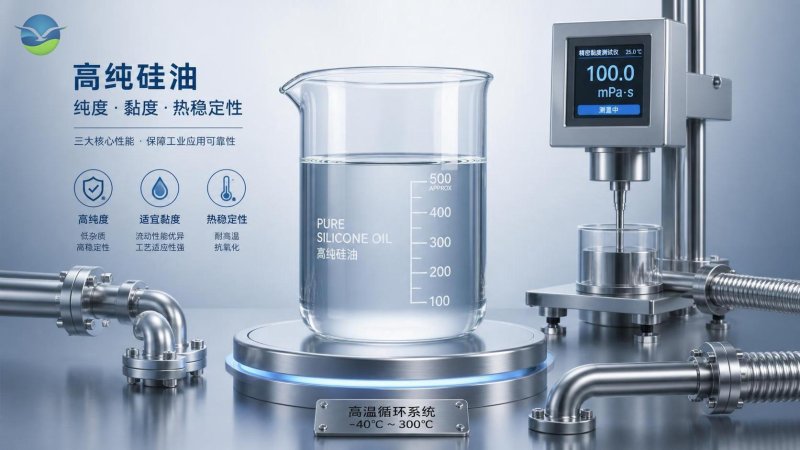
Selecting pure silicone oil is rarely a matter of choosing the “highest purity” product on a supplier’s data sheet. In practical formulation, processing, and maintenance environments, the correct grade is the one whose molecular structure, viscosity behavior, volatile content, and contaminant profile are controlled for the operating conditions—not simply the one described with the broadest purity claim.
For most industrial uses, pure silicone oil refers to a polydimethylsiloxane (PDMS) fluid with no intentional fillers, emulsifiers, pigments, or reactive modifiers. Yet that definition still leaves major technical differences between products. Two clear, colorless 350 cSt fluids may perform differently in a release-coating line, a cosmetic emulsion, or a high-temperature lubrication system if their molecular-weight distribution, cyclic siloxane content, moisture level, acidity, or trace residues are not equivalent.
The selection task therefore starts with the end-use failure mode. Is the concern oil migration into a substrate? Viscosity loss at elevated temperature? Incompatibility with seals? Surface defects in a coating? Odor in a personal-care base? A meaningful evaluation links each specification to one of these actual risks.
Purity is application-specific, not a universal ranking
“Pure” can be misleading when it is treated as a single measurable property. In silicone fluids, a high PDMS assay may be relevant, but it does not by itself establish suitability for demanding applications. Technical evaluators should clarify what contaminants matter in the intended process and how they are measured.
For general-purpose industrial lubrication, mold release, water repellency, and mechanical damping, the principal concern may be consistency: appearance, kinematic viscosity, flash point, volatile matter, and absence of visible particulate contamination. A broadly specified technical-grade fluid can be appropriate where there is no regulated contact application and where small differences in trace constituents will not alter performance.
For cosmetics, personal care, pharmaceutical-adjacent processing, food-contact-related applications, or sensitive electronics, the purity discussion becomes narrower and more consequential. Relevant questions can include:
- Whether the product contains intentionally added solvents, stabilizers, or processing aids;
- The level and control method for low-molecular-weight volatiles, including cyclic siloxanes where applicable;
- Odor, color, and sensory consistency between batches;
- Moisture and ionic contamination limits for electronic or optical uses;
- Residual catalyst, acid, alkali, or metal content where the silicone fluid enters a reactive formulation;
- The documentation needed for the destination market and the specific downstream use.
It is important not to assume that a food-grade, cosmetic-grade, medical-grade, or electronic-grade claim can be inferred from a standard COA. These labels depend on the application, manufacturing controls, traceability, and sometimes regional regulatory requirements. A supplier’s general statement of “high purity” is not a substitute for a defined specification or a formal compliance review.
For silicone oil used as a process aid, a practical purity specification often has more value than a generic assay figure. An example would be: “PDMS fluid at nominal 1,000 cSt, no added solvent, water below an agreed limit, specified volatile fraction, clear appearance, and no nonvolatile residue above the application threshold.” This gives production, quality, and procurement teams a shared acceptance standard.
Viscosity determines handling, film behavior, and functional durability
Viscosity is normally the first property on a silicone oil purchase specification, usually reported in centistokes (cSt) at 25°C. It is closely tied to molecular weight. Lower-viscosity fluids flow rapidly, wet surfaces easily, and can be metered through fine dispensing systems. Higher-viscosity fluids provide a more persistent lubricating or damping film but demand more careful pumping, heating, and mixing arrangements.
There is no universally “best” viscosity range. The right choice depends on how the oil must move before it performs its function.
Nominal viscosity alone is insufficient. The allowable viscosity tolerance is often the more important control point for automated production. In a precision dispensing operation, a batch at the low end of a broad tolerance may deliver more material per cycle than expected; a high-end batch may not fully atomize or may overload a pump. A specification such as “350 cSt” should therefore be paired with an agreed testing method and acceptable range.
Temperature must also be considered. Silicone fluids generally retain fluidity over a wide temperature range and have a favorable viscosity-temperature relationship compared with many mineral oils. That advantage does not eliminate the need for testing. A fluid selected by its room-temperature viscosity may become too thin in a heated line or too resistant to flow in cold storage and startup conditions.
For systems with recirculation, spray application, narrow-gauge metering, or high-speed coating, evaluate viscosity at the real operating temperature rather than extrapolating from a room-temperature COA. A bench trial should measure pumpability, filtration behavior, coating weight, and line cleanability under representative conditions.
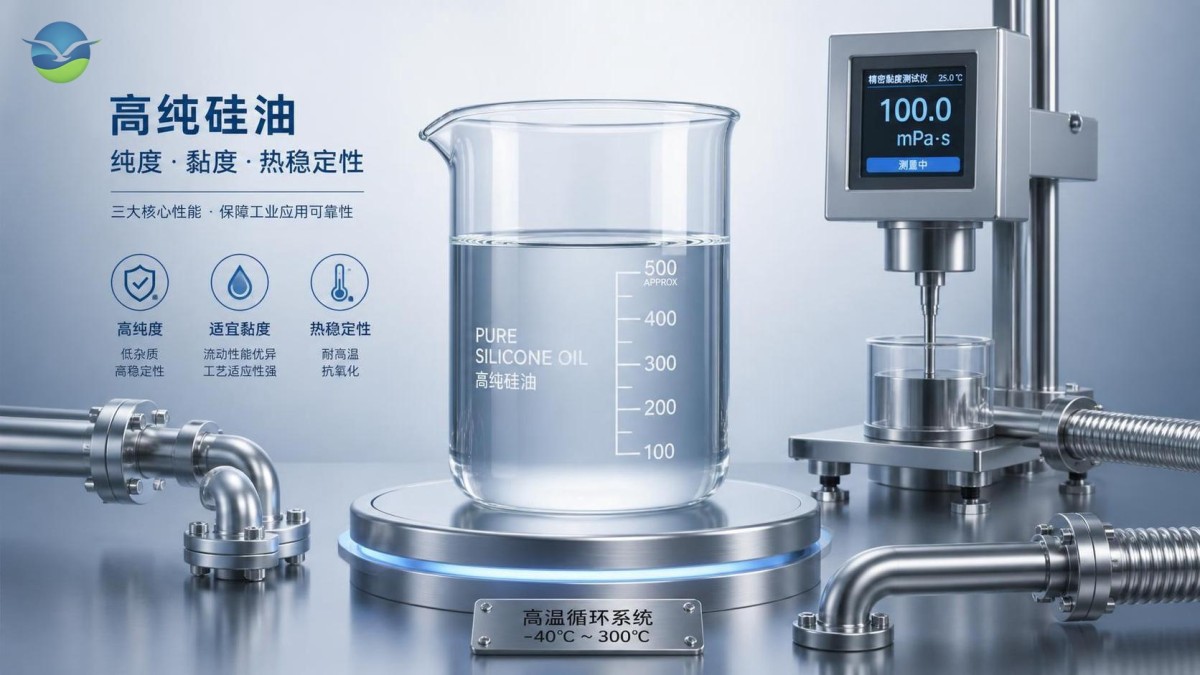
Thermal stability should be evaluated as a system property
Pure silicone oil is often chosen because PDMS fluids have strong thermal stability, low surface tension, water repellency, and generally good dielectric properties. These characteristics support use in heat-transfer systems, release operations, textile processing, lubricating applications, and specialty formulations. However, “high-temperature resistant” does not mean a silicone oil can be used indefinitely at any elevated temperature.
Thermal performance is affected by oxygen exposure, residence time, contact with reactive metals, contamination from other oils, local hot spots, and the geometry of the equipment. At elevated temperatures, low-molecular-weight fractions can contribute to smoke, odor, deposits, or viscosity changes. In open systems, oxidation and volatilization may dominate. In closed systems, seal compatibility, heat-transfer efficiency, and fluid cleanliness can matter more than visible degradation.
A realistic evaluation should ask for the intended maximum continuous temperature, peak temperature, exposure duration, and atmosphere. The product’s flash point is a safety parameter, not a direct measure of long-term thermal serviceability. Similarly, a high initial flash point does not prove that the fluid will remain clean or stable after extended thermal cycling.
Where high-temperature service is critical, the better approach is to qualify a candidate fluid in the actual equipment or in a controlled simulation. Monitor viscosity drift, mass loss, color change, deposits, acidity where relevant, and changes in heat-transfer or lubricating performance. This is especially important when a process contains catalysts, metallic fines, elastomer debris, or residues from prior fluids.
Compatibility is where many apparently suitable grades fail
PDMS silicone oil is chemically inert in many environments, but it is not universally compatible with every polymer, solvent, coating, adhesive, or elastomer. The risk is often not dramatic chemical attack. More commonly, the problem is poor wetting, migration, surface-energy disruption, swelling of a seal material, or interference with adhesion and subsequent finishing.
Low surface tension is one of silicone oil’s most useful properties, but it also explains why trace carryover can create defects in coating, painting, printing, bonding, and electroplating operations. In an adhesive assembly line, silicone contamination can cause localized fish-eyes, poor paint adhesion, or inconsistent bond strength at extremely low transfer levels. Facilities that use silicone-based release fluids and silicone-sensitive coatings should separate handling tools, storage zones, and cleaning procedures.
Elastomer compatibility deserves the same attention. Some rubber compounds, seal designs, and plastic components may swell, soften, harden, or extract additives after prolonged contact. Compatibility cannot be judged from the generic material name alone. “Nitrile rubber,” for example, covers formulations with substantially different plasticizer packages and crosslink densities. Immersion testing using the actual seal or substrate is more informative than a broad compatibility chart.
In formulation work, silicone oil may also affect rheology, gloss, slip, foam control, and intercoat adhesion. If the system contains polar resins, waterborne components, or reactive curing chemistry, assess whether the silicone fluid can be dispersed and remain stable at the required dosage. A fluid that produces an initially smooth blend may separate after storage or change the cure profile under heat.
This issue is relevant in polymer-processing plants as well. Silicone fluids can be used as processing aids or external lubricants, but they should not be confused with the base resin selection. For example, film flexibility, low-temperature toughness, adhesion, and hot-melt behavior in an EVA Ethylene Vinyl Acetate Polymer Raw Material system are primarily determined by EVA grade, vinyl acetate content, melt flow characteristics, additives, and processing conditions. Silicone oil may influence surface slip or release behavior, but it can also compromise printability or lamination adhesion if migration is not controlled.
Documentation should support a decision, not merely complete a supplier file
A useful COA for pure silicone oil should identify the batch and report the agreed critical values, rather than relying on a generic “qualified” statement. At a minimum, the review normally includes appearance, viscosity and test temperature, density or specific gravity, flash point where relevant, and volatile matter if it affects the application. For sensitive uses, the COA may need expanded controls such as water content, refractive index, color, acid value, particulate cleanliness, or targeted trace analysis.
The Safety Data Sheet serves a different role. It supports safe handling, transport, storage, exposure control, and emergency response. It should not be used as evidence that the fluid meets a particular regulatory, food-contact, cosmetic, medical, or electronics requirement. Those claims require separate documentation and must be assessed against the finished application and the destination market.
Traceability is particularly important when switching suppliers or moving from sample qualification to container-scale supply. A laboratory sample may be acceptable while later production material has a different viscosity distribution or volatile profile. Before approval, establish whether batches are manufactured to a fixed internal specification, whether reblending is used to hit nominal viscosity, and how changes in raw materials or process conditions are controlled and communicated.
Storage and packaging influence the delivered condition
Silicone oil is relatively stable in storage, but poor packaging practice can undermine an otherwise suitable grade. Drums, IBCs, closures, liners, and transfer hoses should be chosen to minimize contamination and moisture ingress. In low-viscosity grades, even minor leakage or closure problems can create handling and housekeeping issues. In high-viscosity grades, cold conditions may slow unloading enough to disrupt production schedules.
For clean applications, technical teams should define whether a dedicated transfer path, filtration step, or nitrogen blanketing is necessary. These measures are not always required, but they are often less costly than diagnosing surface defects after the material has entered a coating or adhesive system. Storage temperature limits, shelf-life expectations, and re-test rules should be agreed before the first commercial shipment.
A practical qualification sequence
The most reliable selection process begins by converting the end use into measurable requirements. Define the functional purpose of the fluid—lubrication, release, damping, heat transfer, dielectric insulation, defoaming, surface modification, or formulation component—then identify the failure mode that cannot be tolerated. From there, specify the viscosity window at process temperature, purity-related limits, thermal exposure profile, substrate and seal compatibility, and documentation needs.
Request a representative sample with a batch-specific COA, not merely a retained reference sample. Conduct a short application trial that includes storage stability, processing behavior, and downstream effects. Where the oil contacts sensitive surfaces, evaluate transfer and cleanability as well as immediate performance. If the trial succeeds, compare consecutive batches before finalizing the commercial specification.
The central lesson is that pure silicone oil should be selected as a controlled functional fluid, not as an interchangeable commodity. Purity protects the process only when it is defined around relevant contaminants. Viscosity matters only when it is measured at meaningful temperatures and tolerances. Thermal stability and compatibility become reliable only when they are tested in the actual system. That discipline turns a simple fluid purchase into a more predictable technical decision.
Please give us a message
Send Us Your Inquiry Today
Scalable production and one-stop R&D, manufacturing, sales & after-sales services.