






Niacinamide Wholesale Buying Guide for Importers, Distributors, and Brand Owners
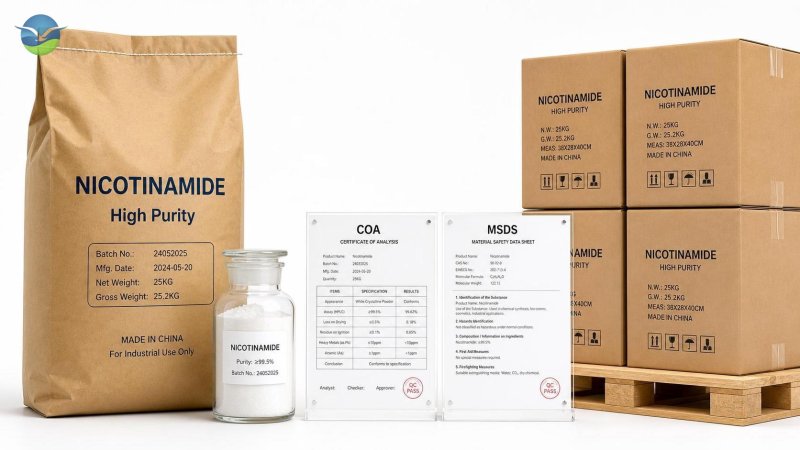
For many buyers, niacinamide wholesale looks straightforward on paper: compare quotes, check purity, ask for a COA, and move forward. In practice, that is rarely enough. The real purchasing risk usually sits in the parts that are less visible at the quotation stage—batch consistency, document responsiveness, packaging fit for export, and whether the supplier can stay reliable when volumes move from trial orders to regular container shipments.
That matters even more for importers, distributors, and brand owners working across several markets. Niacinamide may be a familiar ingredient, but the commercial side of sourcing still requires disciplined screening. A low price can become expensive very quickly if one shipment is delayed at customs, if paperwork is incomplete, or if an approved sample does not match later production lots.
A sensible buying decision usually balances four things at the same time: cost, supply stability, communication efficiency, and technical documentation. If one of those is weak, the supply chain starts to feel fragile.
Why niacinamide sourcing is more nuanced than many first-time buyers expect
Niacinamide is widely used in applications where buyers care about purity, appearance, handling, and downstream performance. Depending on the end use, a purchaser may focus on assay, particle characteristics, moisture, packaging integrity, or how the material behaves in formulation and storage. That means procurement teams should not treat all offers as interchangeable simply because the product name is the same.
One common mistake is to evaluate only the quoted unit price per kilogram or per ton. Experienced distributors usually look one level deeper. They ask whether the supplier is the original manufacturer or a trader, whether sample management is controlled, whether production and export communication happen in one place, and how quickly revised documentation can be issued if customs, QA teams, or end customers request changes.
Another point buyers often underestimate is rhythm. The first order is rarely the hardest one. The harder stage is the second or third order, when forecasts shift, packaging details change, and delivery timing starts affecting inventory cost. That is where operational discipline matters more than sales promises.
What should actually be checked before placing a niacinamide wholesale order
A useful supplier review usually starts with product basics, but it should not stop there. Purity and routine quality documents are expected, not exceptional. The more practical questions are often these:
- Can the supplier provide consistent batches, not just a compliant sample?
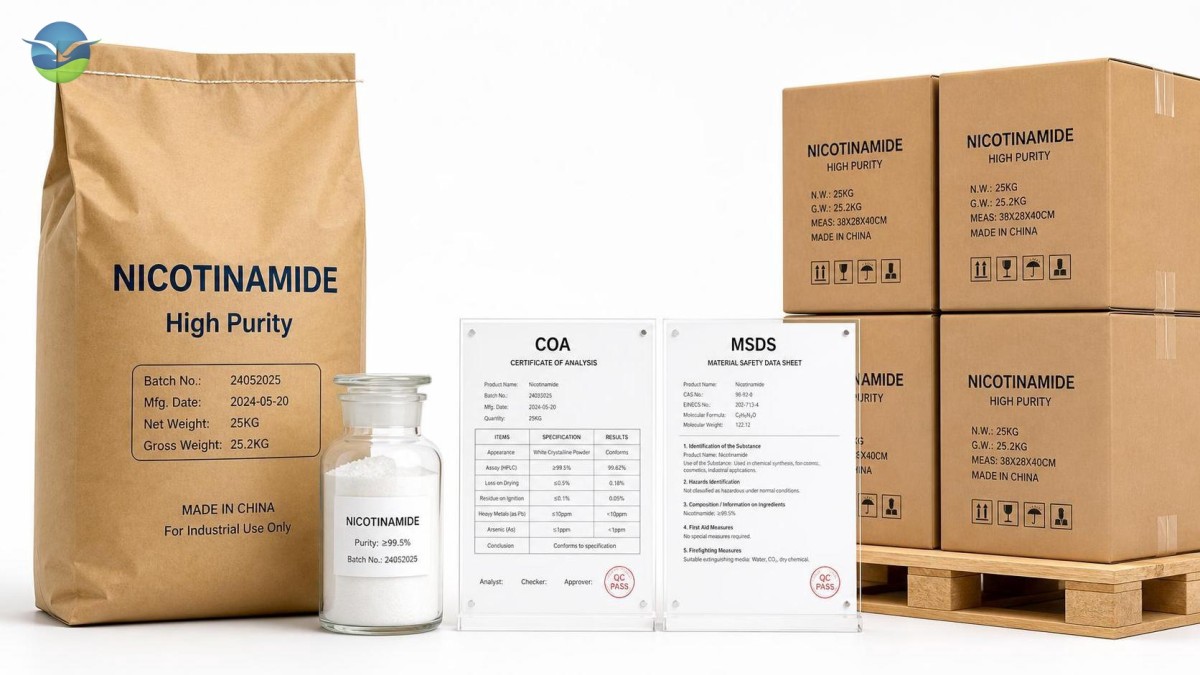
- Are COA and MSDS issued clearly and on time for every shipment?
- Who handles export documentation and customer communication when issues arise?
- Is production under direct control, or dependent on shifting upstream sources?
- Can the supplier support both small qualification orders and larger FOB shipments without changing service quality?
These questions sound basic, but in chemical trade they separate manageable supply relationships from troublesome ones. A buyer does not just need material shipped out; they need a supplier who can still respond when a forwarder asks for clarification, when a local team requests a revised packing list, or when an end customer needs supporting documents fast.
Cost control is not only about ex-works price
In niacinamide wholesale procurement, the visible price is only one layer of cost. Importers who have managed repeated chemical shipments usually watch the hidden cost drivers more closely: repacking risk, delayed documentation, unstable lead time, and communication gaps between factory and export team.
For example, a cheaper source may still be the more expensive option if it causes extra warehouse dwell time or customs review because shipment papers were not aligned. Likewise, if a factory cannot maintain stable scheduling, buyers may end up carrying more safety stock than planned. That ties up working capital, which is a real procurement cost even though it never appears on the supplier’s quotation.
This is one reason buyers often prefer original manufacturers with export coordination capability rather than relying only on fragmented intermediaries. The appeal is not just lower source cost. It is the ability to reduce friction across the order cycle.
Why supply structure matters: production in Shandong, export support in Wuxi
Qixiang Chemical’s setup is worth noting because it reflects a structure many overseas buyers actually find practical. Its foreign trade operations are based in Wuxi, Jiangsu, a major trade and commercial center in the Yangtze River Delta, while the source manufacturing base is in Shandong, where chemical industry clustering helps support scalable production and more cost-conscious raw material sourcing.
That split can work well when it is managed properly. The Wuxi team handles inquiry response, sample coordination, quotation work, order follow-up, logistics communication, qualification documents, and after-sales support. For overseas customers, that means the communication window stays active and organized instead of depending on production personnel to answer export questions. In real transactions, this can save time, especially when buyers need quick feedback on lead times, labeling details, or document revisions.
On the manufacturing side, Shandong operates a self-managed standardized facility covering 10,000 square meters, with production lines, storage, and quality inspection laboratories under one system. That matters because full-process control generally gives buyers more confidence in scale-up and repeat orders than loosely coordinated outsourcing does. Each shipment includes COAs and MSDSs, which is not a marketing point so much as a minimum requirement for smoother international handling.
The practical advantage is fairly simple: communication efficiency comes from Wuxi, while manufacturing capacity and cost control come from Shandong. Buyers who need both sample flexibility and larger FOB export support tend to care about exactly that combination.
How experienced distributors compare suppliers
When distributors evaluate niacinamide wholesale offers, they usually compare more than a technical specification sheet. They also compare how easy the supplier is to work with under pressure. A technically acceptable supplier may still be operationally weak.
This same logic applies across many chemical raw materials, not just niacinamide. Buyers handling multiple SKUs often prefer suppliers with a consistent export process across product lines. In that sense, a company capable of supporting niacinamide as well as products such as Potassium Sorbate Food Preservative Raw Material may be easier to work with if your procurement model values process stability and consolidated communication.
Questions worth asking before you approve the first bulk order
Before moving beyond samples, buyers should ask a few direct questions that reveal how the supplier actually operates. Not polished answers—real operating answers.
Ask who will be responsible for your account after the PO is issued. In some companies, service quality drops once sales hands the order off internally. Ask whether the same team that handled sampling will also coordinate shipment documents and after-sales issues. That continuity reduces misunderstanding.
Ask what documents are routinely included with each batch and how quickly they can be reissued if formatting needs to change for local clearance. Ask how packaging is prepared for export and whether lot traceability is clear. If your market has product registration or importer filing requirements, confirm early which supporting documents can be supplied and which items need separate review under local rules.
It is also reasonable to ask how the supplier handles a deviation claim. Not because you expect a problem, but because the answer shows whether the business has a real after-sales process or only a sales process.
A realistic way to buy better, not just cheaper
The best niacinamide wholesale decision is usually not the lowest bid and not the most polished brochure. It is the source that can hold quality steady, issue clean paperwork, answer quickly, and still perform when your order pattern changes. Buyers who manage inventory risk already know this; the procurement price matters, but the total supply experience matters more.
Qixiang Chemical’s dual-location model speaks to that reality. Wuxi supports fast international coordination, while Shandong provides direct manufacturing control and scalable production. For importers and distributors, that is often a more useful procurement structure than a single attractive quote without operational depth.
If you are comparing suppliers now, start with three things: verify who controls production, review the standard shipment documents, and test how the supplier responds when you ask detailed commercial questions. Those early signals usually tell you more about future order performance than the first quotation ever will.
Please give us a message
Send Us Your Inquiry Today
Scalable production and one-stop R&D, manufacturing, sales & after-sales services.