






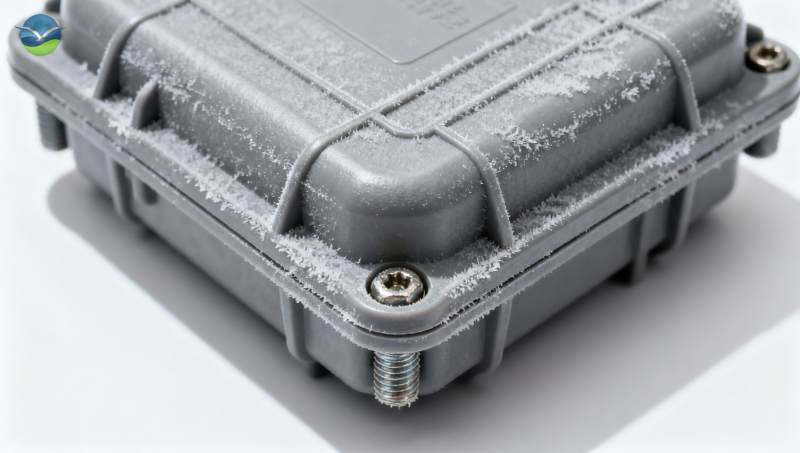
ABS resin can suit industrial parts exposed to low temperatures, provided the selected grade maintains adequate toughness under the actual service conditions and loading.
For technical evaluators selecting ABS resin for industrial parts, suitability depends on minimum service temperature, impact loading, component geometry, and manufacturing consistency across production batches.
Room-temperature strength cannot establish cold-service reliability. As temperatures fall, reduced toughness can increase brittle-fracture risk, particularly around notches, weld lines, fasteners, and molded stresses.
This article explains how to screen candidate grades, interpret low-temperature data, and define supplier validation requirements before approving ABS components for demanding industrial applications.
What makes ABS suitable—or unsuitable—for cold industrial service?
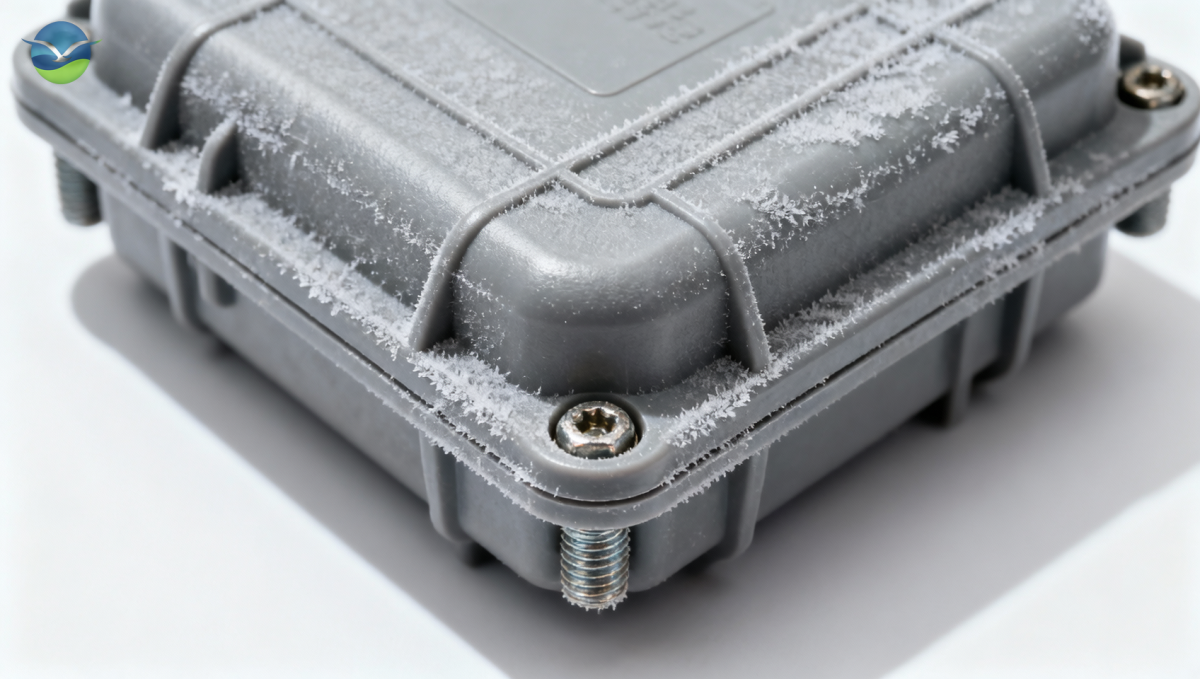
ABS combines a relatively rigid styrene-acrylonitrile matrix with a dispersed rubber phase. This structure provides a useful balance of processability, stiffness, and impact resistance.
Cooling changes how these phases respond to stress. The material may absorb less energy before fracture, while loading speed and stress concentrations become increasingly consequential.
However, ABS does not have one universal minimum operating temperature. Different formulations can behave differently at the same temperature, even when their descriptions appear similar.
A lightly loaded indoor enclosure may remain acceptable where a similar material fails in a dropped housing, snap-fit assembly, or vibrating machine guard outdoors.
Consequently, a temperature rating without its test method, applied load, conditioning history, and acceptance criteria provides limited support for a defensible engineering approval decision.
The practical question is whether the finished component retains sufficient impact resistance, dimensional stability, and connection strength throughout its specified temperature and loading envelope.
Treat ABS as a candidate requiring qualification whenever cold exposure coincides with impact, sustained stress, aggressive chemicals, or failure consequences that demand greater reliability.
Define the cold-service conditions before comparing resin grades
Begin with the lowest credible part temperature, including storage, transportation, startup, and shutdown. Ambient air temperature alone may not represent the component’s actual exposure.
A housing installed near refrigeration equipment, for example, may experience localized cold spots. Outdoor equipment may also face colder conditions during overnight storage before operation.
Separate continuous exposure from occasional excursions. Record how long each exposure lasts, how often it occurs, and whether mechanical loads remain present during cooling.
Next, identify foreseeable impacts: handling drops, tool strikes, assembly knocks, moving equipment contact, and sudden loads transferred through brackets or fasteners during routine operation.
Document assembly constraints as well. A plastic cover bolted tightly to metal may develop thermal stresses because the materials contract differently as temperatures decline.
Include sunlight, moisture, oils, cleaners, and other chemicals in the exposure profile. Combined environmental effects can change material performance beyond what temperature-only testing reveals.
A useful specification states temperature, exposure duration, loading, component condition, and pass criteria together. This gives suppliers a measurable target instead of an ambiguous request.
Which test data actually support a low-temperature decision?
Request impact results at temperatures relevant to your application, rather than accepting room-temperature figures as evidence. Ask for the exact test method and specimen preparation.
Notched Izod and Charpy tests help compare materials under defined conditions, but their results are not interchangeable. Specimen thickness and notch geometry also matter.
ASTM D256 and ISO 180 describe Izod methods; ISO 179 covers Charpy methods. Confirm the applicable version, conditioning procedure, and units before comparing supplier data.
Ask whether specimens reached the target temperature throughout their thickness and how temperature was maintained during testing. Warming during transfer can distort a comparison.
Also review failure mode and result variability. Averages alone can conceal occasional brittle failures that would be unacceptable in production parts with demanding reliability requirements.
Tensile, flexural, and creep information may also be necessary, depending on loading. Heat deflection temperature and Vicat softening temperature do not establish cold-impact suitability.
If published low-temperature data are unavailable, arrange testing before approval. A general claim such as “high impact” should trigger further evaluation, not automatic acceptance.
When should you consider impact-modified ABS or another polymer?
Impact-modified ABS can be appropriate when standard grades lack sufficient toughness, but the specific formulation must demonstrate improvement at the required temperature and loading rate.
Higher rubber content or different impact modification can affect stiffness, heat resistance, appearance, and processing behavior. Evaluate these tradeoffs against the complete component specification.
Flame-retardant, filled, colored, or recycled-content formulations need separate review. Their cold-temperature behavior cannot safely be inferred from an unmodified natural ABS grade’s published performance.
Likewise, a PC/ABS blend may offer a useful balance of properties, but suitability still depends on formulation, chemical exposure, processing conditions, and measured cold-impact behavior.
Where ABS cannot meet the requirement, investigate alternatives against the same specification. Appropriate polycarbonate, polyethylene, polypropylene copolymer, or engineering polymer grades may warrant comparison.
These alternatives bring different limitations involving stiffness, creep, thermal expansion, chemical resistance, or processing. Polymer family names alone cannot establish which option will perform best.
For repeated severe impacts, very low temperatures, or safety-related functions, broaden material selection early. This avoids spending development time optimizing a fundamentally unsuitable candidate.
How can part design and molding change the outcome?
Cold failures frequently initiate at local stress concentrations. Sharp internal corners, abrupt thickness changes, thin snap-fit roots, and poorly positioned weld lines deserve particular attention.
Use generous radii and gradual wall transitions where feasible. Position gates to reduce weak weld lines in areas expected to receive impact or concentrated loads.
Do not assume that simply increasing wall thickness solves the problem. Thickness affects cooling, residual stress, shrinkage, and the failure behavior observed during impact.
Check screw bosses, inserts, and clamped joints under cold conditions. Assembly preload and differential contraction can create stresses that standard material coupons do not reproduce.
Follow the selected grade’s drying and processing recommendations. Poor drying, excessive thermal exposure, and unsuitable molding conditions can reduce consistency and compromise finished-part performance.
Control regrind use through an agreed specification and validation program. Repeated processing, contamination, or inconsistent blending can make previously qualified performance difficult to reproduce reliably.
Finally, test molded production-representative parts. Prototype tooling, different gate positions, or another molding process may produce results that do not transfer directly to production.
What should a practical qualification program include?
Start by screening a small number of candidate grades using comparable low-temperature data. Select candidates that also satisfy stiffness, dimensional, chemical, and regulatory requirements.
Produce trial parts using intended molding conditions and documented material preparation. Record the resin grade, lot, color formulation, regrind content, and relevant processing parameters.
Condition complete assemblies to the specified temperature before testing. Include fasteners, seals, inserts, and mating components when these influence stress distribution or mechanical restraint.
Apply loads that represent foreseeable service events. Depending on the component, these may include drops, localized strikes, snap-fit operation, vibration, or loading during startup.
Define acceptance criteria before testing: no cracks, retained function, acceptable deformation, secure attachment, or another measurable requirement. Cosmetic damage and functional failure require separate definitions.
Add thermal cycling or combined chemical exposure when supported by the service profile. Inspect stressed areas after testing, including locations where small cracks may remain hidden.
Use a justified sample size and include relevant production variability. Qualification should address more than one favorable specimen, particularly when failure carries significant operational consequences.
If failures occur, identify their origin before changing material. Geometry, assembly stress, molding defects, and resin selection may require different corrective actions and subsequent verification.
What should technical evaluators request from Qixiang Chemical?
Provide Qixiang Chemical with the application specification and request an exact candidate grade, current technical data sheet, safety data sheet, and available cold-temperature test reports.
Confirm who manufactures the proposed resin and whether any modification occurs before supply. Record the grade designation, formulation controls, and responsibilities for technical performance claims.
Qixiang Chemical’s stated operating model places overseas customer coordination in Wuxi, Jiangsu, with its production base in Shandong. Use these roles to assign clear responsibilities.
The Wuxi team can coordinate inquiries, samples, quotations, logistics, and documentation. Ask it to consolidate technical responses so commercial discussions remain aligned with engineering requirements.
For production approval, request traceable samples and shipment documentation, including a certificate of analysis. Clarify which properties are measured routinely and which require additional testing.
A certificate of analysis may cover identification or processing properties without confirming cold-impact performance. Establish whether application-critical tests belong in the agreed quality control plan.
Also agree on change notification, retained samples, complaint handling, and batch traceability. These controls help preserve qualification when raw materials, formulations, or manufacturing conditions change.
Keep unrelated chemicals under separate specifications. Qixiang’s Glycerin Vegetable Glycerol Raw Material is listed as cosmetic-grade vegetable glycerol, supplied in 25 kg barrels.
That product’s moisturizing and solvent uses do not establish relevance to cold-service ABS. Do not treat it as a validated ABS modifier without formulation-specific evidence.
Approve ABS only when the evidence matches the application
ABS resin for industrial parts can be a practical cold-service choice when the selected grade and finished component meet clearly defined temperature, impact, and durability requirements.
Approve the material when relevant test data, representative component trials, and production controls support the intended use. Reserve conditional approval for explicitly limited operating conditions.
If evidence remains incomplete, specify the missing tests before release. If validated performance falls short, revise the design, evaluate another grade, or select another material.
The strongest purchasing decision connects a precise service specification with measurable acceptance criteria and traceable supply. That approach turns a broad suitability claim into defensible engineering approval.