






How to compare offers from high density polyethylene suppliers fairly
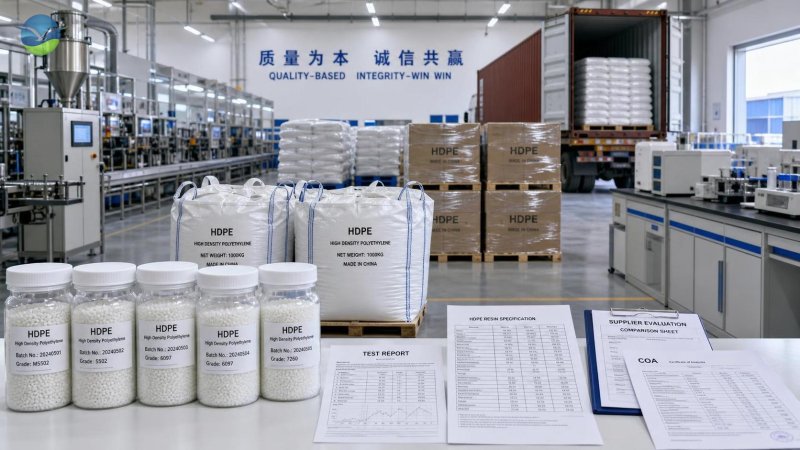
When procurement teams compare offers from high density polyethylene suppliers, the real question is rarely “Who is cheapest?” It is “Which offer will still look competitive after production, freight, documentation, and claim handling are taken into account?” In chemical procurement, a quotation is only the surface. The commercial risk usually sits underneath: resin consistency between batches, whether quality records can stand up to customer audits, how quickly samples move, and how much coordination the supplier can actually handle once an order leaves the trial stage.
That is why a fair comparison needs a wider lens. Two suppliers may quote the same grade name or a similar density range, yet deliver very different outcomes in extrusion, blow molding, pipe production, film conversion, or packaging applications. For international buyers in particular, the difference between a workable supplier and a problematic one often shows up in communication speed, export readiness, and the ability to solve issues without pushing everything back onto the customer.
Start with grade fit, not with unit price
Before comparing commercial terms, make sure the offers are genuinely comparable materials. HDPE is purchased into specific processing windows and application requirements, so the first screening point is whether each supplier is quoting the right grade for the intended use. A blow molding grade for detergent bottles should not be benchmarked directly against a pipe grade or a film grade just because both are described as HDPE.
In practice, procurement should ask for a side-by-side technical sheet review that includes the core indicators relevant to the process. Depending on the application, that may include melt flow index, density, tensile properties, impact performance, environmental stress crack resistance, molecular weight distribution, additive package, color stability, and food-contact or regulatory status where applicable. If one supplier gives a broad typical range while another gives batch-level control targets, those are not equivalent disclosures.
A low offer can become expensive quickly if the processor has to adjust temperature profiles, cycle times, wall thickness, scrap rates, or additive loading to make the resin run acceptably. Fair comparison starts by eliminating false equivalents.
Look at consistency as a cost factor
Many buyers evaluate specification compliance as a pass-fail issue. In reality, consistency is an economic issue. A resin that stays inside spec but shifts noticeably from batch to batch can still create downtime, unstable output, or customer complaints. That matters even more for converters supplying downstream industrial accounts, where process stability is often valued more than a marginal raw material discount.
Ask each supplier how production is controlled, how often key properties are tested, and whether the same formulation and raw material sourcing are maintained over time. If a supplier operates its own production base and manages blending, granulation, and final testing internally, that generally gives procurement a clearer line of accountability than a purely trading operation working through multiple outside plants. It does not automatically guarantee better quality, but it usually makes root-cause analysis faster when issues arise.
For buyers serving export markets or regulated end uses, shipment documentation matters here as much as the resin itself. A supplier that can provide complete COAs and MSDSs shipment by shipment is easier to qualify than one that sends generic files only after repeated requests. Missing paperwork is often the first signal of weak process discipline.
Compare offers on a landed-risk basis
A fair quote comparison should convert headline prices into landed-risk cost. That means reviewing not only resin price, but also packaging, minimum order quantity, sample policy, port terms, lead time reliability, and claim response obligations. On paper, a lower FOB number may look attractive. In operation, it may come with rigid production scheduling, slow document turnaround, or weak after-sales follow-up that increases internal workload for the buyer.
This is especially relevant when sourcing cross-border. Buyers need to know who handles export documentation, who responds to labeling or customs questions, how quickly revised files can be issued, and whether communication runs through a dedicated foreign trade team or through a factory contact balancing multiple responsibilities. A supplier with a defined customer-facing operation can remove friction that does not appear in a unit-price comparison but has real consequences for shipment release and customer service.
In that context, some procurement teams deliberately favor suppliers that combine manufacturing depth with a trade coordination hub. A dual-location model can be useful when the commercial and documentation interface is managed by an export-oriented team, while production remains at a specialized manufacturing base. For example, when foreign trade operations are handled from a commercial center such as Wuxi and manufacturing is based in a production cluster in Shandong, buyers may benefit from faster inquiry handling and document support while still accessing scalable plant capacity and more competitive source-side cost control. That structure is not a reason to buy on its own, but it is a relevant factor when comparing execution risk between offers.
Check whether the supplier can support the way you actually buy
Procurement decisions are often made as if every order were a standard container shipment. Many are not. Some buyers need trial quantities before annual contracting. Some need mixed export support, frequent sample coordination, or faster turnaround on qualification files than on bulk tonnage. Others need a supplier that can support both small-batch testing and later container-scale supply without changing the commercial interface.
That is where the supplier’s operating model becomes practical rather than theoretical. If the overseas communication team can respond around the clock, arrange samples, support remote factory review, and manage qualification documents without long internal relay delays, the buyer’s evaluation cycle gets shorter. The advantage is not only convenience. It reduces the time spent waiting for basic answers during technical review, which is a meaningful procurement cost in itself.
Midway through supplier evaluation, many teams also benchmark adjacent polymer options to sharpen their purchasing logic. In some cases, comparing HDPE offers against another polyolefin reference helps clarify whether the application truly requires HDPE performance or whether a different material family may be commercially reasonable for a non-critical use. A reference point such as PP Polypropylene Polyolefin Plastic Raw Material can be useful in those internal discussions, not as a substitute for HDPE, but as a reminder that fair sourcing starts with validating the material route before negotiating the supplier route.
Do not over-trust samples
One of the most common procurement mistakes is treating a good sample as proof of stable commercial supply. Samples are useful, but they are only one checkpoint. The right follow-up questions are: Was the sample taken from a standard production run? Will commercial lots come from the same line, same formulation, and same QC process? What variation should be expected between lots? Can the supplier support a pre-shipment confirmation process for early orders?
This matters because some supplier comparisons become distorted by uneven sample practice. One company may provide well-prepared sample material with fast courier support, while another is slower but stronger in full-scale execution. The buyer needs both dimensions in view. Sample experience should influence the evaluation, but it should not dominate it.
Audit the communication chain, not just the factory
In international chemical trade, communication breakdown is a supply risk. Delays in specification clarification, document corrections, loading updates, or complaint handling can create losses that outweigh modest price differences. Yet many procurement teams still audit the plant more carefully than the communication chain.
When comparing high density polyethylene suppliers, ask who owns each stage after inquiry:
- quotation preparation and technical clarification
- sample dispatch and tracking
- contract and order follow-up
- export documentation
- logistics coordination
- after-sales issue response
If those responsibilities are fragmented or unclear, problems tend to surface after the PO is issued. By contrast, when a supplier has a dedicated foreign trade center handling customer engagement, documentation, and after-sales coordination, there is a clearer service structure for overseas buyers. That does not remove all risk, but it does improve traceability and response speed when something goes wrong.
A simple comparison table usually exposes the real gaps
Procurement teams often benefit from converting supplier offers into a structured comparison sheet. The goal is not complexity. It is to stop different types of value from being collapsed into one price line.
Once this table is filled honestly, the “best” offer often changes. The lowest quote may still win, but it has to win on a more defensible basis.
Be careful with broad claims suppliers make
Several common sales claims deserve closer review. “Factory direct” does not automatically mean lower total cost if the supplier lacks export coordination. “Large capacity” does not guarantee stable scheduling for your order. “Customized grades” can be useful, but they may introduce qualification complexity or change-control risk. “Fast delivery” may refer to sample dispatch, not repeat bulk shipments.
The same caution applies to geography-based assumptions. Production in a strong chemical cluster can support raw material access and cost efficiency, but buyers should still confirm whether the supplier controls its own plant, whether testing is done in-house, and how shipment quality is documented. A clean operating structure matters more than a broad regional story.
The decision should reflect the cost of failure
Not every HDPE purchase requires the same level of scrutiny. If the application is non-critical, volumes are small, and substitution is easy, procurement may reasonably weight price more heavily. But when the material affects packaging integrity, industrial part performance, export compliance, or a customer-approved production formula, the cost of supplier failure rises sharply. In those cases, fair comparison means giving measurable weight to consistency, response speed, and execution discipline.
That is usually where experienced buyers separate sourcing from shopping. They are not looking only for a quote; they are looking for a supplier structure that can hold up under normal orders, urgent changes, and inevitable exceptions. For high density polyethylene suppliers, the strongest offer is often the one that combines technical fit, traceable production, usable documentation, and a communication model that does not slow the business down every time something needs to be clarified.
When those pieces are in place, price becomes easier to judge for what it really is: one part of the purchasing decision, not the decision itself.
Please give us a message
Send Us Your Inquiry Today
Scalable production and one-stop R&D, manufacturing, sales & after-sales services.