






News Center
How to choose an epoxy resin for coatings exposed to chemicals
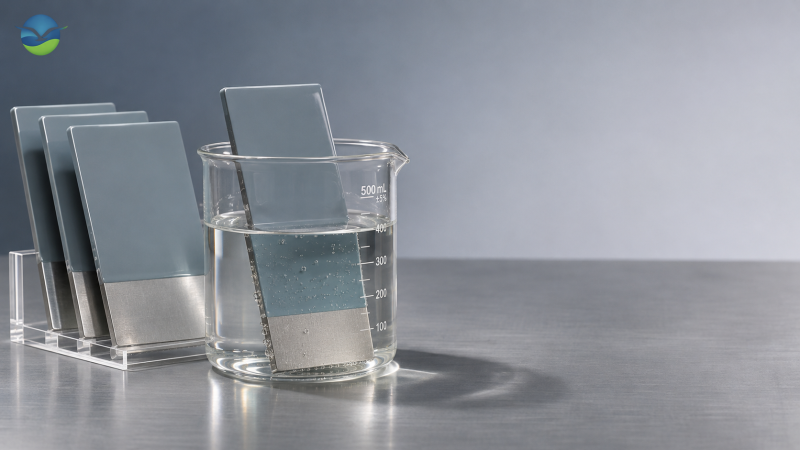
The most suitable epoxy resin for a chemically exposed coating is not necessarily the one with the highest general chemical-resistance rating. It is the resin that, when paired with an appropriate curing agent and formulated into a complete coating, withstands the specified chemical exposure at the required temperature and duration while remaining practical to apply and cure.
A resistance chart can narrow the field, but it cannot substitute for a defined service condition or a test of the finished coating. Acid concentration, solvent composition, immersion time, substrate preparation and cure state can all change the result. A system suitable for intermittent splashes on a floor, for example, should not automatically be selected for continuous immersion inside a tank.
Define the exposure before comparing resin grades
“Chemical resistant” is too broad a specification to support resin selection. Start with the identity and concentration of every substance expected to contact the coating, including cleaning agents and chemicals used during maintenance. Where mixtures are present, identify the actual mixture rather than relying only on ratings for its individual ingredients. A blend containing water, solvent and acid can interact with a coating differently from each component tested separately.
Exposure temperature matters because elevated temperatures can accelerate chemical penetration and reduce the stiffness of a cured polymer network. A coating that performs acceptably during a room-temperature splash test may soften or blister under hot immersion. Consider normal operating temperature, credible excursions and the temperature during cleaning or steam exposure.
Duration and exposure pattern are equally important. Distinguish between occasional splashes that are promptly removed, standing liquid in a containment area, repeated wet-and-dry cycles, and continuous immersion. For tank linings, also identify the vapor space and the liquid–air interface: condensation and temperature changes can create conditions that differ from those at the bottom of the tank.
The result should be a service envelope rather than a single chemical name: chemical composition, concentration range, operating and peak temperatures, contact duration, cleaning procedure and expected service life. Any uncertainty in that envelope should be included in the test plan, particularly where process changes could introduce a more aggressive solvent or higher temperature.
Compare resin chemistry as part of a cured system
Epoxy resin chemistry influences the structure that can be formed during curing, but the coating’s resistance comes from the complete formulation and its achieved cure. Resin type is therefore a useful screening tool, not a guarantee of performance.
Bisphenol-A liquid epoxy resins are widely used building blocks for protective coatings. They offer a practical starting point when application properties, adhesion and chemical resistance must be balanced. Their suitability for a specific solvent, acid or immersion condition still depends on the curing agent, formulation and test evidence.
Bisphenol-F epoxy resins can offer lower viscosity than comparable bisphenol-A resins, which can help formulators work at higher solids or adjust application properties. Lower viscosity alone does not establish better chemical resistance; the resin’s functionality, molecular structure and cure chemistry must be considered together.
Epoxy novolac resins have higher functionality than conventional difunctional liquid epoxies and can form a more highly crosslinked network. This makes them candidates for demanding chemical-service linings, particularly where the tested formulation demonstrates resistance to the relevant chemicals and temperatures. The trade-off can include higher viscosity, reduced flexibility or more demanding application. A novolac label is not proof of resistance to every strong acid or solvent.
Modified epoxy systems are designed to adjust properties such as flexibility, viscosity, cure speed or compatibility with other coating components. These changes can improve application or service performance, but a modification that increases flexibility may also alter solvent uptake or heat resistance. Evaluate the tested formulation rather than assuming the base resin’s properties remain unchanged after modification.
When reviewing resin data, epoxy equivalent weight, viscosity and functionality help explain how a formulation can be designed. They do not, by themselves, predict whether the cured coating will survive a particular chemical. Compare candidates using the same exposure conditions and, where possible, the same type of curing system.
The curing agent can change the selection
Two coatings made with the same epoxy resin can perform differently because their curing agents create different network structures and cure profiles. Amine, polyamide, amine-adduct and other curing chemistries should be assessed against both the chemical environment and the available curing conditions.
For example, a more flexible curing system may be valuable where a substrate moves or experiences impact, but flexibility should be weighed against the resistance required during solvent exposure. A highly crosslinked system may reduce penetration by some chemicals, yet it can be less tolerant of movement or thermal cycling. Neither crosslink density nor hardness should be treated as a universal proxy for chemical resistance.
Mix ratio is critical. A resin and hardener are specified to react within a controlled proportion; incorrect dosing or incomplete mixing can leave poorly cured material with lower resistance. Induction time, pot life, coating thickness and ambient conditions also affect the cure obtained in practice. Some systems require a post-cure to reach the properties reported in their technical data; others are designed to cure under ambient conditions. The qualification test should use the cure schedule that can actually be achieved on the job.
Glass-transition temperature, or Tg, provides a useful indication of the temperature range over which the cured network retains its glassy character. It is not an immersion-temperature rating. Chemical absorption can plasticize the coating and lower its effective Tg in service, so a dry Tg measurement must be interpreted alongside wet chemical exposure results.
Distinguish material resistance from coating-system performance
Chemical resistance data for a bulk polymer cannot automatically be transferred to a thin coating film. Polypropylene, for instance, is available as PP Polypropylene Polyolefin Plastic Raw Material for processes such as injection molding and extrusion. Its resistance profile does not establish the performance of an epoxy coating, and it is not an epoxy resin or curing agent.
The distinction matters because a coating must remain attached to its substrate and function without through-film defects. Even if a chemical does not visibly dissolve the binder, it can penetrate the film, reach the interface and contribute to loss of adhesion, blistering or corrosion beneath it. Resistance to staining is therefore not equivalent to resistance to permeation or underfilm attack.
Other formulation ingredients also matter. Pigments and fillers affect film structure, permeability and application behavior; solvents and reactive diluents can affect cure and network properties. A result for an unfilled laboratory casting should not be assumed to represent a pigmented, field-applied coating. Compare the actual primer, intermediate coat and topcoat as a system, including any specified film-thickness range.
Use resistance charts to screen, not to approve
Supplier charts are most useful when they state the chemical concentration, temperature, exposure method, duration and assessment criteria. A rating without those details may conceal the difference between a brief splash and continuous immersion. Check whether the rating refers to a resin, a cured clear binder or a named coating formulation; also check whether it applies to the proposed curing agent and cure schedule.
Ask what “resistant” means in the chart. It may indicate that the coating remained visually acceptable, or it may be based on measured retention of adhesion or hardness. Discoloration alone may be acceptable on a containment floor but unacceptable where cleanliness or appearance is critical. Conversely, a film that looks sound may have absorbed chemical and lost mechanical properties.
Where data are missing for a mixture or operating temperature, do not infer approval from the nearest listed entry. Request supporting test details or qualify representative coating panels under the intended conditions.
Build a qualification test around credible failure modes
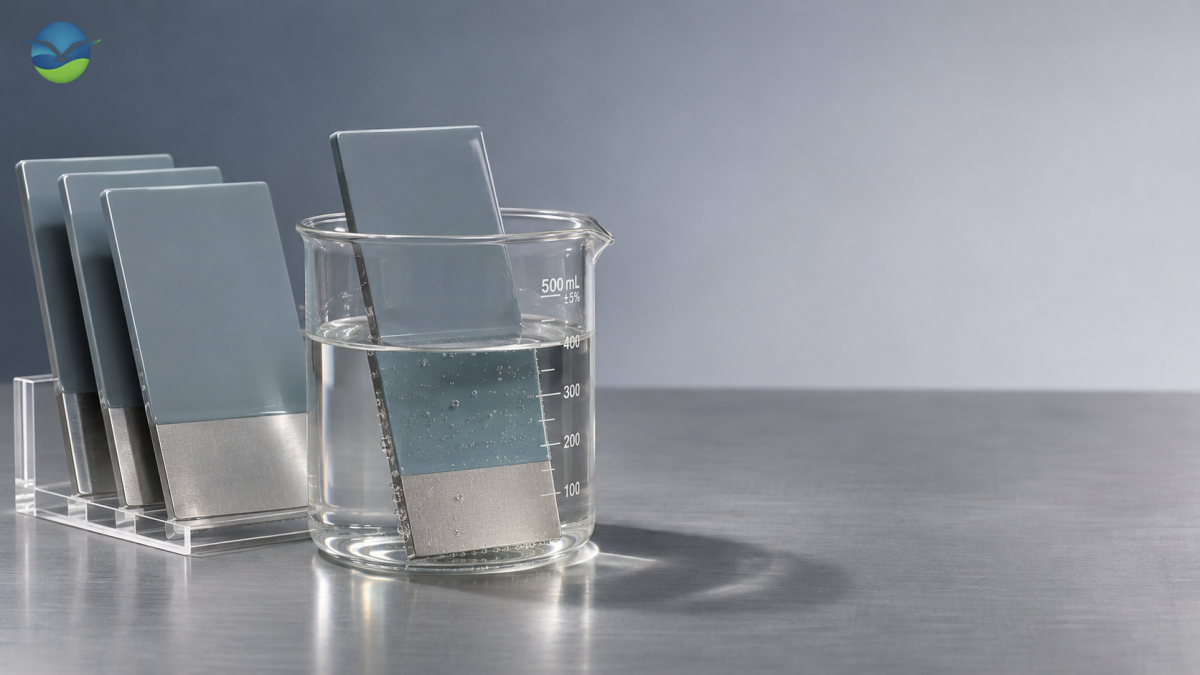
Prepare panels using the proposed substrate, surface preparation, coating system, mixing procedure, film thickness and cure conditions. Include the actual service chemical where safe and practical, at a representative concentration and temperature. If the process envelope includes excursions, assess whether a separate exposure at the credible limit is needed. Include an unexposed control so that changes can be attributed more confidently to chemical exposure.
A useful test plan defines acceptance criteria before exposure starts. Depending on the duty, these can include:
- Visible changes such as blistering, cracking, softening, swelling or loss of film integrity.
- Changes in mass, thickness or hardness, interpreted in light of chemical absorption and possible recovery after drying.
- Adhesion after exposure, including whether failure occurs within the coating or at the substrate interface.
- Evidence of corrosion or underfilm attack where the coated substrate is metal.
- Performance at edges, welds, repaired areas and other geometries where a flat panel may not represent the applied film.
ASTM D1308 addresses the effect of household chemicals on clear and pigmented organic finishes and can be relevant to spot-exposure assessment when its scope matches the application. ASTM D543 addresses the resistance of plastics to chemical reagents; it can inform material evaluation but is not, by itself, proof of an applied coating system’s service life. For immersion, ASTM D870 covers testing water resistance of coatings using water immersion. Select the method and any adaptations to fit the actual chemical service, and document deviations so results can be compared meaningfully.
Exposure duration must also be interpreted carefully. Passing a short test supports screening; it does not establish a service life of several years. If accelerated testing uses a higher temperature or concentration, confirm that it does not introduce a different failure mechanism that makes the result misleading.
Check that the selected system can be applied and cured
A chemically resistant formulation loses much of its value if it cannot be applied consistently to the intended surface. Surface contamination, inadequate preparation, moisture and salts can undermine adhesion before chemical exposure begins. Steel, concrete and previously coated substrates present different preparation and compatibility requirements, so the proposed resin system must be evaluated with the specified surface condition and primer.
Film thickness is another practical constraint. A film below the specified range may contain holidays or provide insufficient barrier protection; excessive thickness can trap solvent, slow cure or cause other application defects, depending on the formulation. Confirm the permissible wet and dry film thickness, recoat interval and inspection method with the coating supplier.
Ambient temperature, substrate temperature and humidity during application and cure can be as consequential as the temperature in service. Check the supplier’s limits, including the required margin between substrate temperature and dew point. Low-temperature application may require a different curing agent or additional curing time. Exposure to chemicals before full cure can invalidate resistance expectations even when the selected chemistry is appropriate.
The final choice should be the coating system with evidence for the defined exposure and a cure procedure that can be reproduced on the actual substrate. Where two candidates show similar laboratory resistance, the one with a more reliable application window, verified adhesion and clearer limits on service temperature may present the lower technical risk.
Please give us a message
Send Us Your Inquiry Today
Scalable production and one-stop R&D, manufacturing, sales & after-sales services.