






How to assess storage compatibility before choosing a bulk chemical supplier
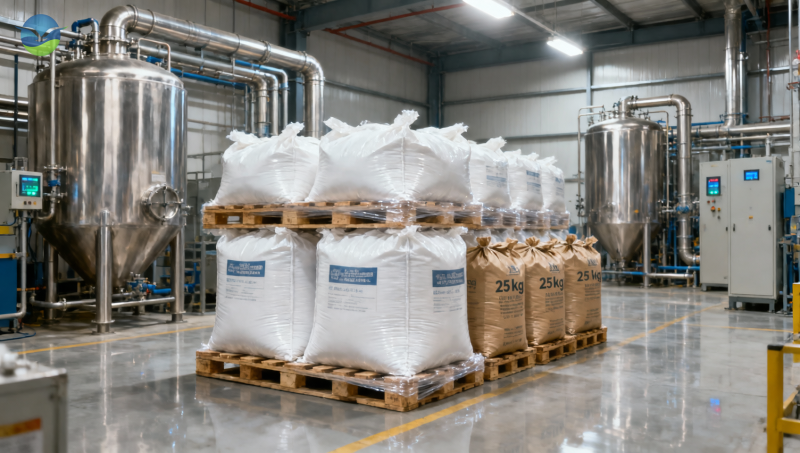
Storage compatibility should be established before price, lead time, or nominal capacity enters the supplier comparison. A bulk chemical can meet its specification at dispatch and still arrive unsuitable for use if its storage environment, packaging barrier, handling sequence, or remaining shelf life does not match the receiving site. The relevant question is whether the supplier's material can remain within its intended condition from production through inland transport, port handling, sea freight, receiving, and on-site storage.
Begin with the material's actual sensitivity profile rather than a broad label such as “stable” or “non-hazardous.” Heat, moisture, oxygen, light, static charge, cross-contamination, pressure, and repeated temperature cycling affect different materials in different ways. A dry powder can absorb moisture and form hard lumps without undergoing a chemical reaction. A polymer pellet may retain its chemistry but develop blocking, agglomeration, dust, or altered flow behavior after exposure to heat. A liquid can remain within assay limits while water pickup or sediment changes its suitability for a downstream formulation.
The supplier assessment should therefore connect four elements: the material's storage instruction, the offered package, the logistics route, and the conditions available after receipt. A statement such as “store in a cool, dry place” is useful only when it is translated into practical limits and handling controls. It should be possible to determine what “cool” means for the material, how moisture is excluded after a package is opened, whether direct sun exposure during loading is acceptable, and whether the warehouse can preserve the required condition for the planned inventory period.
Start with the material's failure modes
Read the safety data sheet and product specification together. The SDS identifies hazard-related storage and incompatibility concerns, while the specification shows the properties that must remain acceptable for use. Neither document replaces the other. A material may have modest transport hazards but still be highly vulnerable to moisture, oxidation, discoloration, particle-size change, or loss of processing consistency.
Ask for the storage recommendation in its complete form, including any limits on temperature, humidity, light, stacking, ventilation, container closure, and segregation. Then identify what happens when the recommendation is missed. “Avoid high temperature” has a different operational meaning for a material that softens and blocks than for one that decomposes, generates pressure, or loses an active component. Likewise, “keep dry” can refer to preventing visible caking, preventing hydrolysis, avoiding corrosion of packaging components, or preserving a low moisture limit required by a later extrusion or reaction process.
A useful review separates irreversible changes from reversible handling issues. Some powders become free-flowing again after controlled conditioning; others form hard agglomerates that cannot be screened without changing the product. Some resin pellets can be dried before processing, whereas surface contamination, thermal history, or fused pellets cannot be corrected by drying. A supplier's storage compatibility is stronger when it can explain the observed failure mode and the control used to prevent it, rather than merely repeating a generic warehouse instruction.
Match package design to the full storage window
Package selection is part of product compatibility, not a shipping detail. The outer bag, inner liner, sealing method, pallet configuration, and unit size determine how much protection remains after loading and unloading. For hygroscopic or moisture-sensitive solids, ask whether the moisture barrier is the liner itself, a sealed inner bag, a drum, or a combination of these. A woven outer sack provides mechanical strength but does not by itself establish a vapor barrier. If a liner is punctured during handling, the package may still look intact while the contents have already been exposed.
Evaluate the route from first opening to final consumption. Large bags can be economical, but they create an exposure issue when only part of the contents is used at one time. The receiving site needs a defined method for resealing, labeling the opened package, controlling exposure time, and preventing material from one lot being mixed with another. Smaller units reduce open-package exposure but add more handling events, which can increase the chance of damaged bags, misidentification, or contamination.
For materials delivered on pallets, verify the maximum stack height, whether pallet loads can be double-stacked, and whether the package tolerates the compression expected in the warehouse and container. Long-term compression can deform soft bags, compact powders, or encourage pellets to block at elevated temperature. Stretch wrap protects a load from shifting but should not be assumed to provide meaningful moisture protection unless the packaging design specifically supports that claim.
For example, EVA Ethylene Vinyl Acetate Polymer Raw Material is supplied as white or light-yellow powder or glass-like particles in 25 kg film-coated PP woven bags, with a stated 12-month shelf life and a requirement for tight sealing in a cool, dry place. The compatibility review should not stop at those words. It should consider whether storage temperatures could cause particle blocking, whether unopened bags remain dry through the route, and whether partially used bags are resealed before the material is used in film, foam, hot melt adhesive, cable sheath, or packaging production.
Do not assess the supplier warehouse in isolation
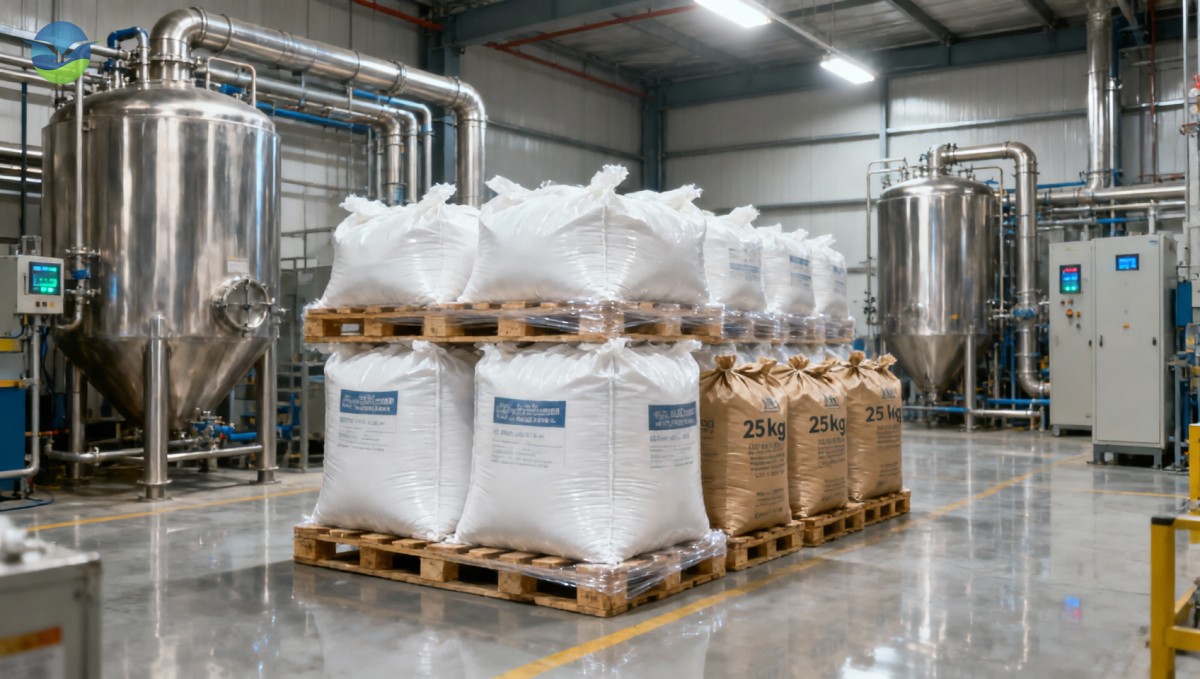
Warehouse photographs and a statement that a site is dry are weak evidence unless they are linked to the actual material flow. The highest exposure often occurs outside long-term storage: while containers wait before loading, during transfer from warehouse to truck, at port staging, after arrival during customs delay, or when goods are unloaded into a receiving area with different climate control.
Map the likely dwell points. This does not require a theoretical logistics study; it requires a realistic sequence from finished packaging to use. For each point, identify whether the goods are indoors, covered, exposed to ambient air, near heat sources, subjected to condensation, or handled repeatedly. Temperature cycling deserves particular attention. A container may be closed and dry at loading but undergo warm days and cool nights that promote condensation on interior surfaces. Materials in moisture-sensitive bags are more exposed if the barrier has been compromised or if the load remains in that condition for an extended period.
Bulk liquid storage needs a different level of detail. Compatibility must cover tank material, valve and gasket materials, venting arrangement, transfer hoses, sampling points, and cleaning residue. “Compatible tank” is incomplete if the transfer hose or a shared pump introduces a contaminant. Determine whether dedicated equipment is required, whether previous cargoes are controlled, and how line contents are managed between deliveries. For reactive, oxidizing, corrosive, or flammable products, segregation and emergency provisions also need to be verified against the hazard information for the specific grade.
Segregation is about contamination pathways as well as hazards
Hazard-based segregation prevents incompatible substances from contacting one another during an incident. Product-quality segregation prevents lower-level exposures that do not create an emergency but still make material unusable. Dust from pigments, carbon black, fillers, metalworking products, or strongly scented materials can create unacceptable contamination for light-colored resins, adhesive applications, films, and sensitive compounding work. A shared warehouse may be appropriate when zoning, enclosure, housekeeping, and traffic control are adequate; the presence of other chemicals alone does not decide the issue.
Ask how goods are separated from odorous substances, volatile solvents, acids, alkalis, oxidizers, and materials that produce dust. The answer should distinguish physical distance from effective separation. A pallet stored several meters away from a dusty operation may still be exposed if forklifts, air movement, or torn packaging carry particulate matter through the area. Similarly, a product kept in an enclosed bay may be protected from dust yet still be unsuitable if it shares a poorly controlled temperature zone with heat-sensitive stock.
Cleaning practices matter when a warehouse handles many grades. Sweeping can redistribute fine particulate contamination, while wet cleaning can increase local humidity. The appropriate method depends on the product and the facility, but the assessment should establish that damaged packages are isolated promptly, spills are not left beside conforming stock, and questionable pallets are not silently returned to normal inventory.
Use documents to verify control, not merely availability
Certificates of analysis, SDSs, batch records, packaging specifications, and shelf-life statements form a chain of evidence. The review should confirm that the documents identify the same grade, lot, package, and relevant revision. A COA demonstrates release testing for a batch; it does not prove that conditions remained acceptable after release. Conversely, a warehouse procedure may describe good control but not show whether the delivered lot was released under the required specification.
For time-sensitive materials, request the manufacturing date, retest date where applicable, and shipment date early enough to assess remaining usable life on arrival. A nominal shelf life is not the same as usable inventory time. Allow for transit, receiving inspection, internal transfer, quarantine, production scheduling, and any time needed to resolve a discrepancy. A material received near the end of its stated period may be acceptable for immediate consumption but unsuitable for a slow-moving formulation program.
Clarify the action taken when a package is damaged, wet, heat-exposed, or delivered with an unreadable label. A credible process identifies the lot, isolates affected units, documents the event, and establishes whether additional testing or rejection is required. Avoid treating visual appearance as the only release criterion. Dry-looking granules can have absorbed enough moisture to affect downstream processing, and an undamaged outer bag does not confirm an intact inner liner.
Compare conditions against the receiving site before approval
The supplier can only be considered compatible with the storage system that will actually be used. Compare the declared storage needs with local warehouse temperature variation, humidity exposure, roof and dock conditions, pallet storage practice, fire separation, available covered unloading space, and stock rotation method. Include the period after the package is opened, especially where production consumes material intermittently.
A trial shipment is most informative when it tests the actual weak point in the intended chain. If the concern is humidity during sea freight, retain records of package condition and material properties after arrival rather than inspecting only the supplier's warehouse. If repeated opening is the concern, evaluate the material after the expected on-site handling cycle. The purpose is to establish whether the combined storage system preserves the properties relevant to the final process.
Approval should be delayed when a storage instruction cannot be converted into a workable receiving and warehouse practice, when packaging details are unclear, or when the available documentation cannot be linked to the supplied lot. Those gaps are not administrative details. They indicate that the material may be specified correctly but insufficiently controlled for the conditions under which it will actually be stored and used.
Please give us a message
Send Us Your Inquiry Today
Scalable production and one-stop R&D, manufacturing, sales & after-sales services.