






How to Evaluate a Citric Acid Supplier for Food, Pharma, and Industrial Needs
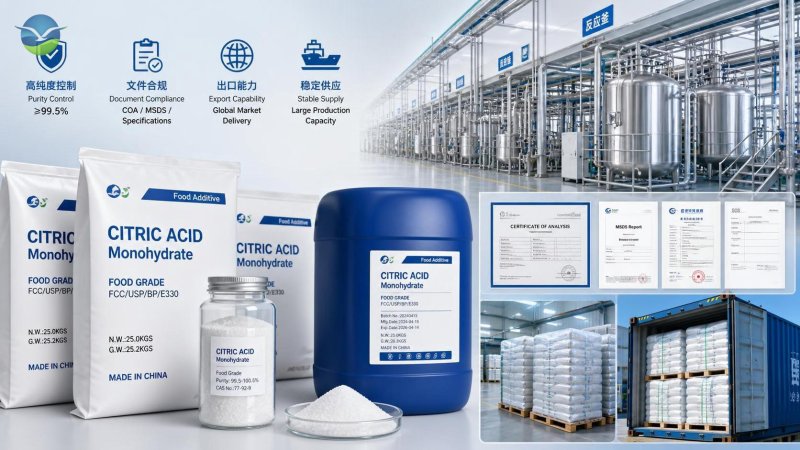
Choosing a citric acid supplier is rarely just a sourcing exercise. For food processors, pharmaceutical manufacturers, and industrial formulators, the supplier becomes part of the product risk profile. Purity drift, incomplete documentation, unstable lead times, and weak export coordination can all create downstream costs that are far larger than a small price difference per ton. That is why business evaluation teams usually need to look past the quotation sheet and ask a more practical question: can this supplier support the exact compliance, consistency, and delivery model the business actually needs?
In practice, the answer depends on application. A buyer looking for citric acid for beverages or confectionery is not evaluating the same risk set as a buyer using it in pharmaceutical excipients, cleaning systems, or industrial process formulations. The material name may be the same, but the purchasing logic is not. A reliable assessment should therefore start with use-case fit, then move into manufacturing control, export execution, and commercial resilience.
Start with the use case, not the supplier pitch
Many supplier conversations go wrong because they begin with broad claims like “food grade,” “stable quality,” or “competitive export price.” Those terms matter, but they do not tell a procurement or supplier-quality team whether the product is suitable for a specific plant, market, or customer contract.
For food applications, the core concerns are usually product purity, sensory neutrality, batch consistency, traceability, and complete quality documentation. For pharmaceutical-related procurement, the standard rises further: buyers often need tighter document control, clearer change-management discipline, and stronger confidence that each lot will align with the required specification set and registration pathway. For industrial applications, the evaluation may focus more on concentration consistency, impurity profile, packaging suitability, corrosion-related handling, and whether the supplier can support repeat bulk orders without performance variation.
That is the first screening principle: define the application risk before comparing suppliers. A low-cost exporter may still be the wrong choice if your internal team must spend time resolving document gaps, retesting material, or managing delayed shipments.
Production control matters more than trading claims
One of the most important distinctions in this market is whether the supplier is a true source manufacturer, a trader, or a hybrid operation with its own plant plus a separate export team. For business evaluators, this distinction directly affects visibility and accountability.
A supplier with direct control over production generally has more leverage over raw material selection, batch scheduling, quality inspection, and corrective action. That does not automatically mean better performance, but it usually makes root-cause tracing and delivery planning more manageable. By contrast, a purely commercial intermediary may offer convenience and multilingual communication while having limited influence over the plant itself.
In that context, a dual-location model can be worth examining carefully. When export operations are handled by a dedicated foreign trade center while production remains at a source manufacturing base, the arrangement can reduce communication lag without losing factory-level control. Qixiang Chemical’s structure follows this logic: its foreign trade operations are handled in Wuxi, a major Yangtze River Delta trade hub, while manufacturing is based in Shandong. For overseas buyers, that means commercial communication, sample coordination, qualification documents, and after-sales follow-up can be handled by a specialized team, while production remains tied to a self-managed facility rather than outsourced loosely across multiple plants.
That kind of setup is not a guarantee by itself, but it is operationally relevant. Evaluation teams should ask whether the sales contact can directly coordinate with manufacturing, whether quality records are plant-originated, and whether shipment documents reflect actual batch control rather than generic templates.
Quality documentation is not paperwork overhead
In citric acid procurement, documentation is often treated as a routine box-checking exercise until a problem occurs. Then it becomes central. A supplier that provides complete COAs, MSDSs, and supporting qualification documents with every shipment reduces approval friction, internal audit exposure, and customs-related delays. More importantly, it gives the buyer a usable record when a customer complaint, formulation issue, or regulatory query appears later.
What evaluators should watch for is not just the presence of documents, but their credibility and consistency. Are test items aligned with the agreed specification? Do different batches show reasonable variation, or do all values look mechanically identical? Can the supplier explain its test methods and laboratory control process? Is there a clear link between lot number, production date, and release record?
These questions matter across sectors. Even in industrial use, incomplete document discipline can create avoidable exposure, especially when material is exported into multi-party supply chains. Buyers should also verify whether the supplier can respond quickly to requests for updated paperwork, additional declarations, or customer-specific compliance files. In real procurement cycles, responsiveness often separates workable suppliers from frustrating ones.
That responsiveness becomes more valuable when companies source multiple chemical raw materials across categories. A buyer that already works with vitamins, acids, or cosmetic intermediates, for example, may prefer suppliers that can support document handling across different product families rather than only quote one line item at a time. In some sourcing portfolios, a company reviewing citric acid may also be comparing adjacent ingredients such as Niacinamide Vitamin B3 Cosmetic Raw Material, where the same underlying questions about origin control, documentation quality, and export support still apply.
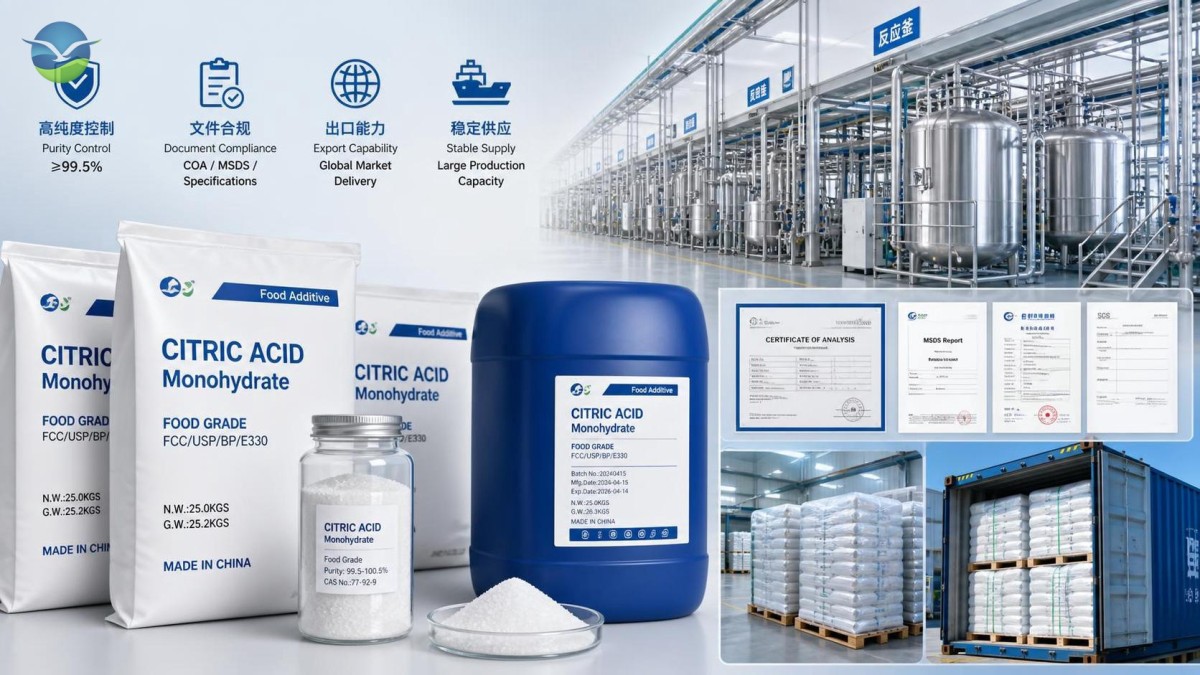
Export coordination is a real part of supplier quality
For overseas procurement, product quality and delivery quality are inseparable. A compliant batch that misses a vessel window, arrives with incorrect documents, or triggers repeated clarification requests still damages operations. This is why experienced buyers increasingly evaluate logistics coordination, sample turnaround, and after-sales handling as part of supplier capability rather than as secondary service features.
Suppliers with a mature export function should be able to handle inquiry response, sampling, quotations, order tracking, documentation, and issue resolution in a structured way. They should also be able to support both small-batch sample movement and container-scale export without losing speed. If a supplier claims strong overseas service, buyers should ask for practical evidence: typical response times, who owns document preparation, how exceptions are escalated, and whether video factory inspections or remote qualification reviews can be arranged efficiently.
This is where location can matter. A foreign trade center based in an established commercial and logistics hub often has advantages in customer communication, staffing, and cross-border execution. Meanwhile, production in a lower-cost chemical cluster may support more competitive manufacturing economics. The combination can be useful when it is well integrated; it is less useful when communication and production are organizationally disconnected. The buyer’s task is to determine which of those two realities exists.
Do not overfocus on price per ton
Citric acid is widely used and, in many procurement environments, appears to be a relatively standardized commodity. That creates a common mistake: treating the supplier decision as mostly a price comparison. In reality, the total procurement cost includes internal qualification effort, inspection burden, order management, shipment stability, and the cost of variability.
A lower nominal price may lose its advantage quickly if the supplier requires repeated follow-up, sends inconsistent lots, or struggles with export documents. This is especially true for food and pharma-related applications, where a rejected lot or delayed release can disrupt customer delivery commitments. Even in industrial applications, reformulation work, production downtime, or customer complaints can erase the initial savings.
Business evaluators should therefore compare suppliers on landed and managed cost, not just invoice price. Useful commercial questions include:
- Can the supplier support both trial orders and stable volume scale-up?
- Are packaging formats appropriate for your receiving and storage conditions?
- Is there a clear policy for claims, replacement, or technical clarification?
- How exposed is the supplier to raw material cost swings or plant scheduling disruption?
- Can the supplier maintain delivery discipline during peak export periods?
These questions often reveal more about long-term value than an aggressive opening quote.
How to tell whether a supplier can support your actual growth path
Not every buyer needs the same supplier profile. Some need a transactional exporter that can move standard material quickly at competitive cost. Others need a long-term manufacturing partner that can support qualification, periodic audits, and volume planning across multiple markets. The right choice depends on where your business is headed.
If your procurement profile includes recurring export orders, customer-specific documentation requests, and the need for steady commercial communication, then organizational structure matters. A supplier with a dedicated external-facing team and an owned production base may be better positioned than a plant with weak commercial support or a trader with limited manufacturing visibility. Qixiang Chemical’s Wuxi-Shandong arrangement is relevant here because it combines a customer-facing operations center for around-the-clock overseas coordination with a self-operated manufacturing base that manages blending, processing, testing, and shipment documentation internally.
For evaluators, the practical point is not the corporate story. It is whether the supplier can maintain continuity from first inquiry to after-sales support. Sample handling, quotation clarity, video factory review, qualification documents, order follow-up, COAs, and post-shipment issue resolution should feel like one controlled process rather than several disconnected handoffs.
A practical supplier review framework
When comparing a shortlist, it helps to use a simple business-focused review table rather than an abstract scorecard.
This framework also helps internal alignment. Procurement may prioritize cost and lead time, while QA, regulatory, and operations focus on control and documentation. A structured review allows those teams to compare the same supplier through different risk lenses.
What common claims should be treated carefully
Several statements are common in supplier outreach and should be tested rather than accepted at face value.
“We are highly competitive because we are a manufacturer.” That may be true, but manufacturing status alone does not prove stable quality, export readiness, or document discipline.
“Food grade can also cover other applications.” Sometimes this is operationally fine, but application suitability still depends on the end market, customer expectation, and internal control standards.
“We can provide all required documents.” The real issue is whether the documents are shipment-specific, accurate, and delivered on time.
“Large capacity means reliable supply.” Capacity claims should be matched against scheduling discipline, raw material availability, and actual export execution.
Buyers evaluating a citric acid supplier should be cautious of broad assurances without process detail. Good suppliers are usually able to explain not only what they provide, but how they control it.
The useful decision is rarely “best supplier,” but “best fit supplier”
For most business evaluation professionals, the right outcome is not identifying a universally superior seller. It is selecting the supplier whose operating model best matches the business’s regulatory burden, communication needs, order pattern, and risk tolerance. In citric acid sourcing, that often means giving real weight to production ownership, document discipline, and export coordination instead of letting price dominate the discussion.
Where a supplier can combine source manufacturing, scalable plant control, complete shipment documentation, and a responsive foreign trade interface, the procurement risk profile tends to improve. That is the practical lens through which a company like Qixiang Chemical should be assessed: not as a generic exporter, but as a supplier whose Wuxi commercial center and Shandong manufacturing base are intended to solve the two recurring problems overseas buyers face most often, namely communication inefficiency and unstable execution.
That is usually where a serious evaluation should end as well: not with a marketing claim, but with a judgment about whether the supplier’s structure, controls, and service model are strong enough for the business you actually need to run.
Please give us a message
Send Us Your Inquiry Today
Scalable production and one-stop R&D, manufacturing, sales & after-sales services.